Crypto Assets are now governed by a formal legal and regulatory framework in Indonesia. This matters to investors, businesses operating in the crypto space, and other market participants. They need to understand what activities are permitted and how Indonesian law treats crypto assets.
Our report discusses the four core legal issues to which the legal framework for Crypto Assets in Indonesia may be addressed:
- the classification of different types of Crypto Assets;
- which authorities are relevant to the regulation of Crypto Assets;
- what are the permitted activities within the crypto space;
- what are the prohibited activities within the crypto space.
As the market matures, a clear understanding of this legal framework becomes essential for anyone assessing investment opportunities, business activities, or compliance obligations
Key Takeaways
- OJK recorded 22.93 million crypto consumer accounts and Rp20.52 trillion in monthly transaction value as of July 2026, with 32 licensed entities operating across the digital financial asset ecosystem.
- Crypto Assets are lawful as investment and trading assets through regulated channels, but they are not lawful payment instruments; Rupiah remains the sole legal tender.
- The legal classification of crypto has evolved from a commodity-based model under Bappebti to a digital financial asset framework under the P2SK regime.
- Law No. 4 of 2026, effective 17 June 2026, is a major development: it amends the 2023 P2SK Law, extends consumer protection rules to crypto asset businesses, and gives OJK power to suspend or block non-compliant crypto activity, including offshore platforms serving Indonesian consumers.
- OJK is now the principal regulator for digital financial assets and Crypto Assets, while Bank Indonesia remains central on payment system issues.
- Indonesia’s approach follows the same regulatory direction seen in other major markets: bring crypto activity inside licensed, supervised financial-sector rules rather than leaving it in a commodity or unregulated category.
- Crypto disposals are taxed at 0.21% (licensed domestic platforms) or 1% (unlicensed domestic or offshore platforms) under PMK 50/2025, effective 1 August 2025, with VAT on transfers removed.
- For investors, businesses, and market participants, the key question is no longer whether crypto is legal, but under which licensing structure and regulatory limits it may be held, traded, or integrated into products.
Why the Legal Status of Crypto Assets in Indonesia Matters Now
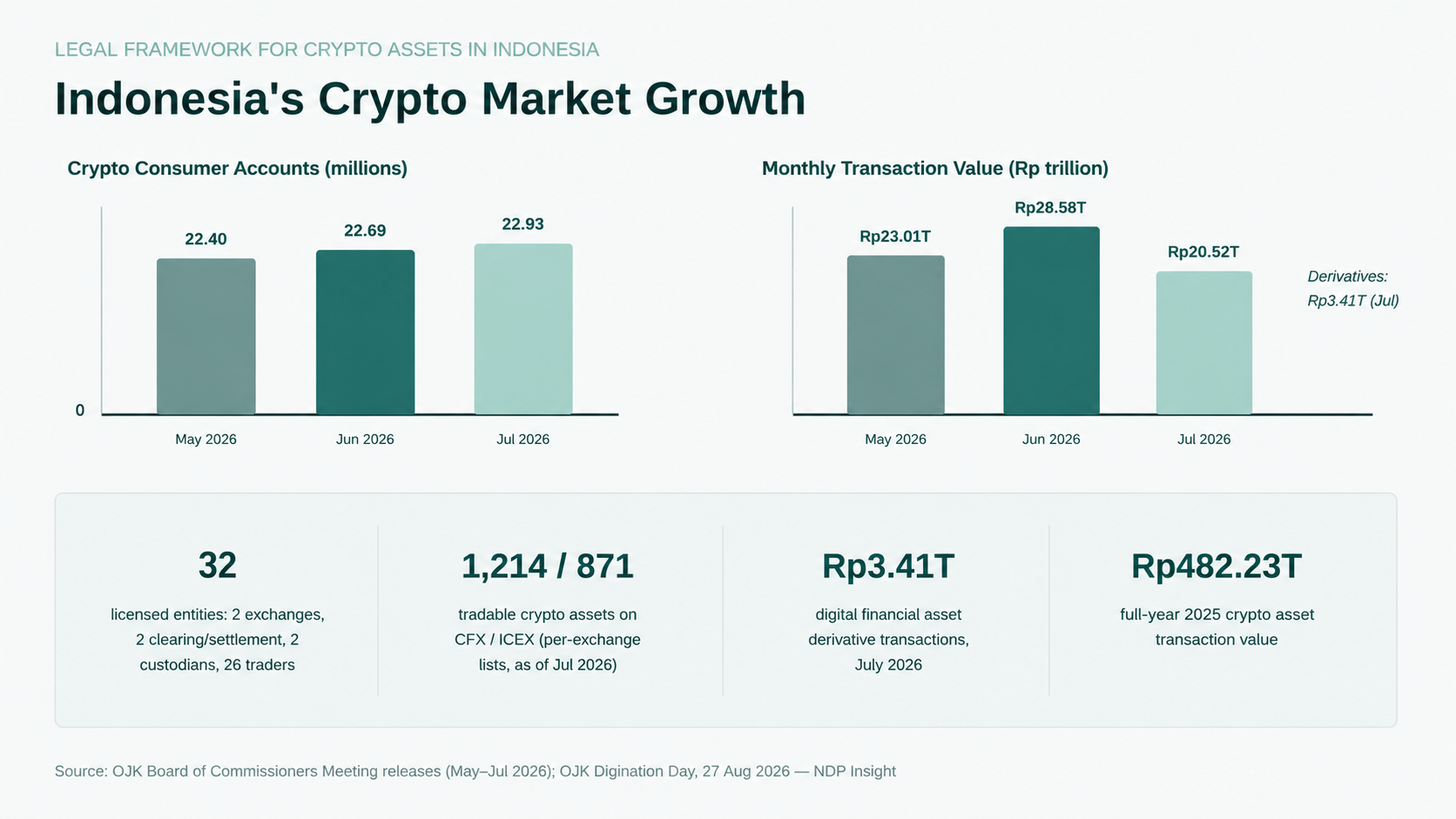
It has become commercially relevant to have legal clarity regarding transactions with crypto assets in Indonesia, as the market has reached a size where it matters. Currently, OJK reports 22.93 million crypto consumer accounts as of end July 2026 (up from 22.69m as of end June 2026 and 22.40m at end of May).
In terms of transaction value, the Indonesia crypto market saw fluctuating activity in the middle of 2026, reaching Rp20.52 trillion in July, down from Rp28.58 trillion in June and Rp23.01 trillion in May, alongside Rp3.41 trillion of digital financial asset derivative transactions in July. Full-year 2025 volume was Rp482.23 trillion. As of July 2026, OJK had licensed 32 entities across the digital financial asset ecosystem, comprising two exchanges, two clearing and settlement institutions, two custodians, and 26 digital financial asset traders. Tradable asset lists are set per exchange rather than as one national list; as of July 2026, CFX listed 1,214 tradable crypto assets and 49 derivatives, and ICEX listed 871 crypto assets.
Even with millions of retail accounts and licensed institutions at stake, the supervisory, disclosure, and enforcement gaps are not isolated risks. They are systemic. That is why the shift from commodity trading to financial-sector regulation is not just a theoretical change of rules. It matters in practice.
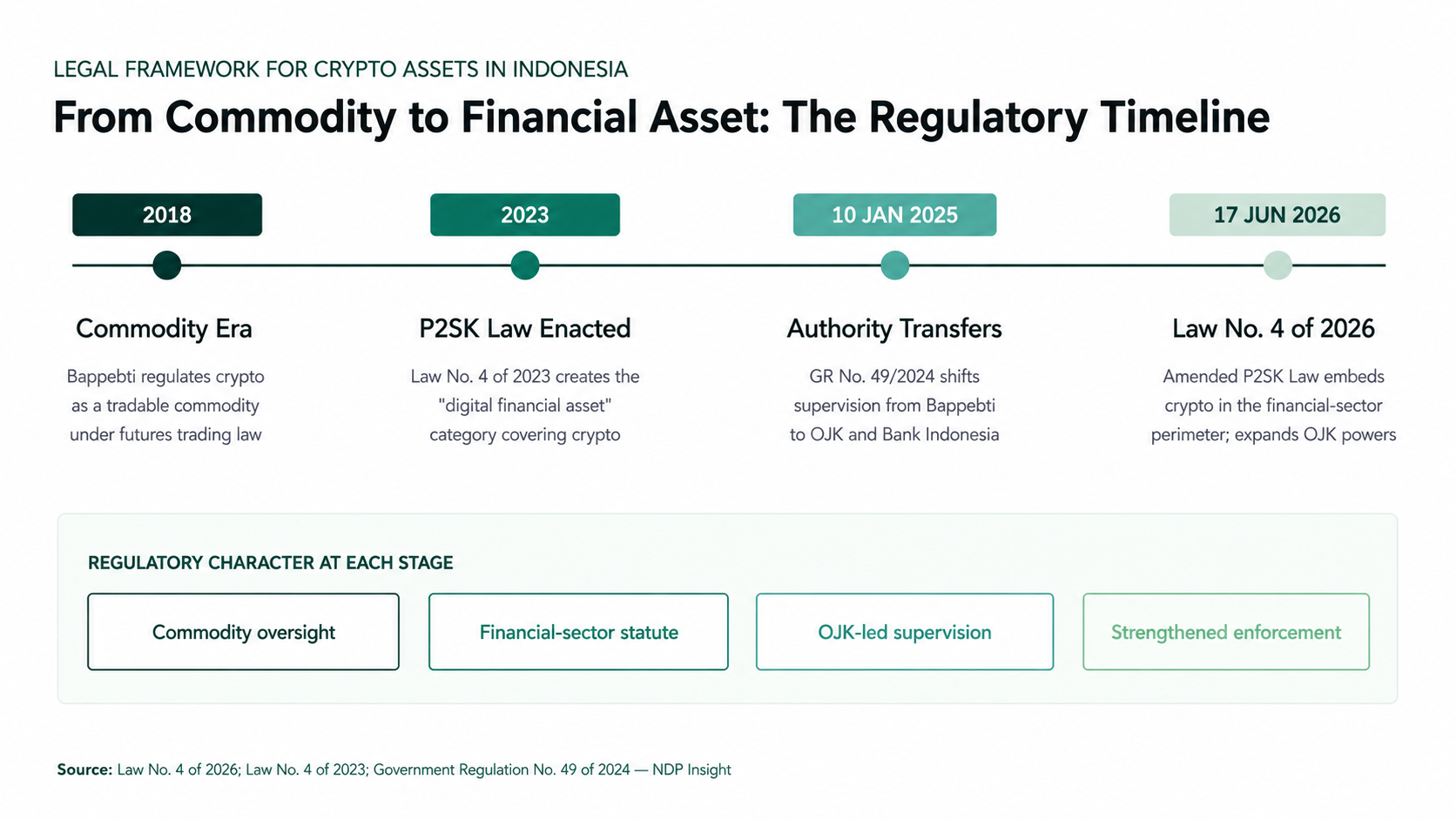
The regulatory framework around crypto has been an evolving space in Indonesia. Crypto assets were first supervised mainly through the commodity trading system. They are now regulated within Indonesia’s digital financial asset framework under the P2SK regime and related OJK rules, following the enactment of Law No. 4 of 2026 on 17 June 2026.
Investors and businesses entering the market as well as other market participants such as investors and consumers are better off with a clearer framework as this enables them to know their rights and obligations and benefit from closer supervisory scrutiny by regulatory bodies.
Figure 2 summarises the key milestones in this shift, from Bappebti’s original commodity framework through to the P2SK Law and the 2026 amendment.
Legal Classification of Crypto Assets Under Indonesian Law
Historical Classification as Commodities
Since 2018 in Indonesia, Crypto Assets are categorized as commodities. They are regulated within the commodity futures trading framework, which is supervised by the Commodity Futures Trading Regulatory Agency (Bappebti) in cooperation with the Ministry of Trade. Bappebti’s rule on physical trading of crypto assets, and its list of allowed assets, set out how crypto assets are treated. It regards them as intangible commodities presented in digital form that use the features of cryptography and distributed ledger technology.
Digital Financial Assets: From P2SK 2023 to the Amended P2SK Law (Law No. 4 of 2026)
Law No. 4 of 2023 on Financial Sector Development and Strengthening (the P2SK Law) first brought digital financial assets, including Crypto Assets, into the financial sector framework. It created the legislative basis for treating digital financial assets as financial assets stored or represented digitally.
Law No. 4 of 2026, effective 17 June 2026, amends the 2023 P2SK Law. It expands OJK’s authority over technological innovation in the financial sector. In practice, this expressly covers activities related to digital financial assets and Crypto Assets.
The amendment responds to two Constitutional Court decisions. Decision No. 59/PUU-XXI/2023 concerned investigations of criminal offences in the financial services sector. Decision No. 85/PUU-XXII/2024 concerned the budget-setting process of the Indonesia Deposit Insurance Corporation. But the amendment goes well beyond those two rulings: it touches at least seventeen distinct areas of financial sector regulation, of which crypto and digital financial assets are just one part.
Crucially for this article, it extends consumer protection provisions that already applied to other financial sector businesses to crypto asset traders, exchanges, clearing and settlement institutions, and centralised custodians.
After the 2026 amendment, Crypto Assets are no longer only “commodities.” The amended P2SK Law’s statutory definition of digital financial assets, financial assets stored or represented digitally, now expressly captures Crypto Assets. This places them within the financial-sector category of digital financial assets for regulatory and supervisory purposes, not just as a matter of commentary but as a matter of statutory text.
Crypto Assets Are Not Legal Tender or Payment Instruments
In Indonesia, only the Rupiah is declared as legal tender. Bank Indonesia maintains that virtual currency is not recognized and therefore is prohibited from being used as a medium of payment. Also, financial institutions are prohibited from offering or facilitating buying and selling of virtual currency as a payment product.
Regulatory Architecture: From Bappebti to OJK and Bank Indonesia
Bappebti and the Ministry of Trade: Legacy Framework
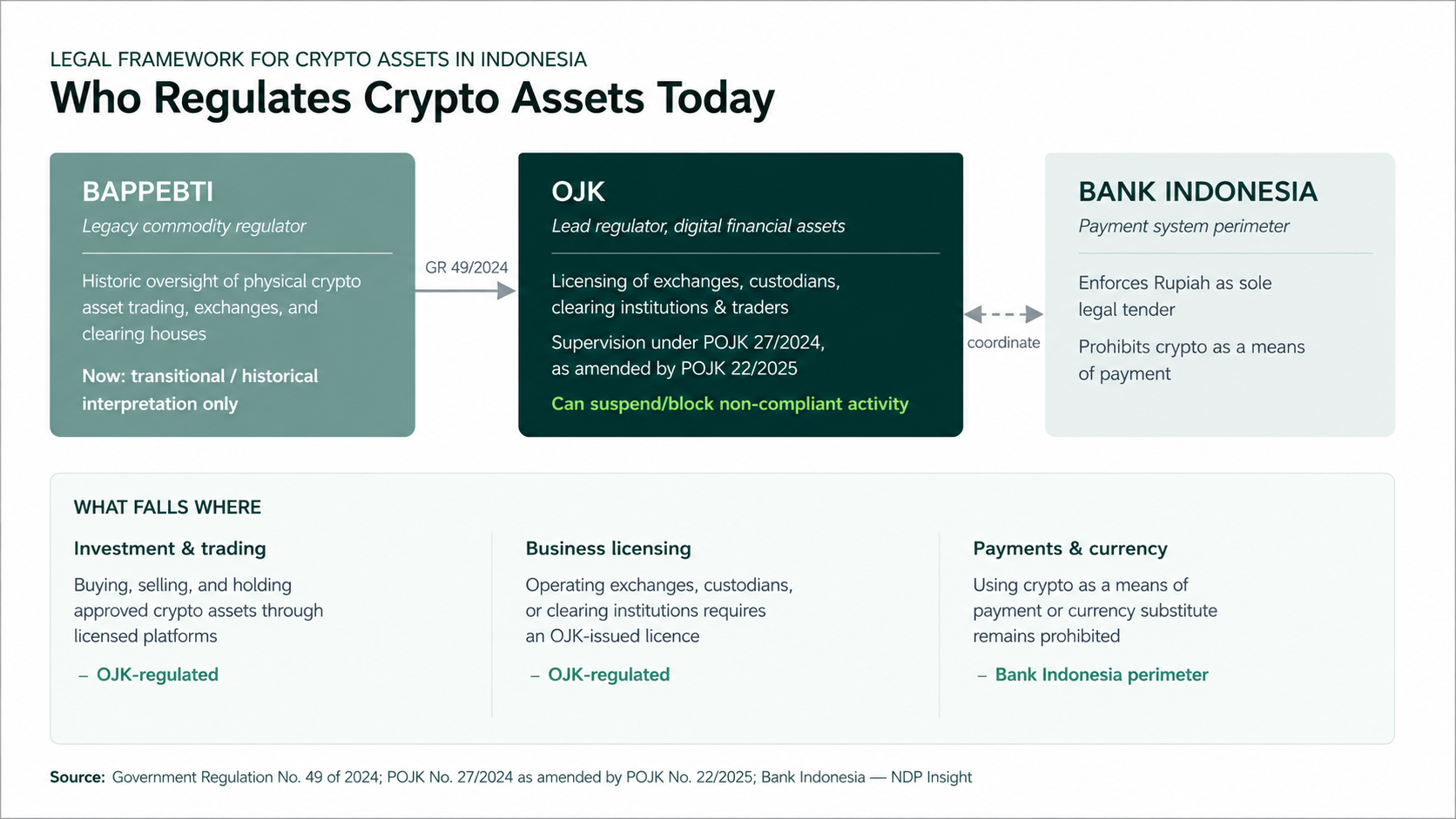
Bappebti was the primary regulator for physical trading of Crypto Assets, and for exchanges, clearing houses, and custodians. Bappebti also established a designated national crypto exchange, clearing house and depository, with the aim of centralizing the trading and settlement of Crypto Assets in Indonesia. Bappebti’s rules and regulations are still relevant today, mainly for transitional purposes and to interpret how Crypto Assets can be traded in Indonesia in the first place.
Transition of Regulatory Authority: Government Regulation No. 49 of 2024
Government Regulation No. 49 of 2024 transferred regulatory and supervisory duties over digital financial assets, including Crypto Assets, from Bappebti to OJK, effective 10 January 2025.
OJK as Lead Regulator for Digital Financial Assets and Crypto Assets
Following the P2SK framework and its 2026 amendment, OJK holds full regulatory and supervisory authority over digital financial assets and Crypto Assets. This covers licensing, supervision, and enforcement. OJK Regulation No. 27 of 2024 on Trading of Digital Financial Assets, including Crypto Assets, as amended by POJK No. 23 of 2025, is the main operational regulation governing trading and public offerings. Law No. 4 of 2026 strengthens OJK’s powers further and solidifies Crypto Assets within the financial-sector regulatory perimeter.
Bank Indonesia and the Payment System Perimeter
Bank Indonesia oversees the payment system and enforces the prohibition on Crypto Assets as payment instruments. Its legal framework on payment instruments and legal tender interacts with OJK’s digital financial asset rules to keep crypto outside the payments domain.
In short: OJK is the current regulator for licensing and supervision, Bappebti’s legacy rules still matter for transitional interpretation, and Bank Indonesia guards the boundary on payments. Figure 3 sets out how these three authorities divide responsibility today.
Core Legal Instruments Governing the Legal Status of Crypto Assets
This section assesses how the regulation of crypto assets in Indonesia is evolving. It looks at the primary legal statutes as they stood after the 2023 P2SK Law, and how they changed after Law No. 4 of 2026 was enacted. In total, there are 6 primary legal sources regulating a company using crypto assets in Indonesia.
1. Law No. 4 of 2023 on Financial Sector Development and Strengthening
This is the statute which sets out a framework for the so-called digital financial assets (aset keuangan digital) and which in fact brought the various Crypto Assets under the regulatory remit of financial institutions to be supervised as opposed to other forms of commodity traded in futures contracts for example.
2. Law No. 4 of 2026 Amending Law No. 4 of 2023
This specific law is now central to any legal analysis for crypto in Indonesia. It took effect on 17 June 2026 and strengthens the framework for digital financial assets, OJK’s authority, and consumer protection rules.
3. Government Regulation No. 49 of 2024
Government Regulation No. 49 of 2024 operationalized the transfer of regulatory and supervisory authority over digital financial assets, including crypto assets, from Bappebti to OJK, effective 10 January 2025. It implements the institutional changes introduced by the P2SK framework and clarifies the respective roles of OJK, Bappebti during the transition, and Bank Indonesia.
4. OJK Regulation No. 27 of 2024 and POJK No. 23 of 2025
These form the operational rulebook for the OJK regime, governing licensing categories, trading conduct, and public offering conditions for digital financial assets, including Crypto Assets.
5. Ministry of Finance Regulation No. 50/2025 (PMK 50/2025)
Effective 1 August 2025, this regulation reclassifies Crypto Assets as equivalent to securities rather than intangible goods for tax purposes. It removes VAT on crypto asset transfers and sets a final income tax of 0.21% on sales through licensed domestic platforms and 1% on foreign platforms. The income tax on crypto sales applies from 1 August 2025, while the income tax provision for crypto miners applies from the 2026 fiscal year.
This is a tax reclassification, not a sectoral regulatory one: PMK 50/2025 governs how crypto disposals are taxed, while OJK’s rules under the P2SK framework govern how crypto businesses are licensed and supervised. The two are separate legal questions. That said, the tax treatment reinforces the same underlying direction as the P2SK reform: both now treat crypto as a financial instrument rather than an ordinary commodity.
6. Bappebti Regulations and Bank Indonesia Materials
Bappebti’s earlier decrees are significant in this context for their historical as well as transitional values, such as decrees which list approved assets and physical market structures. Likewise BI materials are essential in determining that, for now, Crypto Assets are not lawful as payment instruments.
Key Regulatory Map
| Instrument | Function | Why It Matters Now |
|---|---|---|
| Law No. 4 of 2023 (P2SK Law) | Umbrella framework for financial-sector reform and digital financial assets | Foundation for bringing crypto assets within financial-sector supervision |
| Law No. 4 of 2026 (amends Law No. 4 of 2023) | Amends and strengthens the P2SK framework; expands OJK’s consumer protection and enforcement powers | Current legal analysis must account for the amended statute’s treatment of digital financial assets and crypto assets |
| Government Regulation No. 49 of 2024 | Transfers supervisory duties over digital financial assets and crypto assets | Operational bridge from Bappebti to OJK and Bank Indonesia |
| POJK No. 27 of 2024, as amended by POJK No. 23 of 2025 | Operational rulebook for trading of digital financial assets, including crypto assets | Main licensing and compliance reference under OJK’s regime |
| PMK 50/2025 (Ministry of Finance tax regulation) | Reclassifies crypto assets as securities for tax purposes; sets income tax and VAT treatment | Aligns tax treatment with the financial-asset view adopted under P2SK, though this is a separate legal question from OJK’s sectoral classification |
| Bank Indonesia statement on virtual currency as payment | Payment prohibition | Confirms crypto is not a valid payment instrument in Indonesia |
What Is Legally Permitted and Prohibited Today
The answer is not simply that crypto is legal or illegal. Legality depends on how the asset is used, where it is offered, and whether the relevant activity falls within the regulated digital financial asset framework or the prohibited payments perimeter.
Permitted vs. Prohibited at a Glance
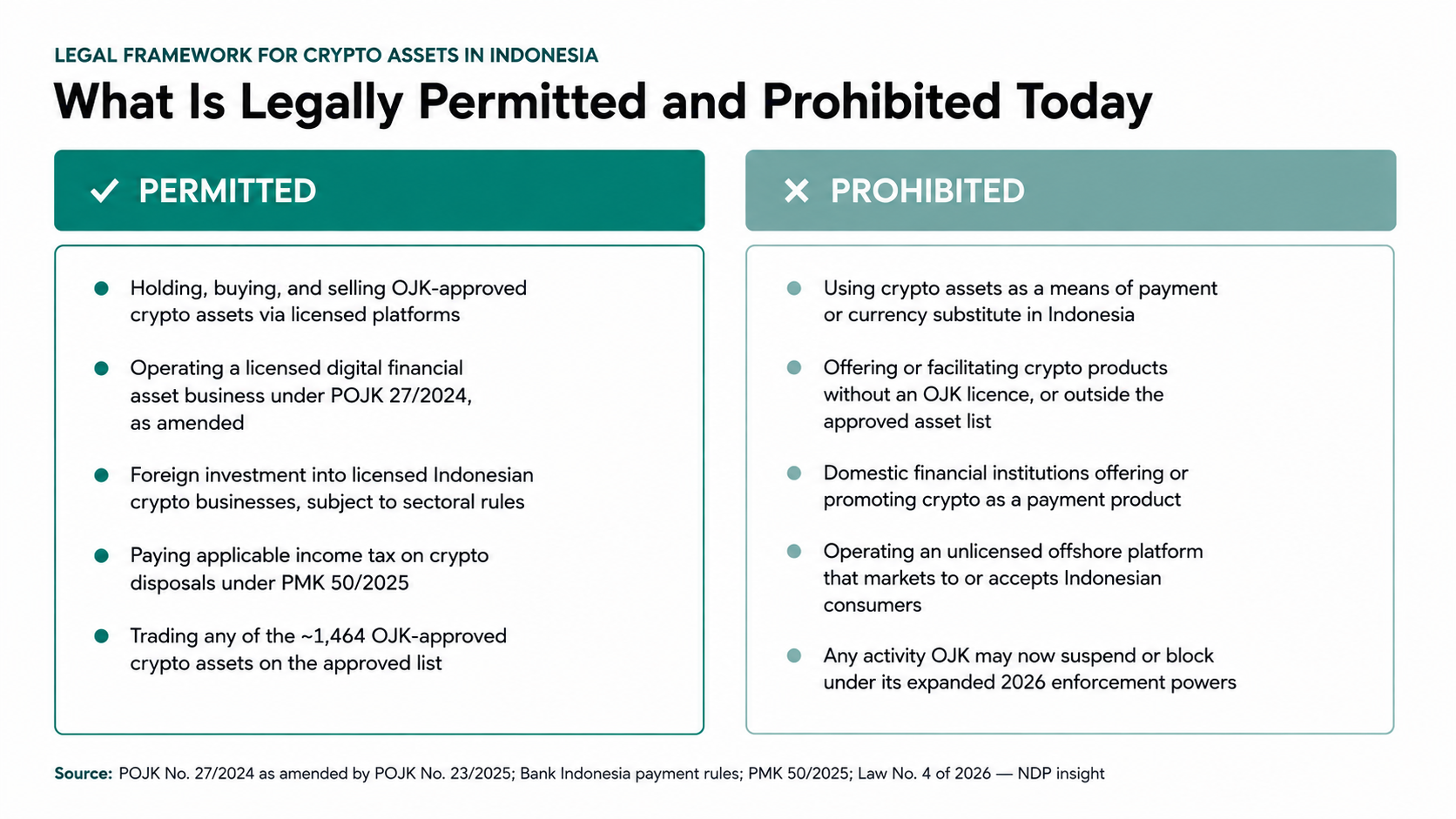
The prohibition on unlicensed offshore platforms follows directly from the amended P2SK Law’s enforcement powers, discussed below. The foreign investment position depends on sector-specific ownership rules and licensing conditions; Part 2 of this series, on licensing and business structuring, covers those requirements in detail.
Transitional and Enforcement Risk Post-Law No. 4 of 2026
The amended P2SK Law gives OJK the authority to coordinate with other agencies to suspend or block crypto asset transactions and trading activities that do not comply with applicable regulations. This includes activities conducted by foreign parties serving Indonesian consumers. It is a material strengthening of supervisory reach: businesses can no longer assume that structuring an offering offshore places it outside OJK’s practical enforcement perimeter.
One issue this raises concretely: an offshore exchange with no Indonesian entity, but that markets to and accepts Indonesian customers, now falls within OJK’s practical enforcement reach even without a local presence. A fuller treatment of cross-border enforcement mechanics, conflict-of-laws issues, and offshore platform exposure follows in the next article in this series, which focuses on investor protection, enforcement, and cross-border legal issues.
For investors and acquirers, the practical implication today is that due diligence must go beyond the legality of the underlying asset. It should also examine licensing pathways, consumer protection exposure, governance, and whether a target’s products might drift into prohibited payment or marketing territory.
Policy Rationale and Alignment with International Standards
Indonesia’s shift from a commodity-based regime to a financial-sector framework for crypto assets is not a unique domestic development. It follows a wider international trend that investors and businesses will recognize from other markets.
The FSB “Same Activity, Same Risk, Same Regulation” Principle
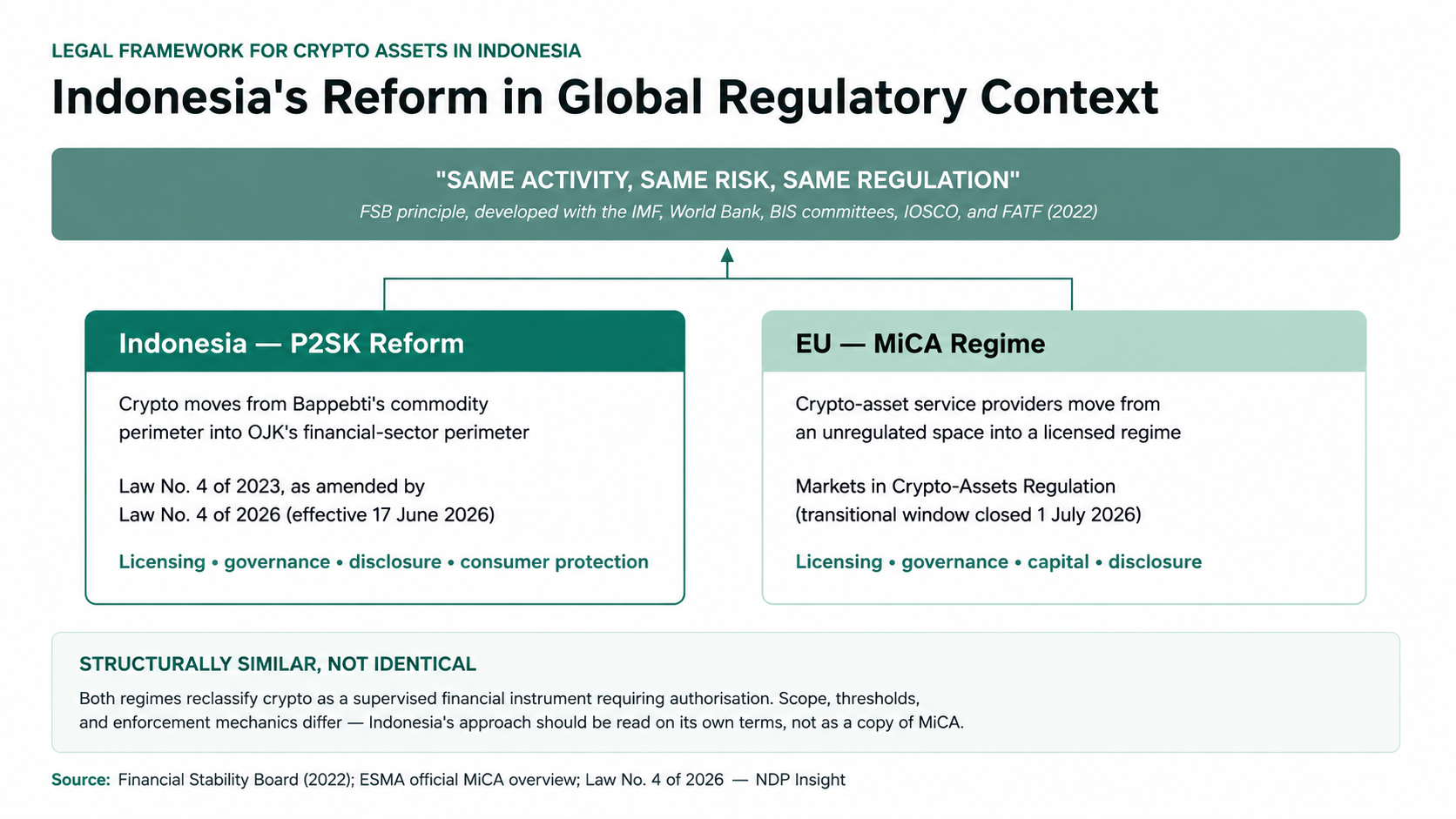
The Financial Stability Board (FSB) has recommended that authorities apply the principle of “same activity, same risk, same regulation” to crypto-asset activities. This appears in its 2022 consultative report on the regulation, supervision, and oversight of crypto-asset activities and markets, produced alongside the IMF, World Bank, BIS committees, IOSCO, and FATF.
Indonesia’s crypto asset businesses are moving from Bappebti’s commodity perimeter to OJK’s financial sector perimeter. Thus, licensing requirements, governance, disclosure and consumer protection, as required for other financial sector businesses, are also being required for crypto asset traders, exchanges and crypto asset custodians.
A Structural Parallel to the EU’s MiCA Regime
Indonesia’s 2026 reform took effect within days of the close of the European Union’s transitional window under the Markets in Crypto-Assets Regulation (MiCA). MiCA itself imposes licensing, governance, capital, and disclosure requirements on crypto-asset service providers. The two frameworks are structurally similar in some respects: both reclassify crypto from a peripheral asset class into a supervised financial instrument, and both require authorisation for service providers.
The P2SK Law (Law No. 4 of 2023) expanded the Capital Markets Act’s definition of securities to include digital investment contracts, and the 2026 amendment builds on that foundation. This follows a broadly similar logic to MiCA’s approach to asset-referenced tokens, though the two regimes differ in scope and detail.
What this means in practice: investors and businesses assessing Indonesia’s crypto market can benchmark it against internationally recognised regulatory concepts, licensing, governance, disclosure, and proportionate supervision, rather than treating it as a one-off or unpredictable regime.
Why This Matters for Investors and Businesses
In simple terms, Indonesia is regulating crypto the way it regulates banks and securities firms, not treating it as a special or lesser category. That is the practical takeaway for anyone assessing legal or reputational risk in this market. The same applies for anyone conducting due diligence on a regulated business model or product that OJK and Bank Indonesia will continue to supervise.
Why Law No. 4 of 2026 Matters for Investors, Businesses, and Market Participants
Law No. 4 of 2026 matters because it shows Indonesia building a fuller financial-sector framework for digital assets, with OJK in the lead regulatory role and expanded enforcement powers reaching even offshore activity that affects Indonesian consumers.
For investors, a more structured legal framework supports better diligence, clearer risk allocation, and greater confidence in how regulated business models are supervised. For businesses, clearer regulation also means clearer accountability: product design, governance, disclosures, and platform conduct are more likely to be examined through a legal and compliance lens under the current regime.
- Crypto Assets are lawful as investment and trading instruments through regulated channels but unlawful as payment instruments; Rupiah remains the sole legal tender.
- Any current legal reading must treat Law No. 4 of 2026 and Law No. 4 of 2023 as a combined P2SK framework.
- Regulatory authority has transitioned from a Bappebti-centric commodity approach to an OJK-led digital financial asset regime, with BI guarding the payments perimeter.
- For investors, businesses, and market participants, the central question is no longer “Is crypto legal?” but “Under which legal and regulatory architecture can Crypto Assets be held, traded, or integrated into products, and what are the supervisory expectations after Law No. 4 of 2026?”
Frequently Asked Questions
What are Crypto Assets in Indonesia?
Crypto Assets in Indonesia are digital assets historically treated as tradable commodities and now recognised within the digital financial asset framework under the P2SK regime. They may be lawful investment assets, but they are not lawful payment instruments.
Is crypto allowed in Indonesia?
Yes. Crypto is allowed for regulated trading and investment purposes through licensed platforms. It remains prohibited for use as a means of payment.
How are Crypto Assets regulated in Indonesia today?
Through a combination of the P2SK framework (Law No. 4 of 2023 as amended by Law No. 4 of 2026), Government Regulation No. 49 of 2024, OJK’s POJK 27/2024 as amended by POJK 23/2025, and Bank Indonesia’s payment system rules. The sector is now supervised primarily through a financial-sector lens rather than a commodity-trading lens.
What is the role of OJK and Bappebti in regulating Crypto Assets?
Bappebti historically supervised crypto asset trading under the commodity framework. OJK now serves as the lead regulator for digital financial assets, including Crypto Assets, covering licensing, supervision, and enforcement. Bappebti remains relevant for legacy and transitional interpretation.
Can foreigners invest in Crypto Assets in Indonesia?
Foreign investors can gain exposure through lawful investment structures, regulated platforms, or investments in licensed local businesses. Typical structures include PT PMA vehicles and investment in licensed Indonesian entities, though the precise analysis, including any foreign ownership caps, depends on the business model and is covered in Part 2 of this series.
Can foreign companies operate a crypto business in Indonesia?
Potentially, but only through a structure that fits within Indonesia’s licensing framework under POJK 27/2024 as amended. The practical answer depends on the business activity, applicable OJK rules, and any foreign investment limitations.
How big is the crypto market in Indonesia?
OJK recorded 22.93 million crypto consumer accounts as of July 2026, with monthly transaction value of Rp20.52 trillion and derivative transaction value of Rp3.41 trillion that month. Full-year 2025 volume was Rp482.23 trillion. OJK had licensed 32 entities in the ecosystem, including 26 digital financial asset traders, and tradable asset lists are maintained per exchange: CFX listed 1,214 assets and 49 derivatives, ICEX listed 871 assets, as of July 2026.
Is there tax on crypto in Indonesia?
Yes. Under PMK 50/2025, crypto asset sales are subject to a final income tax of 0.21% on licensed domestic platforms and 1% on foreign platforms, effective from 1 August 2025. Crypto asset transfers are exempt from VAT. Mining income is taxed at standard income tax rates from the 2026 tax year.
About Nusantara DFDL Partnership
Nusantara DFDL Partnership (NDP) is an Indonesian law firm and a member of the DFDL network, which operates across Southeast Asia. NDP advises foreign corporations, institutional investors, and Indonesian businesses across a full suite of corporate legal services, including corporate advisory, mergers and acquisitions, foreign direct investment, joint ventures, employment law, real estate, dispute resolution, restructuring, and cross-border transactions. NDP works with clients across sectors including digital infrastructure, financial services, energy, manufacturing, and property.
Legal note
This article is for general informational purposes only and does not constitute legal advice. Laws and market conditions change. Readers should seek independent legal counsel before acting on any information contained here.
Read Also: Foreign Investment in Indonesia’s Crypto Market: PT PMA Structures, Licensing, and Market Entry