Crypto assets in Indonesia now sit inside a clearer legal framework. OJK leads that framework under the amended P2SK regime. For foreign investors, one question matters most. It is no longer whether crypto activity is lawful in Indonesia. It is how to structure lawful participation in it. This Part 2 article answers that question. It covers PT PMA vehicles and licensed Indonesian entities. It covers ownership and approval issues. And it covers the risks of serving Indonesian users from offshore.
Key Takeaways
- Foreign investors can participate in Indonesia’s crypto sector. But only through structures that fit OJK licensing and Indonesian investment rules.
- A PT PMA is often the standard vehicle for foreign investment. It does not itself grant permission to run a licensed crypto business.
- The first legal question is always the same. What regulated activity does the business perform: trading, exchange, custody, clearing, or support? This drives the licensing route and every structural choice after it.
- Foreign ownership and control cannot be judged in the abstract. Test it against the business classification, the OJK regime, and any sector-specific conditions.
- Investing in a licensed Indonesian entity is legally different from running a platform from offshore. Law No. 4 of 2026 widened OJK’s reach. That gap now matters more than before.
- Change-of-control, governance, and consumer protection now carry as much weight as headline ownership percentages.
Why Foreign Investment in Indonesia’s Crypto Market Matters Now
Indonesia’s crypto market is already large. OJK data shows 22.93 million crypto consumer accounts as of July 2026, up from 22.69 million in June 2026 and 22.40 million in May 2026. Transaction value fluctuated over the same period, reaching Rp20.52 trillion in July 2026, alongside Rp3.41 trillion in digital financial asset derivative transactions. Full-year 2025 volume was Rp482.23 trillion. OJK had licensed 32 entities in the digital financial asset ecosystem, comprising two exchanges, two clearing and settlement institutions, two custodians, and 26 digital financial asset traders. Tradable asset lists are set per exchange rather than as a single national list; as of July 2026, CFX listed 1,214 tradable crypto assets and ICEX listed 871.
The regulatory architecture has changed too. Topic 1: Crypto Assets in Indonesia: Legal Status and Regulatory Architecture, explained how authority moved from Bappebti to OJK. That shift ran through the P2SK framework and Government Regulation No. 49 of 2024. The regulation took effect on 10 January 2025. It moved regulation and supervision of digital financial assets and crypto assets from Bappebti to OJK and Bank Indonesia. Law No. 4 of 2026 then strengthened OJK’s powers further. It extended consumer protection rules to crypto asset businesses: exchanges, traders, clearing institutions, and custodians. The implication is clear. Foreign investment in Indonesia’s crypto market now sits inside a structured financial-sector regime. Market entry is a licensing and structuring question. It is not just a capital question.
The Choice Facing Foreign Investors Today
The practical question for foreign investors is now clear. Indonesia permits regulated crypto activity. But foreign investors and operators still face a choice. They can enter as minority investors, controlling shareholders, joint venture sponsors, or offshore platforms. Some mix these paths together.
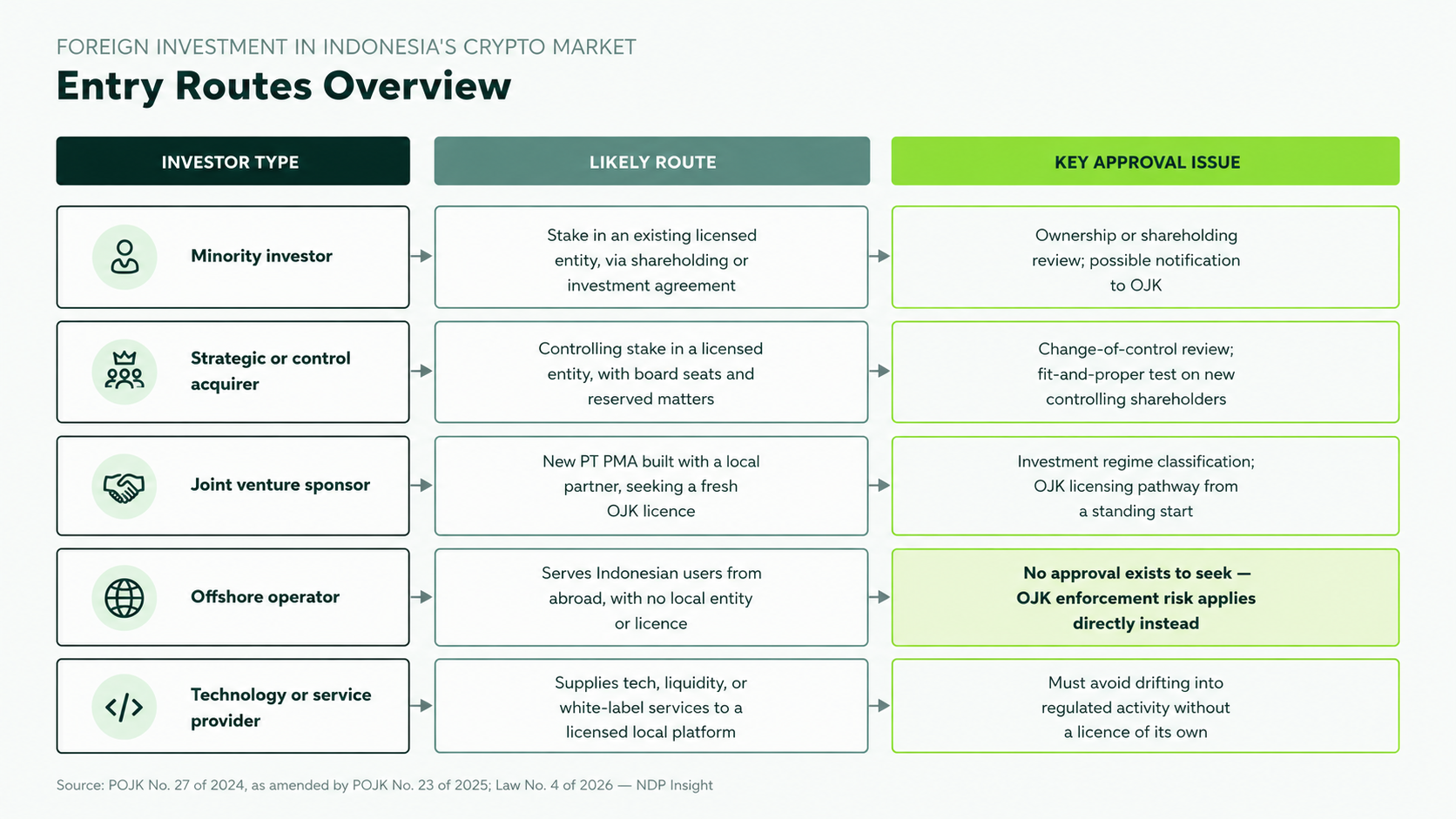
Figure 1 maps each investor profile against its likely route and the key approval issue it will face.
First Question: Investor, Acquirer, or Operator?
Before considering PT PMA structures or foreign ownership limits, foreign investors should first answer one fundamental question: What role do they intend to play in Indonesia’s crypto market? The answer determines the appropriate investment structure, licensing pathway, regulatory approvals, and ongoing compliance obligations.
- Minority investor: A fund or other financial investor will become a minority investor in an already existing (and licensed) company in Indonesia. In most cases, they will just become a strategic (or financial) partner of the local management.
- Strategic acquirer or control investor: A foreign investor acquires a controlling interest in a licensed Indonesian crypto business to obtain strategic control, integrate regional operations, or establish Indonesia as part of its broader business platform. Such transactions typically require OJK approval for a change of control and must satisfy applicable governance, ownership, and regulatory requirements.
- Joint venture sponsor: A foreign party and local party jointly set up a new business. A PT PMA company is set up for this purpose, and a license application will be filed with the OJK for the newly set up business.
- Offshore operator: A foreign platform is offering services to Indonesian customers from outside of Indonesia, typically through a website or mobile application.
- Technology or service provider: Foreign businesses may also supply technology, liquidity, or white-label services to Indonesian-licensed businesses.
Offshore operators serving Indonesian customers must also assess whether their activities fall within OJK’s regulatory perimeter and could trigger enforcement action.
Common Ways Foreign Investors Enter Indonesia’s Crypto Market
Foreign investors typically enter the market through one of four primary structures.
A. Minority investment in an existing licensed entity
Many funds aim for a minority investment in an existing licensed business, since the local entity already holds the required OJK license.
This route still raises real questions. Investors must know the target’s licensed activities: trading, exchange, custody, or clearing. They need the scope and status of its licence. They need OJK’s rules on shareholding changes. And they need clarity on governance and reserved matters. Due diligence must also test one thing closely. Does the target’s actual business match its licensed scope and consumer protection duties under the amended P2SK framework?
B. Majority or controlling investment
Some foreign investors seek more than passive exposure to Indonesia’s crypto market. Instead, they aim to acquire strategic control over a licensed business, allowing them to influence management decisions, integrate regional operations, or expand existing business activities through an established Indonesian platform.
However, a deal that gives a foreign party control of a company draws more attention. While such a deal can be very strategic (i.e. enable the new board of directors of the company to integrate with other regional group companies), change-of-control rules and beneficial ownership requirements must be satisfied. In addition to the usual requirements under company law and the rules with respect to investment in Indonesia, a controlled entity must also satisfy the conditions for approval by the relevant OJK department, as well as the OJK’s rules with respect to controlled institutions.
C. New venture or joint venture through a PT PMA
D. Offshore platform serving Indonesian users
Some foreign platforms serve Indonesian users without a local entity. Although this may appear straightforward, Topic 1: Crypto Assets in Indonesia: Legal Status and Regulatory Architecture, explains why it presents significant regulatory challenges. Law No. 4 of 2026 widened OJK’s enforcement powers. It also strengthened coordination with other agencies over crypto activity that touches Indonesian consumers.
An offshore platform may still fall within OJK’s jurisdiction even without an Indonesian entity if it markets its services in Indonesian, actively onboards Indonesian customers, or develops a significant Indonesian user base. These activities may bring the platform within Indonesia’s regulatory perimeter despite operating from outside the country.
Entry Models at a Glance
| Structure | Typical User | Main Advantage | Main Approval Point | Main Legal Risk |
|---|---|---|---|---|
| Minority stake in licensed entity | Fund or strategic investor | Faster access to a regulated market via an existing platform | Ownership or shareholding review; possible notifications | Governance, legacy compliance, alignment with licence |
| Control investment in licensed entity | Strategic buyer or regional operator | Strategic control over platform and roadmap | Change-of-control review; fit-and-proper test | Higher scrutiny; ownership sensitivity; integration risk |
| New PT PMA or joint venture | New entrant or JV sponsor | Clean, purpose-built platform from day one | Investment classification; OJK licensing pathway | Time to launch; capital and execution risk |
| Offshore platform model | Foreign operator | No immediate local company setup | Assessment of regulatory perimeter and enforcement risk | OJK enforcement; consumer-protection risk |
PT PMA: What It Does and What It Does Not Do
A PT PMA is the standard vehicle for foreign direct investment in Indonesia. It lets foreign shareholders hold equity in an Indonesian company. It is the usual starting point for foreign-owned ventures.
In the crypto sector, however, a PT PMA is only one element of the broader regulatory framework. While it provides the corporate vehicle for foreign investment, it therefore does not by itself authorise regulated crypto activities. Appropriate licensing and ongoing regulatory compliance remain essential.
- A business line open to foreign investment under Indonesia’s investment regime.
- The correct OJK licence: as a trader, exchange, custodian, or clearing institution.
- Compliance with the capital, governance, technology, and reporting rules tied to that licence.
Figure 2 sets out the two layers this creates: the investment vehicle and the licence that must sit alongside it.
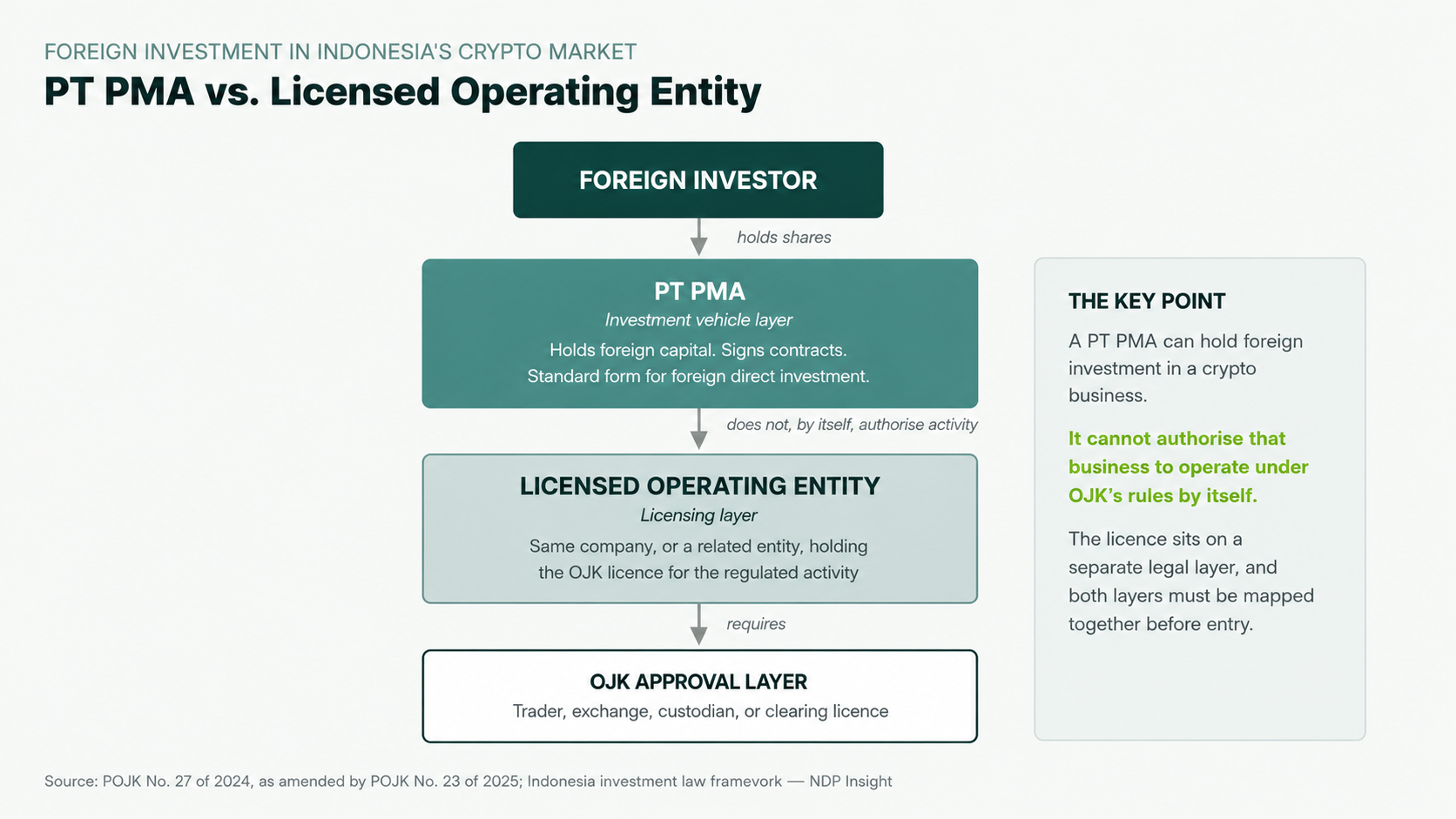
In practice, a foreign investor may hold shares directly in the licensed entity. Alternatively, it may take a position in a holding company over a licensed operating subsidiary. Either way, map the corporate structure against OJK’s licensing rules. General corporate law is not enough on its own.
Foreign Ownership: Where the Constraints Sit
Foreign ownership in Indonesia’s crypto sector has no single percentage rule. Several layers apply together instead:
- General investment regime and business classification: Foreign investment must fit Indonesia’s investment law and business-field rules. Some sectors are open. Some are conditional. Some are closed.
- Sector-specific rules: Digital financial asset businesses sit inside OJK’s financial-sector perimeter now. That can bring conditions on ownership, governance, and control.
- Licensing conditions: OJK Regulation No. 27 of 2024, effective 10 January 2025, and its amendment POJK No. 23 of 2025 (issued 10 December 2024) (effective 10 November 2025), set out licensing and documentation duties for digital financial assets.
- Approval practice: OJK reviews applications and shareholder changes case by case. That review shapes what actually gets approved.
Foreign ownership should not be assessed solely by reference to general ownership percentages or examples from other regulated sectors. Instead, investors should evaluate the proposed structure against the applicable business classification, OJK licensing framework, and any sector-specific ownership or governance requirements.
Where ownership limitations are approval-based rather than percentage-based, reliance should be placed on the applicable legislation and OJK guidance rather than assumptions or market practice.
Licensing Categories Shape the Structure
Licensing questions come before structuring questions here. OJK’s framework starts with one thing: what activity does the business actually carry out? Different activities draw different licences, each with its own conditions.
Key activity types include:
- Digital financial asset traders: Businesses that trade crypto assets as digital financial assets.
- Exchanges or trading venues: Platforms that match buyers and sellers and organise trading.
- Custodians: Entities that safekeep digital financial assets for clients.
- Clearing or settlement institutions: Institutions that handle clearing and settlement for trades.
- Support or infrastructure providers: Businesses that supply technology or connectivity around trading and custody.
OJK treats each of these roles differently. A foreign investor can only choose its structure once the target’s licensed activity is clear. That choice might be a minority stake, a control deal, or a PT PMA build. An offshore operator faces the same test. It must ask whether its activity would need a local licence if it had an Indonesian presence.
How the Legal Question Changes by Business Model
| Business Model | Local Licensing Likely Required? | Is PT PMA Relevant? | Foreign Ownership Analysis Material? | Main Compliance Issue |
|---|---|---|---|---|
| Crypto trading platform serving Indonesian users | Yes, likely under OJK digital financial asset rules | Yes, as a local operating or holding entity | Yes, depending on classification and conditions | OJK licensing, market conduct, consumer protection |
| Crypto custody business | Yes, for safekeeping digital financial assets | Yes | Yes | Safekeeping standards, segregation, governance |
| Exchange infrastructure and order book | Yes | Yes | Yes | Core institutional approvals, technology, resilience |
| Passive foreign holding company owning licensed shares | Not as operator; licence held by subsidiary | Yes, as holding or investment vehicle | Yes | Ownership approvals, control, governance rights |
| Offshore platform with Indonesian users, no local entity | No local licence on paper, but high risk | Could be part of a compliant re-entry structure | Yes, if regularising or acquiring a local platform | Regulatory perimeter, enforcement, consumer-protection risk |
Investing in a Licensed Indonesian Entity: Key Checks
For many foreign investors, the realistic path is simple. Invest in an existing licensed business rather than build one from scratch. That does not make the legal work easy. It shifts its focus instead.
A serious due diligence exercise should cover at least these points:
- Licensed activities: What exactly is the target licensed to do: trading, exchange, custody, or clearing?
- Licence status: Is the licence current, in good standing, and free of open supervisory issues?
- Change-of-control risk: Does the investment trigger any notification, approval, or OJK review?
- Governance and controls: Do the board and control functions meet OJK’s expectations, especially after Law No. 4 of 2026 extended consumer protection duties?
- Product and perimeter fit: Do the target’s actual products match its licence? Do they avoid prohibited activity, especially around payments?
- Transition issues: Has the business moved cleanly from Bappebti to OJK supervision? Do any legacy practices still conflict with the current regime?
These checks matter equally for a minority stake and a full control deal, since both shape regulatory risk and long-term value.
Offshore Platforms and Indonesian Customers
Many platforms want Indonesian customers without a local entity or licence. Topic 1: Crypto Assets in Indonesia: Legal Status and Regulatory Architecture, explained why this is risky.
Law No. 4 of 2026 gives OJK stronger tools. It can coordinate with other agencies to suspend or block non-compliant crypto activity. That includes activity run by foreign parties that serves Indonesian consumers. A platform that markets in Indonesian cannot assume it stays out of reach. Neither can a platform that onboards Indonesian customers. Neither can a platform that targets Indonesia in any other clear way.
A short example makes the risk concrete:
- An offshore exchange has no Indonesian subsidiary and no PT PMA.
- It runs an Indonesian-language site. It accepts Indonesian identity documents in onboarding. It markets actively into Indonesia.
- Under the amended P2SK framework, OJK may treat this as activity inside its perimeter. It may act to protect Indonesian consumers.
Topic 3 of this series covers enforcement and cross-border issues in full. For now, the practical point is simple: no offshore structure guarantees protection from OJK’s enforcement powers.
Due Diligence Checklist Before Entering the Market
Before you start to invest or enter a market, go through this check list:
- What specific products and services will the venture offer to which market?
- Which OJK licensing category likely applies?
- Is the company or business you wish to invest in good standing and operating within the scope of the licenses it has?
- Will the deal trigger a change-of-control or ownership review?
- Does the planned level of foreign ownership need a PT PMA or other local entity?
- Does the proposed level of foreign investment create additional regulatory risks where the business serves Indonesian users from offshore? If so, how will those risks be identified and managed?
- Are governance, risk management, and compliance sufficiently mature to withstand OJK scrutiny?
- Tax structure and PMK 50/2025 on crypto assets and other digital financial assets in relation to business model.
These questions help translate complex legal and regulatory requirements into practical considerations for boards, investment committees, and transaction teams when evaluating investment opportunities.
Common Structuring Mistakes
Several mistakes recur among foreign investors in this market:
- Assuming PT PMA solves everything: It addresses foreign ownership at company level. It does not authorise a licensed crypto business on its own.
- Focusing only on ownership percentages: Ownership caps, where they exist, are one part of the question. Licensing conditions, governance, and approvals matter just as much.
- Ignoring the licence category: A trader, an exchange, and a custodian are not interchangeable. Each faces different regulatory expectations.
- Treating offshore structuring as a safe workaround: Law No. 4 of 2026 narrowed that comfort considerably.
- Relying on pre-transition assumptions: Practices tolerated under Bappebti’s old commodity framework may not survive under OJK’s current regime.
Mistakes to avoid in designing the best structure are largely based on wrong mindset or misunderstanding. Approaching from reverse direction would definitely bring more complexities and lead to regulatory trouble. Proper approach to designing the best structure is to first identify the regulated activities and the level of exposure to consumers, and then work backwards to determine the best corporate and ownership structure.
Practical Pathways by Investor Type
The most suitable market-entry strategy depends on the investor’s commercial objectives and regulatory position.
- Foreign funds will be suitable for minority or significant minority stake in a company and the key rights to be protected are their good governance rights and the change of control structure.
- Strategic buyers and regional exchanges: They can consider a control structure or a joint venture, typically set up through a PT PMA. Their scrutiny on licensing and ownership will be more in depth.
- Offshore platforms: Offshore operators should assess whether to regularise their Indonesian business through a locally licensed structure or carefully limit their activities to remain outside OJK’s regulatory and enforcement perimeter.
- Technology and service providers: Such parties typically supply licensed local entities and may not have a license themselves. They however need to be very careful not to be classified as a part of the regulated activity.
- Indonesian founders: Alignment of licensing, governance and tax early on in the life of a business is key for making a more attractive business to foreign capital and facilitating deal making later on.
Figure 3 maps each profile against its likely structure and the regulator concern that matters most.
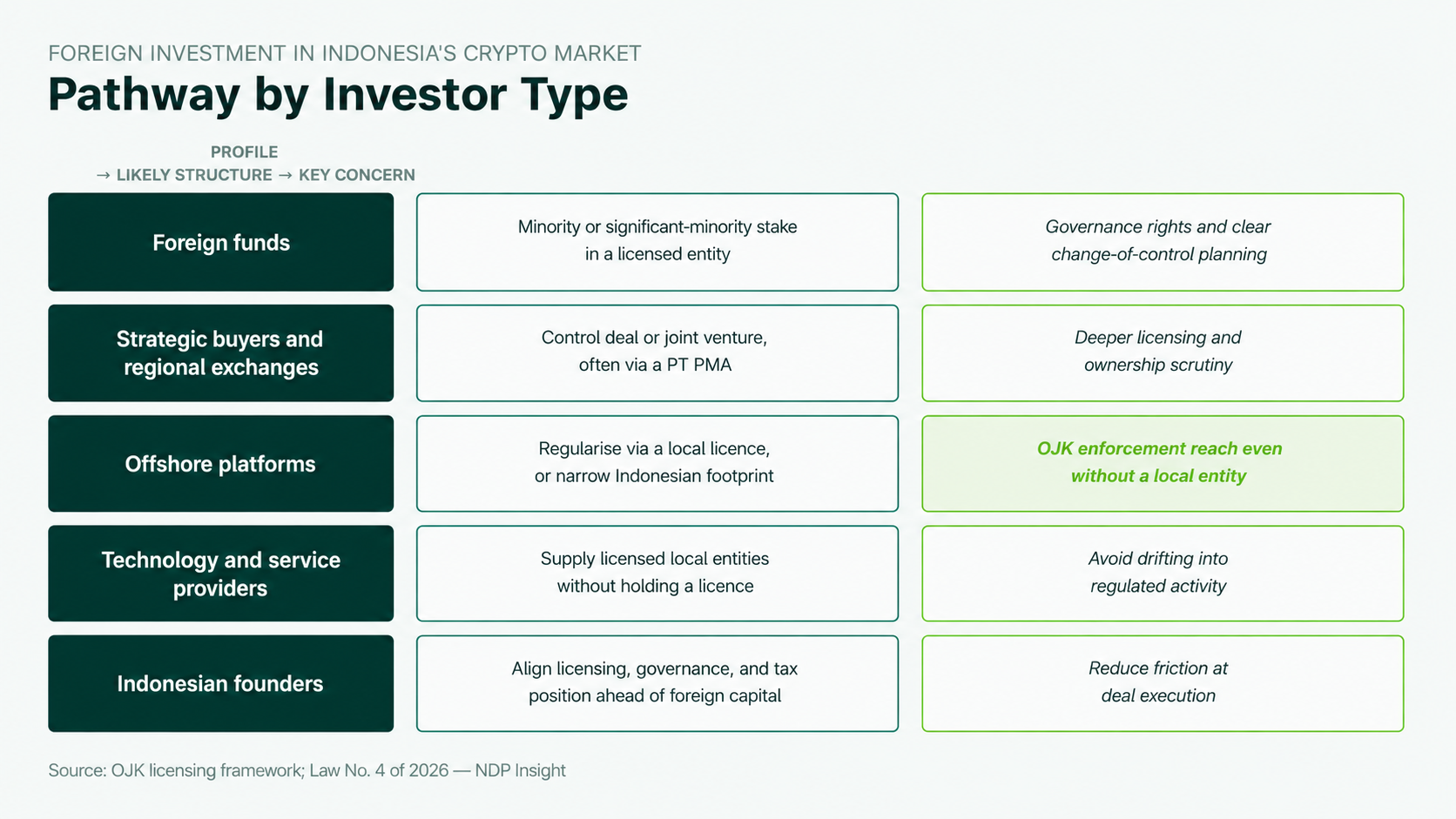
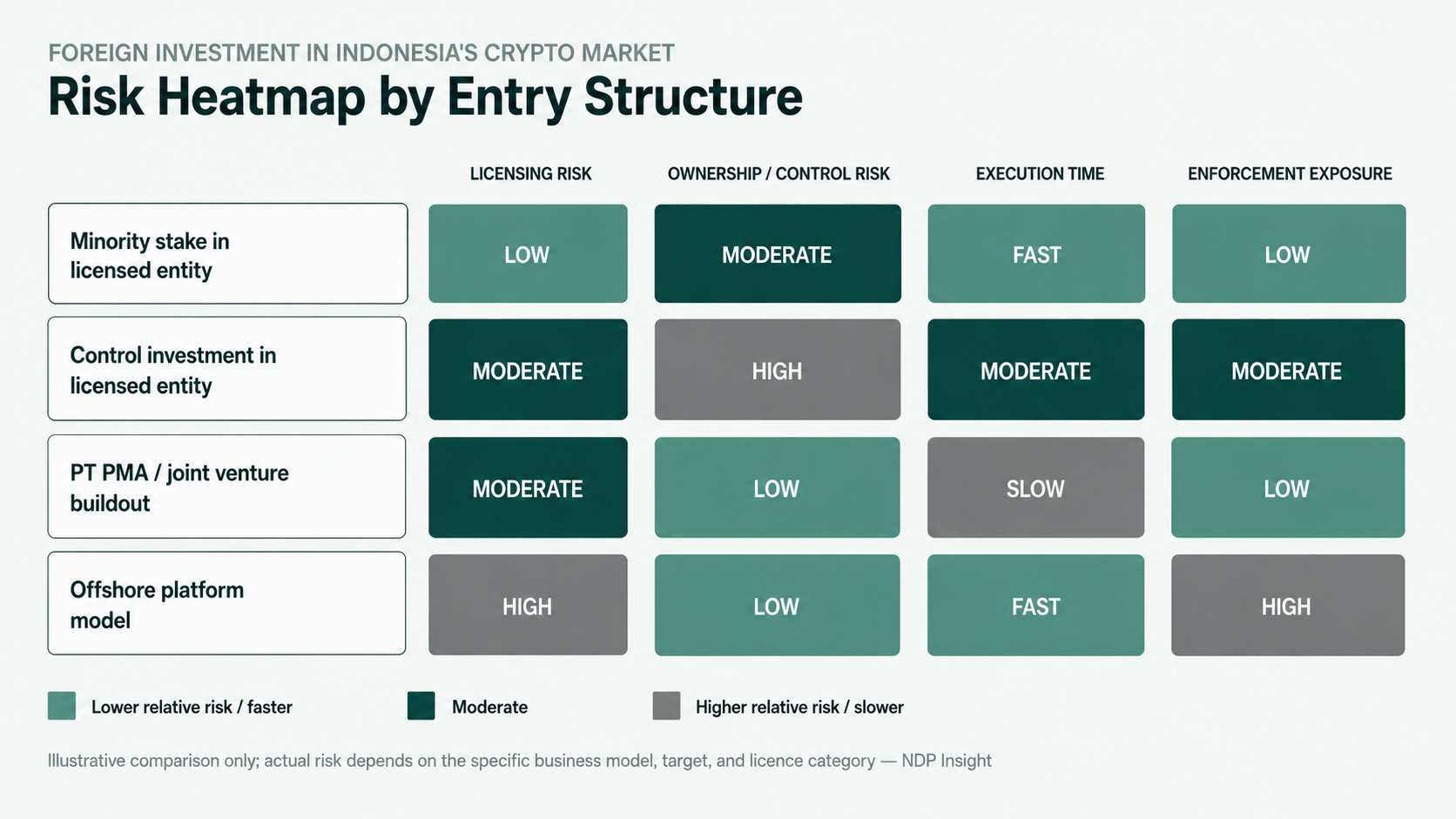
Figure 4 compares the same four entry structures on relative risk, across licensing, ownership, execution time, and enforcement exposure.
Why This Matters Commercially
The transition to an OJK-led regulatory framework has practical implications beyond legal compliance. It influences how transactions are structured, how investors assess regulatory risk, and how businesses plan expansion within Indonesia’s rapidly developing digital financial asset market.
- A clearer framework on licensing can lead to better pricing of risks and more confident capital allocation. Also, regulated business models will have more predictable supervisory conduct.
- Consumer protection and rules enforcement for financial services also works in one of two ways. On the one hand, well-structured and solid financial services with proper and professional governance can avoid any negative attention from the authorities. On the other hand, weak financial services structures with aggressive outside (offshore) strategies will receive negative attention and may be subject to disciplinary action.
- Early adoption by Indonesian founders of the P2SK and OJK framework can create better prospects for foreign capital, and facilitates smoother deal processing and execution.
- The market is no longer focused on how to circumvent the framework of the financial sector. As the market matures, the focus shifts to structuring a deal within that framework.
In plain terms: this market is no longer about finding a loophole. It is about designing a structure that fits a maturing financial-sector framework.
Conclusion
Foreign investors can enter Indonesia’s crypto market. But lawful entry depends on structure, licensing, and the right investment rules, not appetite or capital alone.
While a PT PMA is often the preferred vehicle for foreign investment, it represents only one component of a compliant market-entry strategy. Successful participation in Indonesia’s crypto market also depends on selecting the appropriate licensing pathway, satisfying regulatory approvals, and maintaining ongoing compliance with OJK requirements.
Licensing category comes first. Ownership, approvals, and corporate form follow from it, not the other way round.
Foreign ownership and control must match the actual business model. Test them against the current P2SK and OJK rules, not generic percentage assumptions.
Offshore platforms serving Indonesian users carry real regulatory risk after Law No. 4 of 2026. A local entity is not the only trigger for OJK’s attention.
For investors, businesses, and market participants, one question now matters most. Not “Is crypto legal in Indonesia?” but “Through which structure, under which licence, and with which approvals can we enter this market?”
Topic 3 of this series turns to enforcement, investor protection, and cross-border risk in more depth.
Frequently Asked Questions
Can foreigners invest in crypto businesses in Indonesia?
Yes. Foreign investors can invest in licensed Indonesian entities. They can form PT PMA vehicles. They can enter joint ventures too. Each path must fit Indonesia’s investment regime and OJK’s licensing framework.
Is a PT PMA required for foreign investment in Indonesia’s crypto market?
A PT PMA is the typical form for foreign direct investment here. Foreign investors often use it to hold shares in an Indonesian crypto business. But PT PMA status alone does not authorise crypto activity. The business still needs the right OJK licence.
Can a foreign company operate a crypto exchange in Indonesia directly?
Not without clearing licensing and investment rules first. Serving Indonesian users through an exchange is likely to need a licensed Indonesian entity under OJK’s framework. Offshore-only models can still face real Indonesian risk.
Are there foreign ownership caps on crypto businesses in Indonesia?
It depends on the business classification, the investment regime, and OJK’s licensing conditions. Some structures may allow high foreign ownership. Others may face approval-based or conditional limits. Test each case against primary rules and OJK guidance.
What licence is required to operate a crypto business in Indonesia?
It depends on the activity. Traders, exchanges, custodians, and clearing institutions all fall under OJK’s digital financial asset rules. Each needs the right licence under OJK Regulation No. 27 of 2024, as amended by POJK No. 23 of 2025 (effective 10 November 2025), and related guidance.
Is investing in a licensed crypto company different from operating a crypto platform?
Yes. Investing focuses on ownership, governance, and approvals. Operating a platform focuses on licensing, risk management, technology, and consumer protection. A foreign investor may need both: a sound shareholding structure and confidence in the platform’s OJK compliance.
Can an offshore crypto platform legally serve Indonesian users?
Doing so without local licensing is high risk under the current framework. Law No. 4 of 2026 gives OJK stronger powers here. It can act against non-compliant crypto activity that touches Indonesian consumers, even from abroad.
What approvals may be needed when foreign investors acquire a licensed crypto business in Indonesia?
Approvals or notifications may apply if the deal changes control, major shareholding, or beneficial ownership. OJK and other authorities may review the transaction. The goal is to confirm continued compliance with licensing and governance rules.
What due diligence should investors do before entering the Indonesian crypto market?
Check the target’s licensed activities, licence status, governance, and compliance systems. Check its technology and consumer protection measures. Check its ownership structure and any offshore regulatory exposure. Also check how PMK 50/2025‘s tax rules apply to the business model.
How does Law No. 4 of 2026 affect foreign investors and crypto businesses?
Law No. 4 of 2026 strengthens OJK’s authority over digital financial assets. It extends consumer protection rules to crypto businesses and sharpens OJK’s power to coordinate enforcement where crypto activity touches Indonesian consumers. All of this raises the importance of lawful structuring and proper market entry.
About Nusantara DFDL Partnership
Nusantara DFDL Partnership (NDP) is an Indonesian law firm and a member of the DFDL network, which operates across Southeast Asia. NDP advises foreign corporations, institutional investors, and Indonesian businesses across a full suite of corporate legal services, including corporate advisory, mergers and acquisitions, foreign direct investment, joint ventures, employment law, real estate, dispute resolution, restructuring, and cross-border transactions. NDP works with clients across sectors including digital infrastructure, financial services, energy, manufacturing, and property.
Disclaimer:
This article is for general informational purposes only and does not constitute legal advice. Laws and market conditions change. Readers should seek independent legal counsel before acting on any information contained here.