1. Executive overview and context
The ART creates potentially valuable market-access and investment openings, but its business value depends on three unresolved variables: whether the U.S. tariff architecture survives legal challenge, whether Indonesia completes domestic ratification, and how companies manage the sovereignty, climate, and ESG risks embedded in implementation.
On 19 February 2026, Indonesia and the United States signed the Agreement on Reciprocal Trade (ART) in Washington. The deal was sold as a “historic” USD 33 billion package that would secure market access, cut tariffs, and deepen economic ties across manufacturing, agriculture, and digital trade.
Under the ART, Indonesia agreed to remove tariffs on over 99 percent of US products, while the US kept a 19 percent “reciprocal” tariff on Indonesian exports, with zero tariffs on 1,819 specific Indonesian product lines such as palm oil, coffee, cocoa, rubber and certain textiles.
The agreement also bundled indicative commercial arrangements for US energy, agricultural products, and aircraft worth roughly USD 33 billion over several years, including roughly USD 15 billion in energy and around 50 aircraft valued at about USD 13.5 billion.
What’s changed since signing
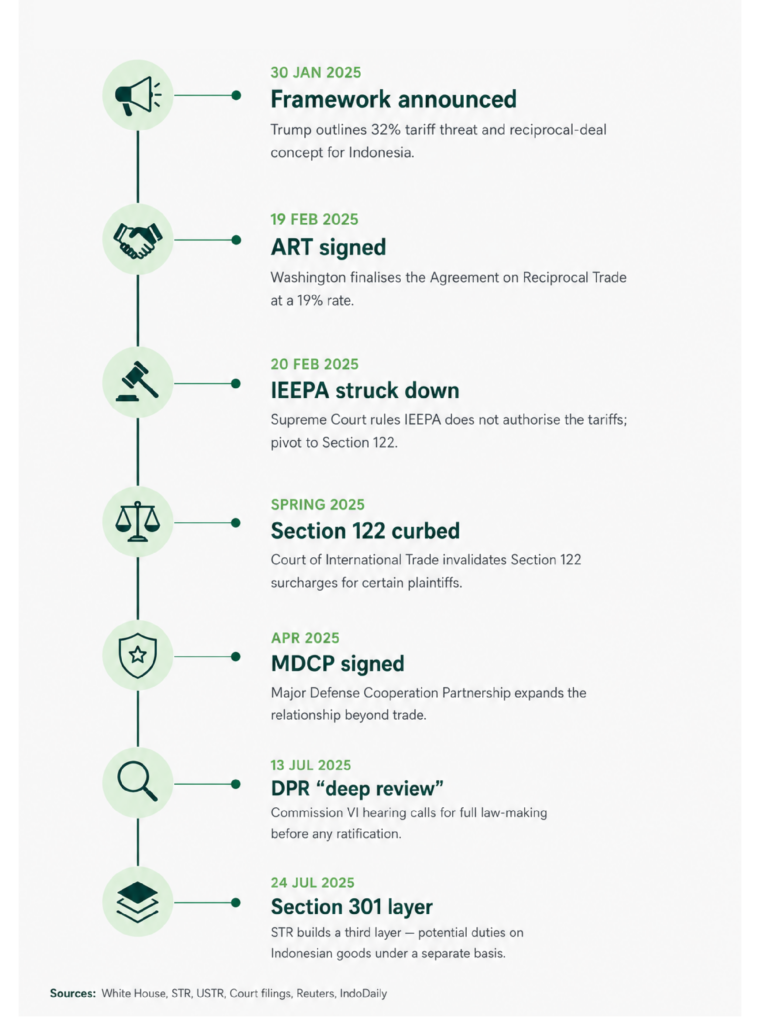
Within 24 hours, the legal ground under the deal began to shift. On 20 February 2026, the US Supreme Court, in Learning Resources, Inc. v. Trump, ruled that the International Emergency Economic Powers Act (IEEPA) does not authorize the President to impose tariffs, undermining the legal basis for the 32 percent tariff threat that pushed Indonesia to negotiate the 19 percent rate. Washington pivoted to another tool, Section 122 of the Trade Act of 1974, which allows temporary surcharges of up to 15 percent, and then faced a further setback when the US Court of International Trade struck down those Section 122 tariffs for certain plaintiffs.
In Jakarta, the agreement has not yet entered into force. Under the ART, it becomes operational 90 days after both governments certify that their domestic procedures are complete. Indonesia has not yet provided that confirmation, and the government has indicated that ratification would normally proceed through the House of Representatives because of the breadth of the commitments involved.
This Insight explains where the ART stands now and what businesses should do with that uncertainty. It assesses the main commercial opportunities and risks, the sovereignty and policy-space questions raised by the treaty architecture, and the climate and extractives implications that companies should address before relying on the agreement’s benefits.
2. Key Takeaways
- The US Indonesia Trade Deal combines a maintained 19 percent US tariff on most Indonesian exports, zero‑tariff treatment for 1,819 Indonesian tariff lines, removal of Indonesian tariffs on over 99 percent of US goods, and facilitated commercial deals worth around USD 33 billion in energy, agriculture, and aircraft.
- US court decisions have undercut the tariff authority used to threaten 32 percent duties and to implement substitute surcharges, while Indonesia has yet to confirm completion of its domestic procedures under the ART; the 19 percent rate and the agreement’s entry into force are therefore legally and politically unsettled.
- Indonesian exporters gain better access to the US for key products but still face a 19 percent tariff on many items, while Indonesian markets open almost entirely to US goods, increasing competition for domestic producers.
- The ART reaches deep into non-tariff barriers, local content rules, licensing regimes, and digital trade, including provisions on cross border transfers of commercial data.
- Side arrangements on energy and critical minerals, together with commitments to remove export restrictions on industrial commodities, raise sovereignty and climate considerations that companies will want to weigh alongside the commercial upside.
- Analysts note that the treaty text is heavily one‑sided: legal clauses phrased as “Indonesia shall…” far outnumber those that bind the United States, underlining the asymmetry of obligations.
- A Major Defense Cooperation Partnership signed in April 2026 builds on the trade agreement and expands joint exercises and defense cooperation, adding a security and alignment dimension to the economic compact.
- For businesses and investors, the ART is best viewed as live but contested. Any strategy that relies on its benefits needs to factor in tariff-authority litigation, the pending ratification process, and evolving ESG expectations.
3. Economic and legal architecture of the deal
3.1 US Indonesia Trade Deal: Tariff and Market Access Commitments
The ART’s headline is simple on paper. Indonesia eliminates tariff barriers on more than 99 percent of US products across agriculture, health, seafood, ICT, automotive, chemicals, and other sectors. The United States keeps a 19 percent reciprocal tariff rate on imports from Indonesia but sets zero tariffs for 1,819 Indonesian tariff lines, including palm oil, coffee, cocoa, spices, rubber, electronics and some textiles through a tariff-rate quota mechanism.
Beyond this, annexes and official commentary indicate that Indonesia will support and facilitate commercial arrangements for US exports worth roughly USD 33 billion, including about USD 15 billion in energy and orders for about 50 aircraft valued at USD 13.5 billion. These are not all legally binding purchase contracts, but they frame expectations for trade flows and investment in the near term.
The legal footing behind the numbers
The legal footing of the US tariff side is less tidy. The 32 percent tariff threat that drove the negotiations rested on IEEPA. On 20 February 2026, the Supreme Court held, in Learning Resources, Inc. v. Trump, that IEEPA does not permit the President to impose such tariffs. The administration then relied on Section 122 of the Trade Act of 1974, which allows temporary surcharges of up to 15 percent in balance-of-payments situations, a lower ceiling than the negotiated 19 percent rate. The Court of International Trade invalidated the Section 122 tariffs for certain plaintiffs on 7 May 2026. For other importers, the surcharge remained in effect under a Federal Circuit stay pending appeal, until it expired on its own 150-day statutory term on 24 July 2026 and was immediately superseded by a Section 301 duty (see below). For Indonesian exporters and their counterparts, this means the “19 percent” number is more political than settled.
That signalling became action. On 24 July 2026, USTR imposed a separate 10 percent duty on Indonesian goods under a Section 301 investigation into forced-labor import enforcement covering 60 economies. Indonesia’s ART commitments, which include a forced-labor import ban, were what qualified it for the lower 10 percent rate rather than the 12.5 percent applied to economies without such a commitment. This duty stacks on top of the rates described below and is a separate legal action from the ART itself.
Table 1. Headline tariff and market-access changes
| Product / Category | Pre-deal Status | Post-deal Status | Legal / Implementation Caveat |
|---|---|---|---|
| Palm oil, cocoa, rubber, coffee, some electronics | Threatened 32% tariff | Zero tariff (1 of 1,819 lines) | Subject to rules of origin and product-specific lists |
| Textiles and apparel | 32% threat / prior MFN rates | 19% standard rate, with TRQ pathway to zero | Quota mechanism still to be specified |
| Most other Indonesian exports | 32% threat | 19% “reciprocal” tariff | Section 122 surcharge expired 24 July 2026 and was superseded by the Section 301 forced-labor duty; the 19% rate itself remains politically, not legally, settled |
| US goods entering Indonesia (agriculture, industrial, consumer) | Pre-deal MFN tariffs | Zero tariff on 99%+ of lines | Indonesia side of the deal is not contingent on the US litigation |
| All Indonesian goods – Section 301 layer | n/a – separate action | Additional 10% duty from 24 Jul 2026, stacking on the rates above | Separate forced-labor import-ban action under Section 301; Indonesia’s ART commitment on forced labor is what secured the lower 10% rate |
Key Business Takeaway
The agreement remains subject to legal challenges in the United States and domestic ratification in Indonesia. Companies should therefore monitor regulatory developments before making long-term commercial decisions.
3.2 Non‑tariff barriers, regulatory commitments and digital trade
The ART goes beyond customs duties. Indonesia is expected to remove or relax several non-tariff barriers, including import quotas tied to licensing requirements, commodity-balance requirements, certification and labelling rules, and pre-shipment inspection requirements.
In removing these NTB measures, US producers will benefit from a number of regulatory shortcuts.
For example, vehicles will be able to be certified under US Federal motor vehicle standards, rather than having to undergo testing and certification under additional local standards. In addition, products that are certified by the FDA will not have to be subjected to duplicative testing and certification under local standards.
Digital trade is included in the treaty as well.
The treaty also covers digital trade. It exempts electronic transmissions from customs duties, permits cross-border transfers of commercial data, and creates a more favourable environment for digital service providers operating in Indonesia. Officials have clarified that the data-transfer commitment applies to commercial data only, not state data or sensitive security information.
The ART also includes a provision dealing with third countries.
The ART obliges Indonesia to apply measures with similar restrictive effects to US customs duties or other measures including sanctions with respect to specified third countries (referred to as “covered third countries”).
The ART also extends beyond bilateral trade. It requires Indonesia to apply measures with similar restrictive effects to certain U.S. customs duties or other measures, including sanctions, against specified “covered third countries.” This could affect Indonesia’s position in regional trade negotiations, particularly its approach to measures involving China.
For companies operating across borders, these regulatory changes may simplify market access. However, businesses should continue monitoring implementing regulations to ensure ongoing compliance.
4. Business implications: trade, investment and compliance
4.1 Indonesian exporters and importers
For Indonesian exporters, the ART offers clarity where there was previously only the threat of a 32 percent tariff. In the agricultural, food, and light industry fields, many products now face either zero% duty or 19% duty, which is still high but no longer fluctuates.
For 1,819 tariff lines, including palm oil, coffee, cocoa, spices and some electronic products, Indonesian exports receive zero-tariff treatment.
While the most critical products for Indonesian agri food and light manufacturing exporters are now able to enter the US market almost duty-free, many other Indonesian exports to the US still face a 19 percent duty.
Consequently, while Indonesia’s agri food and light manufacturing products are now able to compete in the US market against other suppliers that benefit from free trade agreements (e.g. Singapore, Australia, Chile) and lower Most Favoured Nation (MFN) tariffs, they still face significant difficulties competing against US goods, which can enter the Indonesian market almost entirely duty-free, including grains and corn, meat and chicken, processed foods, medical equipment and a host of other manufactured goods. Import-competing sectors will, therefore, come under increasing pressure.
Recommended Business Action
Exporters should review their tariff classifications, rules of origin, and customs documentation before relying on the new tariff benefits under the ART.
4.2 Foreign investors and FDI strategies
For foreign investors, the ART signals that Indonesia is willing to lock in far‑reaching commitments on tariffs, non‑tariff barriers, and digital trade to secure access to the US market. This creates incentives to build capacity in Indonesia aimed at US demand in sectors like textiles, footwear, electronics, agro‑processing, and some automotive components.
Investors in mining, energy, and critical minerals see additional openings.
The ART and related side texts emphasise cooperation on mining, processing and downstream activities for industrial commodities and critical minerals, such as nickel, cobalt and bauxite. For US companies, this is an explicit invitation into the value chain. For non‑US investors, it creates new competitive dynamics and potential requirements to align with ART‑driven standards and practices.
However, the asymmetry of commitments and the contested legal foundation introduce risk.
The 19 percent rate that anchors many business models may not survive litigation or policy shifts in its current form. Indonesian ratification is not guaranteed, and the agreement will only take effect once both governments confirm domestic procedures are complete. Capital-intensive projects that assume a stable, long-term ART framework need to price in the possibility of change.
Foreign investors should assess both the commercial opportunities and the legal uncertainties surrounding the agreement before making long-term investment decisions.
4.3 Compliance and risk‑management priorities
Compliance teams will need to work on several fronts at once.
The compliance response should be organized around five practical workstreams: customs classification, origin documentation, regulatory monitoring, internal controls, and legal-change tracking.
On the customs side, importers and exporters need to update their customs declarations to reflect the new tariff schedules, product lists, and quota-based zero-tariff arrangements. This means checking origin, classification, and supporting documentation. Getting this right matters: incorrect declarations can trigger claims, assessments, or even retroactive penalties for alleged misclassification.
As Indonesia implements its non-tariff-measure commitments, including import licensing, local-content requirements, and industry-specific rules, exporters and importers will need to track and comply with each one. Implementing regulations can change quickly and should be treated as living documents; changes driven by domestic politics need to be monitored.
GCs and boards should maintain a risk register covering three items: U.S. litigation over tariff authority, Indonesia’s parliamentary process, and any interpretative declarations, safeguards, or review clauses attached to implementing legislation.
Practical Compliance Checklist
- Review customs classifications.
- Verify product origin requirements.
- Monitor implementing regulations.
- Update internal compliance procedures.
- Track legal developments in both jurisdictions.
5. Sovereignty and policy space: is this a risky trade‑off?
5.1 Asymmetry and “Indonesia shall…”
Commentators have been blunt about the ART’s asymmetry. Analyses of the treaty text highlight that binding obligations are overwhelmingly phrased as “Indonesia shall…”, while provisions using “United States shall…” are much fewer. The pattern is not accidental. It reflects a design in which Indonesia promises to change laws, remove barriers, and facilitate specific commercial outcomes, while US obligations are often framed as maintaining the 19 percent tariff and granting limited zero‑tariff carve‑outs.
The treaty’s own structural terms reinforce this asymmetry. Independent analysis of the ART notes that it contains no binding arbitration mechanism, preserves the United States’ unilateral tariff authority, and allows either party to terminate the agreement on 30 days’ notice. Combined with the “Indonesia shall…” drafting pattern, this leaves Indonesia’s concessions locked in through detailed, binding commitments while the US retains broad flexibility to adjust or withdraw from its side of the bargain.
The practical result is narrower policy space in Jakarta.
Tariff tools, export controls, local-content measures, and non-tariff instruments are all constrained by treaty language. Industrial policy, food security strategies, and regulatory experiments in areas like digital taxes or data localisation are now constrained by ART commitments.
5.2 A deal on a “crumbling foundation”
From the US side, the tariff architecture underpinning the ART rests on unsteady legal ground. The 32 percent threat that brought Indonesia to the table was built on IEEPA authority the Supreme Court invalidated within a day of signing, in Learning Resources, Inc. v. Trump. The subsequent Section 122 surcharges face their own statutory limits and judicial challenges. The ART text, however, still assumes a stable 19 percent rate.
In Indonesia, questions have also been raised about whether the ART sits comfortably alongside constitutional obligations to protect public welfare, food security, and national control over natural resources.
If the US legal basis for the 19 percent tariff is unsettled, the argument goes, the logic underpinning Indonesia’s own concessions becomes harder to defend. The risk is not that the ART automatically falls apart, but that its political legitimacy erodes.
5.3 DPR scrutiny, government position and the MDCP
Parliament has also taken notice. Indonesia’s House of Representatives has signalled that it wants a thorough review of the ART before any ratification, citing the scale of the fiscal and regulatory commitments involved. That scrutiny is consistent with the ART’s own terms, under which ratification and entry into force are a matter for each side’s domestic process, not a formality.
Indonesia’s government has maintained that the bilateral agreement stands on its own footing and is not automatically unwound by US domestic litigation over tariff authority, and that the ART remains important for securing predictable access to the US market and safeguarding jobs in export-oriented sectors.
Layered on top is a new Major Defense Cooperation Partnership (MDCP), announced in April 2026. The MDCP expands joint exercises, training, and defence cooperation. Officials have explicitly framed it as building on the closer economic relationship. The message is clear: the ART is not just about tariffs and quotas. It sits inside a broader alignment relationship that includes defence technology and maritime security.
The ART has not yet entered into force. Official texts make clear that this only happens 90 days after both sides formally confirm domestic procedures are complete. Indonesia has not done so. The ratification debate is therefore more than symbolism; it determines whether the legal obligations ever bite.
Table 2. Sovereignty and policy-space issues
| Policy Area | Related ART/MDCP Commitment | Sovereignty / Policy-space Concern | Possible Mitigation / Review Pathway |
|---|---|---|---|
| Trade and tariffs | Broad Indonesian tariff and NTB commitments vs. US retention of 19% | Reduced flexibility to use tariffs for industrial or social policy | Ratification conditions; review clauses |
| Food security | Near-universal tariff-free access for US agricultural imports | Effects on local producers and price-stability tools | — |
| Industrial policy & export controls | Removal of export restrictions on critical minerals and industrial commodities | Reduced bargaining power in future resource negotiations | — |
| Digital and data | Cross-border commercial data-transfer commitments | Constraints on digital taxes and data localisation | State/security data already carved out |
| Security and defence | MDCP linkages; third-country/transshipment clause | Broader strategic alignment beyond trade economics | — |
6. Extractives, critical minerals and climate risks
6.1 Critical minerals and export restrictions
The ART and related documents indicate that Indonesia plans to lift export restrictions on several industrial raw materials to the US as well as to support US companies involved in mining, processing and downstream development of these raw materials in a commercial manner. Raw materials involved are nickel, cobalt, bauxite, tin, and several other minerals which are inputs for batteries and other electronic products.
Indonesia has long banned exports of unprocessed ore. The idea was to force companies to process raw materials domestically. That way, the country would capture more of the value onshore rather than simply shipping out ore.
The ART moves in the opposite direction.
In effect, Indonesia is giving up some of the leverage its old ore-export ban was designed to protect.
Investors will welcome the move, but will also come under increasing scrutiny from communities and NGOs in resource-producing countries.
6.2 Fossil fuels, captive coal and “energy dominance”
Indonesia’s contemplated purchases of U.S. fossil fuels, including crude oil, refined products and LPG, form a material part of the ART’s commercial package. They may create opportunities for energy suppliers and infrastructure operators, but they should be assessed against Indonesia’s domestic energy planning, emissions trajectory, and energy-transition targets.
Coal-fired generation supporting nickel processing, together with the fossil-fuel purchases contemplated by the ART, should be monitored against Indonesia’s energy-transition targets and any sector-specific emissions commitments.
7. Business strategy and ESG: navigating the trade‑off
7.1 Strategic win or risky trade‑off?
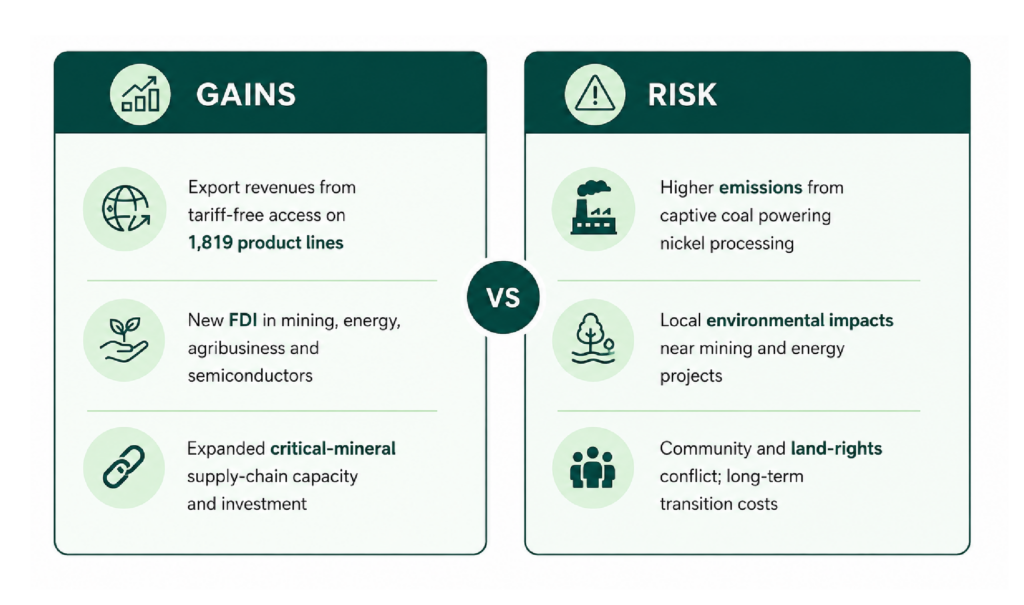
For policymakers, the ART may be presented as a strategic win. For critics, it may look like a risky trade-off. For companies, the practical question is narrower: which assumptions about tariffs, ratification, supply chains and ESG exposure are safe enough to build into business plans?
Boards should look at three layers: the commercial layer; the legal and political layer; and the ESG layer. In the commercial layer, set out real and potential tariff savings, and access to new markets. In the legal and political layer, set out the fragility of the US tariff authority underpinning the 19 percent rate; Indonesia’s pending ratification of the deal; and the possibility of renegotiation or conditional implementation.
In the ESG layer, set out how the company’s exposure to critical minerals, fossil fuels, and shifting global regulation (from consumer products to mining and power generation) aligns, or conflicts, with its climate, human-rights, and governance commitments.
The better approach is to treat the ART as a moving framework rather than a settled platform. It may generate real commercial upside, but that upside sits alongside legal uncertainty, political risk, and ESG exposure that could change as implementation develops.
7.2 A practical playbook for companies
A practical response can follow a clear, disciplined sequence.
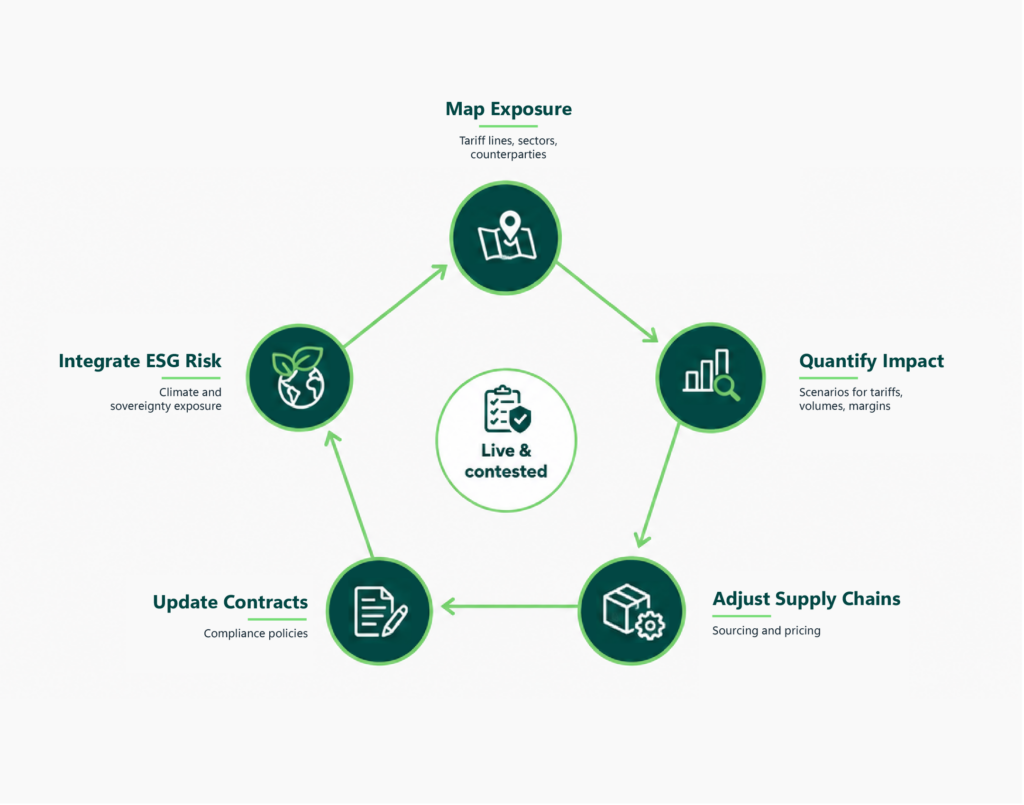
- Map exposure: Identify which tariff lines, sectors, and facilities are directly affected by the ART and its side arrangements. Quantify current and potential trade flows in both directions.2
- Model scenarios: Build at least three cases: full implementation as signed; partial or conditional ratification; and prolonged uncertainty with shifting US tariff tools. Note the impact on landed costs, margins, and capital-expenditure decisions.
- Adjust contracts and investment structures: Where feasible, include clauses that reference ratification, regulatory change, and court decisions as triggers for renegotiation or risk-sharing. Align dispute-resolution choices and stabilization provisions with this fluid backdrop.
- Strengthen ESG and human-rights due diligence: For mining, energy and agribusiness projects linked to the ART, ensure robust environmental and social impact assessments, community engagement processes, and grievance mechanisms.
- Set up monitoring: Create a simple but disciplined process to track DPR proceedings, government statements, U.S. court decisions, and ESG-related policy developments. Legal can own the process, or it can sit with a cross-functional risk committee.
Table 3. Corporate response matrix
| Function | Key Questions | Immediate Actions | Medium-term Monitoring |
|---|---|---|---|
| Legal | Is the 19% rate stable? Will ratification proceed, and on what conditions? | Track treaty and litigation status; update contracts with review triggers | Federal Register notices; DPR committee proceedings |
| Trade/Logistics | Which tariff lines and HTS codes are directly affected? | Reconfigure supply chains; manage origin and classification | New TRQ mechanisms; Section 301 exclusion lists |
| Finance | What is the realistic range of tariff outcomes to model? | Build scenarios; adjust pricing and investment hurdle rates | Currency and landed-cost exposure under each scenario |
| ESG/Compliance | Are due-diligence processes ready for expanded mining and energy exposure? | Strengthen environmental and human-rights due diligence | NGO reporting; international ESG policy shifts |
| Strategy/Board | Does portfolio positioning assume a stable, ratified ART? | Review exposure to contested sectors and geographies | Ratification outcome; MDCP and alignment developments |
8. Implementation outlook: where the agreement stands now
8.1 Legal and political scenarios
Looking ahead 12–24 months, several paths are plausible.
In the US, appeals on Section 122 surcharges will run their course. The administration has already moved to a further tool: a separate 10 percent Section 301 duty took effect on Indonesian goods on 24 July 2026, timed to the expiry of the global Section 122 surcharge.
Further trade-remedy actions remain possible. None of this automatically unwinds the ART, but it shows how leverage is being exercised and which channels are now in play.
In Indonesia, ratification is the hinge. Based on the ART’s own terms and the range of positions in current policy debate, this could in practice translate into three broad scenarios:
- Full ratification with limited safeguards.
- Ratification with explicit conditions, review clauses, and a clear hierarchy favouring regional commitments.
- Non‑ratification or a push for renegotiation of contentious provisions.
8.2 Monitoring points and strategic signals
Executives should monitor a small set of signals that will show whether the ART is moving toward full implementation, conditional implementation, or renewed uncertainty.
- DPR proceedings and any draft laws that give effect to or constrain the ART.
- New U.S. court decisions and Federal Register notices that define, narrow, or modify the tariff authority used to support the ART tariff framework.
- ESG and climate developments, both domestic and international, that could reshape the political acceptability of expanded fossil fuel and extractive projects linked to the deal.
9. Partner Perspective
“The ART is not simply a tariff-relief deal and treating it as one risks missing the bigger picture. Its real value for business lies elsewhere: new market access, room to reposition supply chains, and a signal to investors that Indonesia is opening up further to the US. But none of that value is locked in yet. Ratification in Jakarta is still pending, the US legal basis for its own tariffs remains contested, and Indonesia’s policy space is genuinely narrower under the treaty’s terms. For companies, the practical takeaway is this: treat the ART as a live opportunity, not a finished framework. That means keeping legal, political, and ESG monitoring active rather than building long-term plans on the assumption that today’s terms are permanent.”
Afriyan Rachmad, Partner
10. FAQs: Concise answers to key questions
What is the US Indonesia Trade Deal and why was it signed?
It is the Agreement on Reciprocal Trade, signed in February 2026 to avert threatened 32 percent US tariffs on Indonesian exports by fixing a 19 percent “reciprocal” rate and bundling extensive concessions by Indonesia on tariffs and non-tariff barriers, plus indicative purchases of US energy, agriculture, and aircraft.
What are the main tariff and market‑access changes under the agreement?
Indonesia will remove tariff barriers on over 99 percent of US products, while the US will maintain a 19 percent tariff on most Indonesian imports but grant zero-tariff treatment to 1,819 specific Indonesian tariff lines and establish quota-based zero-tariff access for some textiles and apparel.
How does the trade deal affect Indonesian businesses trading with the US today?
Exporters gain a clearer framework than the threatened 32 percent tariff, with improved or zero-tariff access for selected products. However, many goods still face a 19 percent levy, additional trade-remedy actions may apply, and Indonesian markets open almost fully to U.S. competitors, reshaping margins and market share.
What does the agreement mean for foreign investors and FDI strategies?
The ART signals Indonesia’s willingness to lock in far-reaching tariff and regulatory commitments to secure US access, which can attract investment in export-oriented manufacturing, mining, and energy, but asymmetry and ongoing legal and political developments make long-term certainty elusive.
Why are there concerns about sovereignty and policy space under the deal?
Indonesia takes on extensive “shall” obligations on tariffs, export restrictions, local-content rules, and digital policy, while the US offers narrower, less binding commitments; this asymmetry constrains Indonesia’s ability to pursue food security, industrial policy, and independent digital regulation.
How could the trade deal impact Indonesia’s climate and energy-transition goals?
Large commitments to facilitate US fossil fuel imports, together with expanded mining and coal-powered nickel processing, are a trend businesses should weigh against Indonesia’s own renewable energy and emissions targets.
What are the key compliance and ESG risks companies should consider?
Companies must manage origin and classification to access new tariffs, comply with evolving import and digital rules, and conduct rigorous environmental and human-rights due diligence in mining, energy, and agribusiness projects linked to the deal.
Is the US Indonesia Trade Deal legally and politically settled, or could it change?
US courts have narrowed the legal basis for the tariffs that underpinned the deal, and Indonesia has not yet completed the domestic procedures needed for the ART to take effect, so the framework remains contested and subject to change.
What practical steps should businesses take now in response to the deal?
Map exposure, model different implementation scenarios, adjust contracts and investment plans to reflect legal and political risk, and embed climate, environmental and human-rights safeguards into any project that leans on the ART’s opportunities.
About Nusantara DFDL Partnership
Nusantara DFDL Partnership (NDP) is an Indonesian law firm and a member of the DFDL network, which operates across Southeast Asia. NDP advises foreign corporations, institutional investors, and Indonesian businesses across a full suite of corporate legal services, including corporate advisory, mergers and acquisitions, foreign direct investment, joint ventures, employment law, real estate, dispute resolution, restructuring, and cross-border transactions. NDP works with clients across sectors including digital infrastructure, financial services, energy, manufacturing, and property.
Disclaimer
This article is for general informational purposes only and does not constitute legal advice. Trade, customs, investment and regulatory requirements in this area are subject to change. Readers should seek independent legal advice before making decisions based on the ART or related implementing measures.