A Shareholders’ Agreement in Indonesia is a private agreement among shareholders that governs matters such as ownership and control, funding obligations, transfer of shares, and exit arrangements. While it is legally binding on the parties, it does not, by itself, create rights or obligations that are enforceable against the company, its directors, non-signatory shareholders, or third parties. To ensure that such rights have wider corporate effect, it should be reflected into the company’s constitutional documents and implemented through the requisite corporate approvals, notarial processes, and regulatory filings.
Key Takeaways
- A Shareholders’ Agreement (SHA) is not a legal requirement under Indonesian law. Nevertheless, it is commonly adopted in joint ventures arrangements, private equity and venture capital investments, and family-owned businesses with multiple shareholder groups, because the default provisions of the Indonesian Company Law often do not adequately address the commercial terms and governance arrangements negotiated by the parties.
- A SHA binds only the shareholders who are parties to it. Rights intended to be enforceable against the company itself, such as board appointment or nomination rights, share transfer restrictions, and certain governance arrangements should generally be incorporated into the company’s Articles of Association (AoA) and implemented through the appropriate corporate procedures.
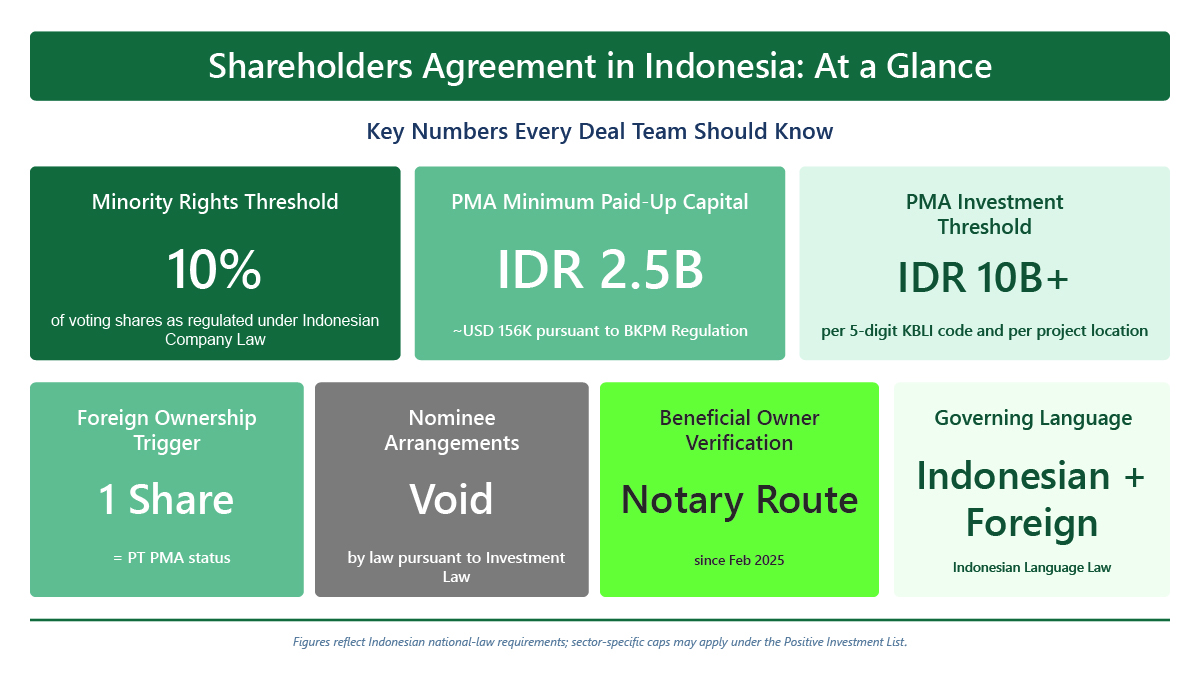
- Under BKPM Regulation, a company with even a single foreign shareholder is classified as a Perseroan Terbatas Penanaman Modal Asing (PT PMA) and is therefore subject to Indonesia’s foreign investment regime, including any applicable foreign ownership restrictions and sector-specific investment requirements.
- Nominee arrangements, under which an Indonesian individual or entity is recorded as the legal shareholder while the beneficial ownership or control rests with a foreign investor are prohibited under Investment Law and are legally null and void.
- Minority shareholders retain certain statutory protections regardless of the provisions of the SHA. These include the right to request the convening of a General Meeting of Shareholders (GMS), petition the court for a company examination, and initiate derivate actions against directors, each of which may generally be exercised by shareholders holding at least 10% of the company’s voting shares.
- Indonesia’s new Criminal Code (Kitab Undang-Undang Hukum Pidana or KUHP), which came into effect in January 2026, reclassified and renumbered the offense of document forgery. As a result, references in older legal materials and online sources may continue to cite the superseded article number.
- Language requirements under Indonesian law can affect both the validity and enforceability of an agreement. Where an Indonesian party is involved, the agreement should generally be executed in Bahasa Indonesia (or in bilingual format), and Indonesian courts have, in certain cases, held that agreements drafted solely in English are unenforceable or invalid due to non-compliance with these language requirements.
Table 1: Quick Reference for CXOs and GCs
| Question or Responsibility | CXO Focus | GC Focus |
|---|---|---|
| Who controls key decisions? | Operational control and investor protections | AoA, reserved matters, quorum and corporate implementation |
| What if more capital is needed? | Funding capacity, dilution and business continuity | Capital call, shareholder loan and default mechanics |
| Can a shareholder sell or exit? | Liquidity, price and timing | Transfer restrictions, tag/drag along, documents and approvals |
| Foreign ownership compliant? | Investment viability and business scope | KBLI, licensing and sectoral restrictions |
| What if the relationship breaks down? | Business continuity and exit | Deadlock triggers, remedies, forum and interim relief |
1. The Practical Role of a Shareholders’ Agreement in Indonesia
A Shareholders’ Agreement in Indonesia is a private agreement entered into by some or all the company’s shareholders. It exists separately from the company’s AoA and is not required to be filed with the Ministry of Law (MOL). The agreement is commonly used to supplement the statutory and constitutional framework governing the company by addressing matters such as corporate governance, shareholder funding obligations, restrictions on share transfers, exit mechanisms, and procedures for resolving deadlock situations among the shareholders.
A SHA is not mandatory under the Indonesian Company Law. In principle, the relationship among the company’s shareholders may be governed solely by the company’s AoA and the applicable provisions of the Indonesian Company Law. In practice, however, SHA is widely used in joint venture arrangements, private equity and venture capital investments and family-owned businesses with multiple shareholder groups. This is because the statutory framework and AoA often do not fully address the commercial understandings, governance arrangements, funding obligations, transfer restrictions, and exit mechanisms negotiated among the shareholders.
When does a Shareholders’ Agreement in Indonesia become essential?
- The company has two or more independent shareholder groups whose commercial interests, investment horizons or strategic objectives may not be fully aligned.
- A foreign investor is investing alongside a local partner through a PT PMA structure and requires clear defined governance, control, and shareholder protection mechanisms.
- The founders seek to establish bespoke minority shareholders protections and clearly delineate the rights, obligations and economic interests of different shareholder groups.
- The founders wish to incorporate arrangements such as vesting schedules, non-compete obligations and good/bad leaver provisions which are typically not addressed in the AoA.
- The shareholders want a clear framework for future funding requirements, liquidity events, exit arrangements and deadlock resolution before disputes arise.
- The company is planning for a future capital raise, strategic investment, trade sale, M&A or IPO and requires a governance framework that aligns with investor expectations and market practice.
| Scope of this guide: This guide focuses on private Indonesian limited-liability companies. Listed companies and businesses in regulated sectors, including banking, financial services, insurance, payments, telecoms, media, energy, and mining, may be subject to additional ownership, governance, disclosure, approval, and change-of-control requirements. |
Related Reading: Structuring a Joint Venture in Indonesia for AI and Digital Infrastructure
2. Law, AoA and Corporate Documents
The Shareholders’ Agreement is often one of the most misunderstood documents in the formation and operation of an Indonesian limited liability company (Perseroan Terbatas or PT). Many shareholders assume that the rights and obligations set out in the agreement automatically bind the company and are enforceable in the same manner as provisions contained in the company’s constitutional documents. In reality, Indonesian law draws a clear distinction between contractual arrangements among shareholders and the corporate rules that govern the company itself. Understanding the different documents involved in establishing and operating an Indonesian PT, and the legal effect of each, is therefore essential to understanding how a SHA functions in practice. The key formation documents and their respective roles are outlined below.
The Deed of Establishment (DOE) and the AoA are notarial instruments that form the constitutional basis of the company. A PT obtains legal entity status upon approval of its DOE by the MOL. Subsequent amendments to the AoA are generally divided into two categories:
- Amendments relating to fundamental corporate matters such as the company’s name, domicile, business activity or purpose, term, or authorized capital require prior approval from the MOL;
- Other corporate changes including changes to the composition of the board of directors or board of commissioners as well as certain shareholding changes and share transfers, generally only require notification to the MOL.
This distinction is important because amendments requiring approval take legal effect only after the approval process has been completed, whereas amendments that are subject to notification become effective upon the satisfaction of the relevant corporate and reporting requirements.
The DOE and AoA govern matters that must be implemented through Indonesian Company Law and formal corporate process. As the company’s constitutional documents, they underpin the company’s legal status and support the enforceability of corporate arrangements vis-à-vis the company and, in many cases, third parties. However, whether a specific restriction or right is enforceable against a specific third party will depend on factors such as the nature of the restriction applicable registration or disclosure requirements, and whether the third party has notice of it. GMS and board resolutions are then used to implement specific corporate actions and decisions authorized under the AoA. The share register serves as the company’s official record of share ownership. By contrast, a SHA is a private contractual arrangement that binds only those shareholders who have agreed to its terms and does not, by itself, create rights enforceable against the company or non-signatories.
The distinction is important because it determines the remedy available for a breach of a SHA. Under Articles 1320 and 1338 of the Indonesian Civil Code, a valid agreement is binding on its parties and enforceable as a contract. Accordingly, a SHA is generally enforceable provided it does not contravene mandatory provisions of the Indonesian Company Law or public order. However, a breach of the SHA does not automatically invalidate a corporate action that has been validly passed under the AoA and the Indonesian Company Law. Instead, the affected shareholder will typically have a contractual claim against the breach, rather than a right to overturn the corporate action itself. Different considerations may apply where the corporate act also violates mandatory law, the AoA, or the statutory duties of directors or commissioners.
Should the company itself be a party to the Shareholders’ Agreement? Including the company as a party to the SHA can support company-level obligations, such as information rights, confidentiality commitments, and operational covenants are binding on the company itself. However, it does not substitute AoA amendments, GMS or board approvals, notarial actions, share register updates, or regulatory filings. Those steps must still be completed separately to give the agreed arrangements corporate effect.
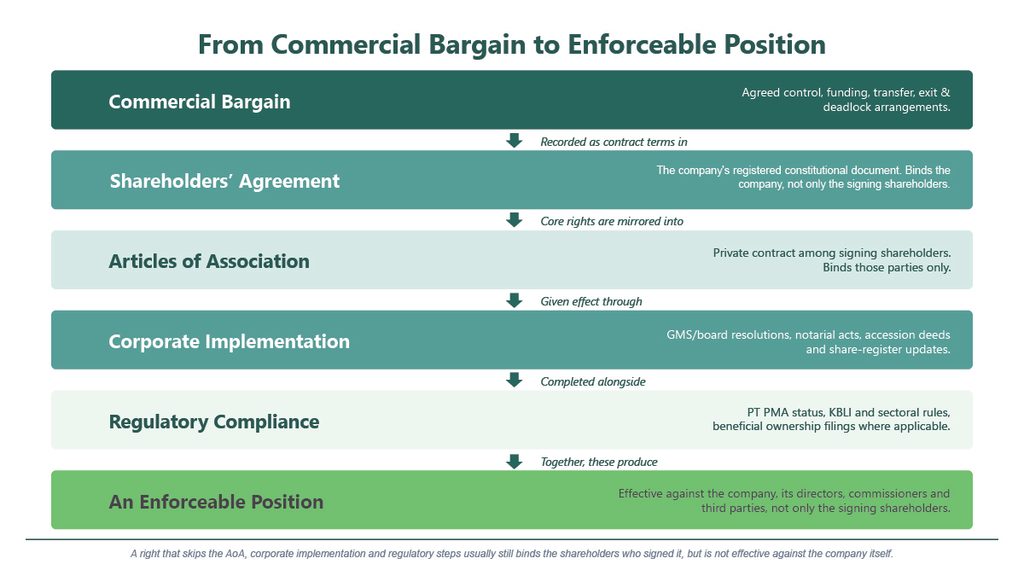
Whether negotiated protection is enforceable often depends on where it is documented.
Table 2: Where Should This Protection Sit?
| Protection | Sits in the SHA | Also in the AoA | Also Require Further Corporate Action |
|---|---|---|---|
| Confidential commercial terms | Primary home | Generally, no | Generally, no |
| Reserved matters and veto rights | Yes | Yes, for the core list | GMS or board resolution |
| Board and commissioner nomination rights | Yes | Often, to bind the company, | GMS appointment resolution |
| Transfer restrictions | Yes | Generally, essential | Share register, notification to MOL |
| Tag-along and drag-along | Yes | Consider AoA support | Transfer deed, accession instrument |
| Founder non-compete and vesting | Yes | Generally, no | Separate service or employment agreement |
A well-drafted SHA addresses these issues from the outset and is structured to align with the AoA, rather than attempting to reconcile the two documents after the fact.
Illustration: Assume two shareholders agree that any related-party transaction above a specified threshold requires unanimous board approval, but that requirement is not reflected in the AoA or an equivalent board charter. The company may still approve the transaction through its ordinary corporate process. In that case, the affected shareholder’s remedy will generally be contractual against the parties that breached the SHA while any claim against the directors or commissioners will depend on the Indonesian Company law.
For this reason, the SHA and AoA should be negotiated and implemented together, not treated as a separate exercise.
| Example: A Singapore investor acquires a 40% stake in an Indonesian operating company. The SHA grants director nomination right, budget approval rights, and tag-along rights. If these rights are not reflected in the AoA and implemented through the required corporate actions, the investor may have a contractual claim but may unable to challenge an otherwise valid corporate action. The SHA, AoA, GMS approvals, appointment mechanics, share-register actions, and accession arrangements should therefore be aligned from the outset. |
| Practical action: For each negotiated protection, identify whether it requires implementation through the AoA, or requires a GMS resolution, a notarial deed, a share register update, or a regulatory filing to be effective. |
3. Before Drafting a Shareholders’ Agreement in Indonesia: The Deal Design Questions
A SHA can only capture what the shareholders have already agreed in principle. Key issues such as control, funding, and exit arrangements must be settled before drafting. If they have not, the agreement will merely leave those issues unresolved, increasing the likelihood that they become points of connection once a disagreement arises.
As a preliminary step to drafting the SHA, it is necessary to consider and resolve the following foundational questions.
- What is each party contributing: capital, assets, intellectual property, licenses, distribution access, or personnel?
- What role will each party play in the management and decision-making of the company? Will any party have the right to veto or otherwise restrict certain decisions?
- Whether the company is being established as a new joint venture, an acquisition vehicle, a family-owned business, or an investment target?
- What will happen if the business underperforms or requires additional funding beyond the original plan?
- Whether the anticipated exit strategy is a trade sale, a founder buyout, a sponsor-led sale, or an IPO?
- Which foreign ownership, licensing, and sector-specific (KBLI) restrictions are applicable to the business?
- Which protections should be reflected in the AoA, notarial deed, shareholders’ resolution, employment or service agreements, intellectual property licenses and share pledges arrangements?
Without alignment on these issues, the SHA is likely to become little more than a collection of ‘standard’ provisions that do not adequately address the parties’ specific commercial risks. The SHA should also be coordinated with other transaction documents, including the share purchase agreement, subscription agreement, investment agreement and the related provisions on conditions precedent, completion mechanics, warranties, disclosures, and purchase price. Its primary purpose, however, is to govern the relationship among the shareholders and the operation of the company following completion.
Related Reading: When Commercial Contracts Fail: Common Structural Gaps That Trigger Disputes in Indonesia
4. Validity, Language and Execution
Contractual validity: A Shareholders’ Agreement is enforceable under Indonesian law provided it satisfies the requirements set out in Article 1320 of the Civil Code: mutual consent, legal capacity, a definite subject matter, and a lawful cause. Consistent with Article 1337 of the Civil Code, an agreement will be void if its purpose or cause contravenes law, public order or morality. This principle likewise underpins the invalidity and unenforceability of nominee arrangements as discussed in Section 11.
Governing language: Indonesia Language Law requires agreements involving an Indonesian party to be executed in Bahasa Indonesia, while permitting a bilingual version where a foreign party is involved. Although later cases and the 2019 implementing regulation have taken a more flexible approach following PT Bangun Karya Pratama Lestari v. Nine AM Ltd, the prudent practice remains to execute a SHA in both Bahasa Indonesia and the relevant foreign language
The agreement should also specify which language version prevails in the event of any inconsistency, taking into account the likely dispute resolution forum and its working language. A prevailing-language clause, however, does not substitute the need for a properly drafted and executed Bahasa Indonesia version.
Execution and instrument mapping: While notarization of a Shareholders’ Agreement is not mandatory in Indonesia, it can enhance its evidentiary value in the event of a dispute. More importantly, parties should identify, on a clause by clause basis, the instrument required to give effect to each right or obligation, whether through an amendment to the AoA, a notarial deed, a GMS or board resolution, an entry in the share register, a regulatory filing, or an accession deed for a new shareholder. This exercise helps ensure that rights documented in the SHA are properly reflected in the corporate records and instruments through which the company or third parties recognize and enforce them.
| Practical action: Execute the Bahasa Indonesia and foreign-language version contemporaneously, rather than treating the Indonesian version as a later translation and clearly specify which version shall prevails in the event of any inconsistency. |
Related Reading: Enforcing Foreign Arbitral Awards in Indonesia: A Practical Guide for Boards and GCs
5. Governance, Control and Minority Protection
Board composition: The Shareholders’ Agreement in Indonesia should define each shareholder’s right to nominate members of the Board of Directors and the Board of Commissioners. Given Indonesia’s two-tier governance structure, commissioners appointments are often as significant as directors appointments particularly from the perspective of minority shareholders seeking oversight and protection of their interests.
Reserved matters: Certainkey decisions are commonly designated as “reserved matters” and require unanimous or enhanced shareholder approval. Typical examples are as follows:
- Approval of the annual budget
- Entry into material contracts
- Incurrence of significant indebtedness
- Changes to the company’s principal business activities
To ensure enforceability against the company, the applicable approval threshold for reserved matters should also be reflected in the AoA and implemented through duly adopted resolutions of the GMS, Board of Directors or Board of Commissioners, as applicable.
| Practical action: Ensure that every reserved matter and related approval or quorum threshold agreed in the SHA is also incorporated into the AoA before it is treated as binding on the company. |
GMS quorum and voting: The Indonesian Company Law prescribes the quorum and voting requirements for GMS. Unless otherwise provided by law or the AoA:
- An ordinary resolution require the attendance of shareholders representing more than half of voting shares and approval by more than half of the votes cast.
- Amendments to the AoA require a quorum of at least two-thirds of voting shares and approved by at least two-thirds of the votes cast.
- Mergers, acquisitions, spin-offs, dissolutions and extension of the company’s term require a quorum of at least three-quarters of voting shares and approval by at least three-quarters of the votes cast
These statutory thresholds may be increased but not decreased. Where a SHA prescribes a higher approval threshold for a particular matter, that threshold should also be reflected in the AoA to be binding on the company
Information rights: A SHA may grant shareholders who are not represented on the Board of Directors additional information and reporting rights beyond those provided under the Indonesian Company Law. Such rights may include access to management reports, financial information, budgets, and other operational updates.
The statutory floor: Indonesian Company Law grants shareholders holding at least one-tenth (10%) of voting shares certain statutory rights and remedies regardless of the terms of the SHA.
Table 3: Statutory Minority Rights at a Glance
| Right | Threshold |
|---|---|
| Request a GMS | 10% of voting shares |
| Petition for court-ordered company examination | 10% of voting shares |
| Bring a derivative claim against directors | 10% of voting shares |
| Bring a derivative claim against commissioners | 10% of voting shares |
| Require the company to buy back shares at fair value | Any shareholder |
These statutory rights represent a baseline level of protection and thus do not preclude shareholders from negotiating additional rights in the SHA. The agreement should be drafted on the assumption that minority shareholders may exercise both their statutory rights and aby enhanced contractual rights granted under the agreement.
Related Reading: Corporate Governance Dispute: Director Removal in Indonesia
6. Funding, Distributions and Economic Protections
Funding obligations: The Shareholders’ Agreement in Indonesia should establish the framework for future funding, including whether capital will be provided through pro-rata equity contributions, shareholder loans, third-party financing or a combination of these. It should also clearly address the consequences of a shareholder who does not participate in a funding round such as dilution, default interest, reduced allocation or other agreed remedies. As the allocation of economic and governance consequences can vary significantly depending on the drafting, the rights and obligations of both the defaulting shareholder and the non-defaulting shareholders should be clearly defined.
Distributions: Shareholders often have different liquidity expectations and investment horizons. The Shareholders’ Agreement should therefore establish a clear dividend policy including how profits are allocated between distributions and retained earnings. Any distribution provisions should be subject to the requirements of the Indonesian Company Law, the company’s financial position, and the approvals required for a valid dividend declaration.
Anti-dilution and valuation: Where different share classes carry distinct economic rights, the agreement should clearly define the following scope:
- anti-dilution protection
- valuation of shares in the event of dispute including:
- appointment of an independent valuer;
- valuation methodology and assumptions;
- relevant valuation date;
- application of any discounts or premiums; and
- responsibility for valuation cost.
Capital structure and share classes: Private equity and venture capital deals frequently involve multiple classes of shares, each class can carry different rights relating to voting, dividends, conversion, dilution, or participation in employee equity plans. These rights should be clearly reflected in both the AoA and the SHA to ensure they are effective and enforceable. Where the parties agree on a liquidation preference, the agreement should specify the order and amount of distributions upon a sale, liquidation or winding-up of the company, with drafting tailored to the requirements of Indonesian Company Law rather than relying on standard-form provisions.
Shareholder loans and security: In addition to capital contributions, additional funding may be provided by way of shareholder loans, third-party financing or a combination of both. The SHA should address the terms of any shareholder loans including repayment priority, interest and any conversion rights. Further, the consequences of a default by a shareholder to meet its funding commitment(s) and any restrictions on the granting of guarantees, the creation of security interests over company assets and the pledging of shares should also be clearly set out. These provisions can significantly affect both the economic position of shareholders and the balance of control within the company particularly where one shareholder has substantially greater financial resources than the others.
Company repurchases: A company’s repurchase of its own shares is subject to capital protection requirements of the Indonesian Company Law and should be distinguished from shareholder-to-shareholder transfers, put or call arrangements, third-party sale processes, and IPO exits, each of which is governed by a different legal framework. Parties should not assume that the company can simply acquire a departing shareholder’s shares as a contractual exit mechanism.
Funding, distributions, shareholder loans, share transfers, and exit rights should be assessed for their Indonesian tax implications, including withholding tax obligations and transfer pricing considerations where transactions involve related parties.
7. Share Transfers, Dilution and Liquidity Rights
Under Indonesian Company Law, existing shareholders generally have a pre-emptive right to subscribe for newly issued shares on a pro rata basis before they may be offered to third parties. This right is subject to exceptions permitted by the AoA or a GMS resolution, such as employee share schemes or debt-to-equity conversions. By contrast, transfer restrictions such as rights of first refusal or first offer, apply where an existing shareholder proposed to transfer shares to a third party. Because pre-emptive rights govern new issuances by the company, while transfer restrictions govern secondary transfers between shareholders and third parties, the two concepts should be clearly distinguished in the drafting.
A contractual right of first refusal should be supported by clear procedural mechanics to ensure it is workable and enforceable in practice: a defined notice process, an agreed valuation methodology and a specified period within which the recipient must respond. Where the transfer restriction is intended to bind not only the contracting shareholders but also the company and future shareholders, it should be reflected in the AoA as well as the SHA.
Transfer provisions commonly address change of control events at the shareholder level including the sale of a shareholder’s parent company, indirect transfers through holding structures, creation of encumbrances such as share pledges, and transfers by operation of law such as inheritance.
Tag-along rights allow a minority shareholder to participate in a sale by the majority on the same terms while drag-along rights enable a majority shareholder to compel a minority shareholders to sell to a third-party purchaser. These are typically paired with minority protections such as a minimum price, equivalent consideration and warranty treatment, and sufficient notice to assess the transaction. IPO provisions, meanwhile, address the consequences of a listing, including the conversion of share classes and the removal of transfer restrictions.
8. Founder, Management and Related-Party Protections
Founder and management terms: For founder-led and growth-stage companies, the Shareholders’ Agreement in Indonesia and related employment/service arrangements commonly cover non-compete, non-solicitation, and confidentiality obligations, vesting or reverse vesting arrangements, good-leaver and bad-leaver provisions, and key-person succession planning. Vesting mechanism typically link a founder’s full economic entitlement to continued service over a specified period, with unvested shares reverting to the company, or being transferred at a predetermined price, if the founder departs early. Good-leaver and bad-leaver provisions then determine the treatment and pricing of those shares, making it important to distinguish clearly between voluntary departures, agreed exits, and terminations for cause. It should also ensure that intellectual property core to the business is validly owned by or licensed to the company rather than retained by a founder personally.
Related-party transactions: Related-party arrangements can transfer value within a corporate group through management fees, procurement arrangements, shareholder financing, or IP licenses involving affiliates. The SHA should establish approval and procedures for related-party transactions including recusal requirements, transfer pricing and affiliate service arrangements, and independent valuation or approval material transactions.
Parties and accession: The shareholders’ agreement in Indonesia should specify whether the company itself is a party and if not the implications of its non-participation. It should also require every new shareholder and transferee to sign a deed of adherence as a condition to acquiring shares. Where ownership and decision-making sit within different entities in a corporate group, the SHA should allocate rights and obligations among the relevant parent, shareholder, and operating-company entities.
9. Deadlock, Default and Remedies
A deadlock occurs when the shareholders or the Board of Directors are unable to obtain the necessary votes for a decision that is material to the company’s operation. Deadlock can disrupt key matters such as budgeting, financing and management decisions. To minimize uncertainty and avoid unnecessary disputes, the events that constitute deadlock should be defined as narrowly, clearly and objectively as possible.
Deadlock provisions are most effective when tied to specific, objectively defined reserved matters requiring board or shareholder approval. A deadlock should arise only where the relevant matter fails to obtain required approval at two consecutive meetings or after another clearly defined process. By contrast, a broadly framed concept such as a general breakdown in the parties’ relationship is inherently subjective, more prone to dispute and more susceptible to opportunistic invocation. A narrowly drafted trigger provides greater certainty and is easier to apply in practice.
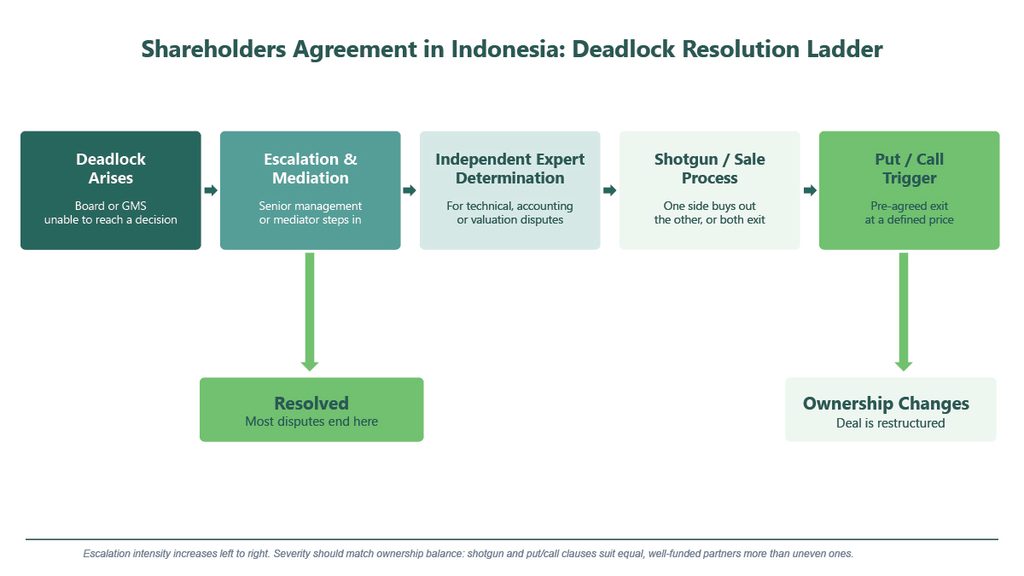
Table 4: Deadlock Mechanisms and When They Fit
| Mechanism | Best Suited To | Main Caution |
|---|---|---|
| Escalation and mediation | Any structure, as a first step | May delay rather than resolve a fundamental disagreement |
| Independent expert determination | Technical, accounting, or valuation disputes | Not well suited to strategic disagreements |
| Shotgun / Russian roulette | Genuinely equal, similarly funded 50:50 partners | Can be coercive if one side has weaker funding capacity |
| Sale process or auction | Shareholders willing to exit | Require robust transfer and valuation mechanics to work |
| Put or call option | Clearly defined default or trigger events | Pricing and enforceability need careful drafting |
| Practical action: Deadlock resolution mechanism should reflect the parties’ relative ownership and financial resources. In particular, a shotgun clause may give a better-capitalized shareholder significant advantage in determining the exit outcome. |
Remedies: The shareholders’ agreement in Indonesia should identify the remedies available for breach, including damages, specific performance, and interim relief. It should also address the consequences of a prohibited transfer, any suspension of rights for a defaulting shareholder and practical limits of compelling shareholder or board action. Where a share transfer via power of attorney is used as an enforcement mechanism, its effectiveness should be assessed under Indonesian law and reflected in the drafting.
Related Reading: Corporate Fraud in Indonesia: Remedies and Asset Recovery for Foreign Investors
10. Term, Termination, and Survival
A Shareholders’ Agreement in Indonesia should state when it takes effect, the circumstances in which it terminates, and which obligations survive termination. Events such as a share sale, IPO, winding-up, or a reduction to a single shareholder will often bring governance and transfer provisions to an end while confidentiality, dispute resolution, and accrued payment obligations typically continue. The agreement should also clearly regulate amendments and waivers, particularly where minority-protection rights are intended to require the consent of the affected shareholder rather than approval by a simple majority.
11. Dispute Resolution and Enforceability
The default forum for disputes is the Indonesian court system. However, many Shareholders’ Agreement in Indonesia opt for arbitration instead, commonly under the rules of the Indonesian National Board of Arbitration (BANI), Singapore International Arbitration Centre (SIAC), or International Court of Arbitration (ICC) with the arbitration process governed and enforced within the framework of Indonesian Arbitration Law.
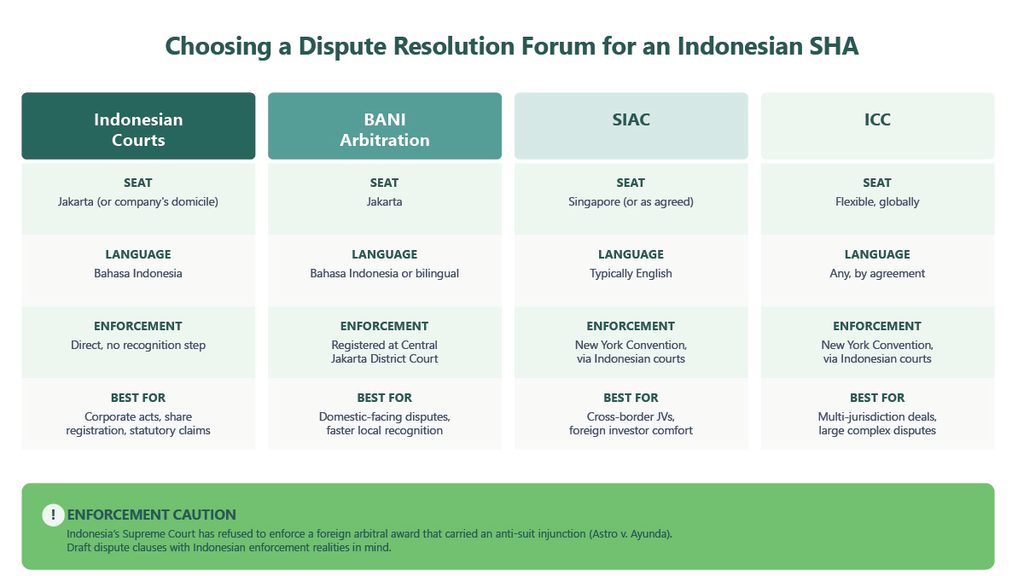
The choice of forum should first be assessed by reference to the jurisdiction in which the company’s principal assets are located as that is likely to be the jurisdiction where enforcement of any judgment or award will ultimately be sought. Nevertheless, other key considerations include the seat of proceedings, language of proceedings, degree of confidentiality, cost, and availability of urgent or interim relief.
A drafting point worth keeping in mind is the enforcement risk associated with certain forms of relief in Indonesia. In the dispute between Astro All Asia Networks and PT Ayunda Prima Mitra, the Indonesian Supreme Court declined to enforce a SIAC award that included an anti-suit injunction arising from a failed joint venture under a Subscription Agreement and SHA. The court held that the injunction violated Indonesian public policy and interfered with an ongoing proceeding before the Indonesian courts. While arbitration remain an effective dispute resolution mechanism for transactions involving Indonesia, the case illustrates the importance of considering not only the arbitration clause itself but also the types of relief that may ultimately be sought and enforced in Indonesia. Anti-suit injunctions, in particular, present a meaningful enforcement risk and should be approached with caution at the drafting stage rather than after a dispute has arisen.
Whatever forum is chosen, certain matters including share registration, validity of GMS, and specific statutory corporate remedies remain subject to Indonesian corporate law and may require recourse to the Indonesian courts notwithstanding an agreement to arbitrate disputes offshore.
Interim relief warrants separate consideration from the forum selected to resolve the underlying dispute. A shareholder seeking to restrain an imminent GMS or prevent the transfer of shares pending the outcome of an arbitration may require immediate relief, and emergency arbitrator mechanisms offered by the arbitral institutions do not always translate into readily enforceable measures in Indonesia. In situation where urgency is critical, a SHA sometimes preserves a limited right for parties to seek interim injunctive relief from the Indonesian courts even though the substantive dispute is otherwise subject to arbitration. Any carve-out should be carefully and expressly drafted, as a broadly worded arbitration clause may otherwise be interpreted as excluding court involvement altogether.
Listen: Arbitration in Indonesia, What You Need to Know (Podcast)
12. For Foreign Investors: Nominee Risk and Beneficial Ownership
Under BKPM Regulation, a company with even a single foreign shareholder, whether an individual, a foreign entity, or another PT PMA, is generally classified as a PT PMA. It must therefore comply with Indonesia’s foreign investment regime, including any foreign ownership restrictions and sector-specific requirements applicable to the relevant KBLI classification and business activity. As a result, even a minority foreign shareholding can alter the company’s regulatory status and compliance obligations notwithstanding that operational control remains with Indonesian shareholders.
Table 5: PMA Regulatory Considerations at a Glance
| Requirement | Figure |
|---|---|
| Minimum paid-up capital | IDR 2.5 billion |
| Minimum total investment commitment | More than IDR 10 billion per KBLI code per project location |
| Foreign ownership trigger | One foreign shareholder |
| Lock-up of paid-up capital | 12 months from placement, limited exceptions |
| Sector-specific ownership caps | Varies by KBLI |
The 12-month lock-up has important treasury implications: during that period, paid-up capital must remain within the company and may only be deployed for asset acquisitions, construction activities, or the company’s operational needs.
Current-law note: the information above reflects the legal and regulatory position as verified in September 2026. Foreign investment requirements may differ depending on the relevant KBLI classification, business sector, and transaction structure, and are subject to change through subsequent regulation or guidance. Accordingly, the applicable requirements should be reconfirmed before implementation.
The nominee arrangement trap. Some investment structures seek to circumvent foreign ownership restrictions by registering an Indonesian party as the legal shareholder of while the foreign investor retains beneficial ownership of effective control through side agreements. Such arrangements constitute nominee structures and are expressly prohibited under Investment Law. As a matter of law, a prohibited nominee arrangement is null and void with the effect that it is treated as though it never existed. Foreign investors should therefore not assume that transfer-back provisions, call options, declarations of trust, power of attorney or similar side arrangement will be enforceable to secure ownership or control of the shares. While separate claims based on fraud, unjust enrichment, or other independent causes of action may be available in particular circumstances, they do not cure the underlying invalidity of the nominee arrangement or serve as a substitute for a compliant investment structure. This position is further reinforced by the Indonesian Company Law.
Depending on how it is implemented, a nominee arrangement may also raise potential exposure under Indonesia’s new Criminal Code. The provisions concern the making or use of forged documents that create, amend or evidence legal rights or obligations, and its relevance will turn on whether inaccurate ownership declarations or fabricated documents were used to support the arrangement. Since the new code took effect on 2 January 2026, references in older commentary should be treated with care. The existence of a nominee arrangement alone does not necessarily establish document forgery; any criminal liability will depend on the particular facts, documentation, and conduct involved.
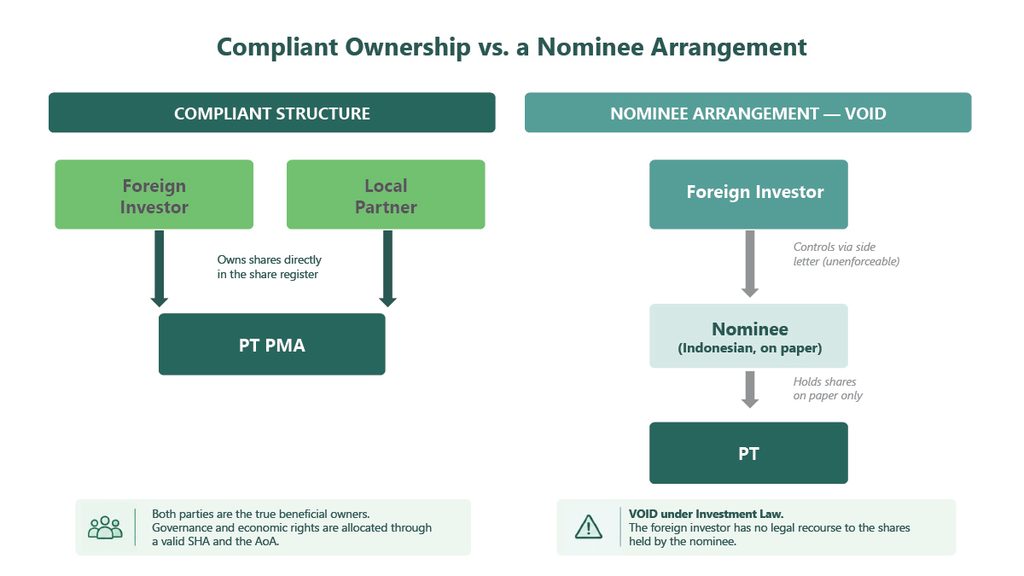
A legitimate Shareholders’ Agreement in Indonesia can afford a minority investor extensive control and protection rights while preserving transparency as to share ownership. The distinction is that a nominee arrangement uses the registered shareholder to conceal the identity of the true beneficial owner or the person actually exercising the rights attached to the shares.
| Practical action: Before relying on a local partner’s shareholding, confirm that the arrangement is not a de facto nominee structure and that the company’s beneficial ownership filings match the true owners and controllers of the shares. |
Beneficial ownership verification: Indonesia has moved beyond the previous self-declaration regime for beneficial ownership reporting. Beneficial ownership disclosures are now subject to active verification through notaries and cross-checking by the Directorate General of General Legal Administration, tax authority, and Financial Transaction Reports and Analysis Center (PPATK). Inaccurate, incomplete or misleading disclosures may result in administrative sanctions. Beneficial ownership compliance is therefore not a one-time incorporation formality. It should be reviewed and updated whenever there is a change in the company’s ownership or control structure.
For foreign investors who are unable or unwilling to hold shares directly, the compliant solution is a properly structured PT PMA with a bona fide local shareholder and a carefully negotiated Shareholders’ Agreement that transparently allocates governance and economic rights. It is not a nominee arrangement disguised as a legitimate investment structure.
13. Implementation Checklist
- Verify the identity of each shareholder, confirm the company’s ultimate beneficial owners, and ensure that all signatories have the requisite authority to act.
- Confirm PT PMA status, applicable KBLI classification, licensing position, and any foreign investment restrictions relevant to the sector.
- Identify any provisions that must be reflected in the AoA to ensure they are enforceable against the company.
- Obtain all required GMS and board approvals/resolutions.
- Execute the Bahasa Indonesia and foreign language versions contemporaneously, with a clear agreement on the choice of prevailing language in the event of inconsistency.
- Secure all necessary signatures, powers of attorney, accession deeds and spousal consents (where applicable).
- Update the shareholder register, corporate records documentation and all relevant beneficial ownership disclosures and filings.
- Make any statutory filings, notifications or registrations required to implement the agreed arrangements.
- Put in place any related documentation needed to support the transaction including IP assignments or licenses, founder employment arrangements, shareholder loan agreements, service agreements and share transfer instruments.
- Schedule a legal review whenever there is a financing round, a new investor, a change in business activities or KBLI classification, a proposed exit transaction, or a change in the company’s beneficial ownership structure.
In Indonesia, the effectiveness of a SHA is not measured by how well it records the parties’ commercial understanding, but by how successfully it converts that understanding into rights and obligations that can be implemented and enforced under Indonesian Company Law, investment regulations, language requirements, and corporate governance rules.
Talk to NDP’s Corporate Advisory team about structuring or reviewing a SHA for your next transaction.
Partner Perspective
“A Shareholders’ Agreement in Indonesia complements the AoA by setting out commercial arrangements among shareholders, including governance, funding, transfer rights, and exit mechanisms. Its value lies in ensuring alignment between the shareholders’ deal and the company’s constitutional documents, while providing a clear framework that helps prevent future disputes.” – Jade Hwang
14. Frequently Asked Questions
1. What is a Shareholders’ Agreement in Indonesia?
A Shareholders’ Agreement in Indonesia is a private contractual arrangement entered into by some or all of a company’s shareholders to regulate matters such as governance, funding commitments, share transfer restrictions, deadlock resolution and exit rights. It operates alongside but is distinct from the company’s AoA, which governs the company’s internal affairs and are publicly registered.
2. Is a Shareholders’ Agreement legally binding and enforceable in Indonesia?
Yes. SHA is generally enforceable between the shareholders who sign it, provided it satisfies the Civil Code’s requirements for a valid contract. It does not, however, automatically bind the company or third parties unless its provisions are also reflected in the AoA and implemented through proper corporate procedures to be fully effective.
3. What law governs a Shareholders’ Agreement in Indonesia?
A SHA in Indonesia is fundamentally a contract and is therefore governed by the Indonesian Civil Code. Its effectiveness, however, is shaped by Indonesian Company Law, which sets the mandatory corporate governance rules that cannot be displaced by private arrangements. As a result, a well-drafted SHA should be structured to complement, rather than contradict, the company’s AoA and applicable corporate law requirements.
4. What should a Shareholders’ Agreement in Indonesia include?
At minimum: key decisions, how the business will be funded, when and to whom shares can be transferred, how shareholder disputes will be resolved, and how investors can exit. Foreign investment arrangements generally require additional provisions on beneficial ownership disclosures, compliance with investment regulations, and confirmation of the parties’ genuine ownership and control arrangements.
5. Is a Shareholders’ Agreement required for an Indonesian company?
No. That said, it is standard in most joint venture and investment transactions because the default rules under the Indonesian Company Law rarely capture the full commercial bargain agreed between the shareholders.
6. What is the difference between a Shareholders’ Agreement and AoA in Indonesia?
The AoA is the company’s registered constitutional document and forms part of its formal corporate governance framework. A SHA is a separate private agreement among the shareholders that records their commercial arrangements and binds only those parties that have signed it.
7. Can foreign investors use a Shareholders’ Agreement in Indonesia?
Yes. It is widely used by foreign investors and is a standard feature of most PT PMA joint ventures and investment transactions. They are particularly important for defining governance arrangements, investor protections, exit rights and other commercial terms that sit alongside Indonesia’s foreign investment and corporate law requirements.
8. Can a Shareholders’ Agreement in Indonesia override a company’s AoA?
No. A SHA cannot, by itself, override the AoA as against the company or third parties. Provisions that are intended to bind the company, such as reserved matters or share transfer restrictions, should generally also be reflected in the AoA and implemented through the required corporate formalities.
9. Does a Shareholders’ Agreement need to be notarized in Indonesia?
No. Notarization is generally optional rather than mandatory. Nevertheless, a notarized SHA may carry greater evidentiary weight if the agreement is later challenged or becomes the subject of litigation.
10. Is an English-only Shareholders’ Agreement valid in Indonesia?
An English-only SHA is not automatically invalid, but it carries avoidable legal risk under Indonesia’s language law framework. The safer and more commonly adopted approach is to execute bilingual Bahasa Indonesia and foreign-language versions simultaneously, with a clear prevailing-language clause.
About Nusantara DFDL Partnership
Nusantara DFDL Partnership (NDP) is an Indonesian law firm and a member of the DFDL network, which operates across Southeast Asia. NDP advises foreign corporations, institutional investors, and Indonesian businesses across a full suite of corporate legal services, including corporate advisory, mergers and acquisitions, foreign direct investment, joint ventures, employment law, real estate, dispute resolution, restructuring, and cross-border transactions. NDP works with clients across sectors including digital infrastructure, financial services, energy, manufacturing, and property.
Disclaimer
This article is for general informational purposes only and does not constitute legal advice. Regulatory requirements in this area are subject to change. Readers should seek legal advice before taking steps to restructure, merge, transfer, dissolve, or otherwise reorganise an Indonesian entity or group.