Key Takeaways
- On 21 July 2026, Indonesia’s House of Representatives (DPR) approved the bill establishing the Pusat Finansial Internasional Indonesia (PFII), Indonesia’s International Financial Center. Formal promulgation remains pending for confirmation.
- The PFII framework establishes dedicated institutions for policy, administration, supervision, arbitration, and court-based dispute resolution. These reportedly include a Governor, an Advisory Council, the PFII Council, a Management Authority, a Financial Services Supervisory Authority, an Arbitration Institute, and a specialist PFII Court.
- English is permitted for specified PFII regulations, contracts, legal proceedings, and court judgments, subject to the precise scope set out in the law and its implementing regulations. This represents a notable departure from the existing Indonesia’s language requirements.
- Eligible businesses carrying out qualifying activities may benefit from the corporate income tax incentives of up to 100% exemption for a period of up to 50 years. However, the maximum incentive period is not applicable to all sector, activity or professional category.
- The global minimum tax regime remains applicable. Multinational enterprise groups with consolidated annual revenue at or above EUR 750 million remain subject to a 15% minimum effective tax rate irrespective of PFII residency. Indonesian authorities have confirmed this position.
- Bali is currently regarded as the frontrunner location for the PFII. However, the law permits the government to establish more than one PFII zone.
- As at the date of this article, many key operational aspects including eligibility requirements, scope of the covered sectors, incentive mechanics, and final location of the PRII remain subject to further clarification through forthcoming Government Regulations and Ministry of Finance Regulations.
Key Takeaways from the PFII Framework
Up to 50 Years
Maximum corporate tax relief period available under the PFII framework for qualifying activities
21 Jul 2026
Date the PFII framework was approved by Indonesia’s DPR
73 Articles
Scope of the PFII framework approved by the DPR, across 10 chapters
15%
Global minimum tax floor (GMT/Pillar Two) for in-scope multinational groups
Indonesia Approves a Dedicated International Financial Center Framework
On 21 July 2026, Indonesia’s DPR approved legislation establishing the PFII. The legislation is a dedicated statutory framework comprising of 10 chapters and 73 articles, establishing specialist institutions and dispute-resolution mechanisms. Most importantly, it also introduces a range of incentives to attract qualifying participants to set up in the PFII. For ease of reference, this article refers to the legislation as the PFII framework. The legislation has not yet formally come into force. Presidential assent and publication in the State Gazette are required before it becomes legally effective. Until then, references should be made to the official legislative record.
There are four key features of the PFII framework which is likely to be of particular interest to sophisticated investors. First, it permits foreign-currency business activity. Second, English is made usable for specified legal documents and proceedings. Third, it establishes specialist institutions for international financial services business. Fourth, it offers a fiscal incentive package whose duration is notable by regional standards.
At present, the PFII is not yet operational. Significant work remains to be done through implementing regulations particularly eligibility criteria, covered sectors, incentive availability and duration, and the location(s) of PFII. Investors, financial institutions and businesses with exposure to Indonesia including those currently using vehicles in Singapore, Labuan or other offshore financial centers should closely monitor development and evaluate the potential implications of the PFII as greater regulatory clarity emerges.
Indonesia’s PFII: Why Now
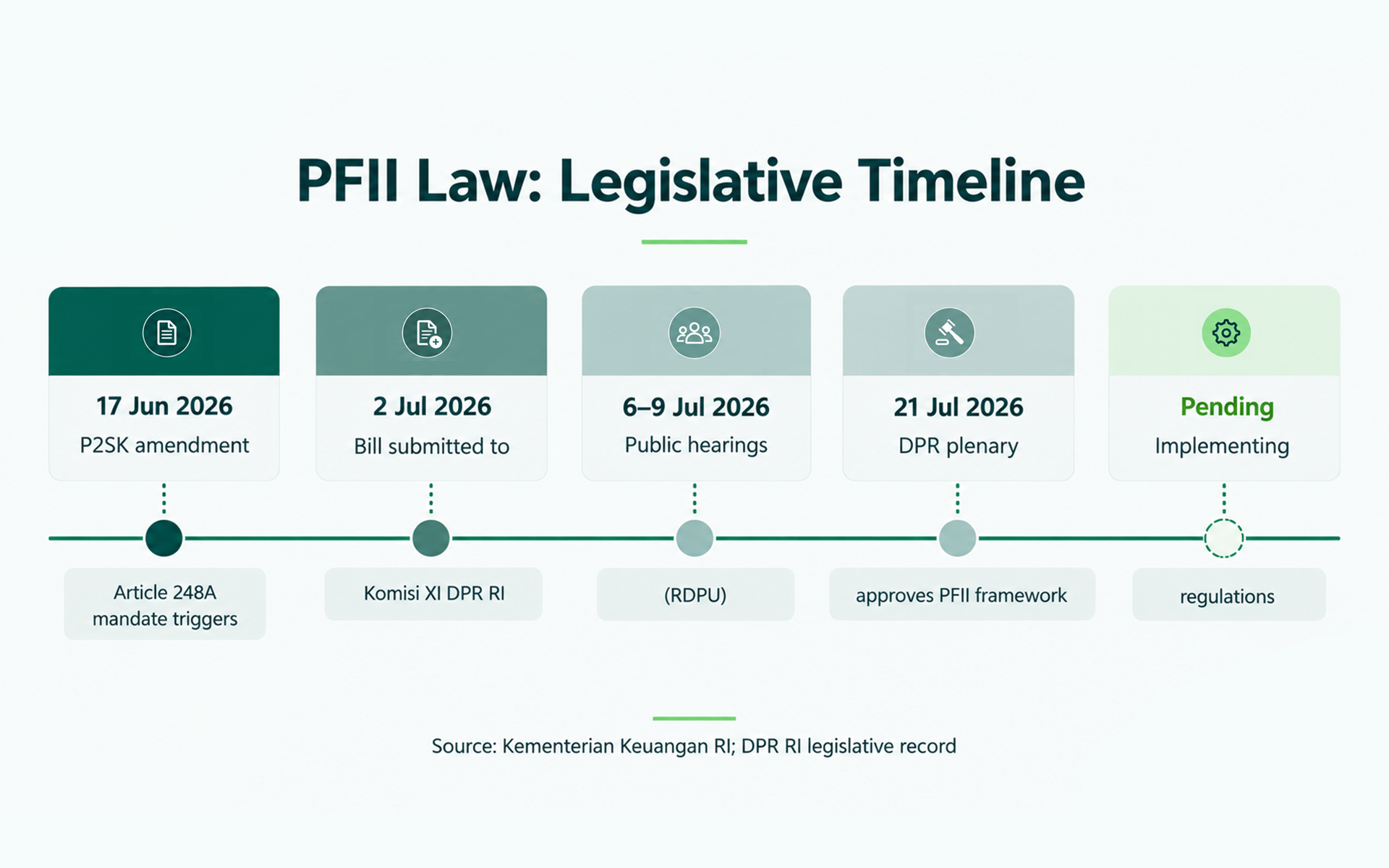
Article 248A of Law No. 4 of 2026, which amended Indonesia’s Financial Sector Development and Strengthening Law (UU P2SK) provides the legal basis for the framework. The amendment, enacted 17 June 2026, mandate the government to enact a standalone law establishing an International Financial Center framework within three months.
The Ministry of Finance has framed the initiative as part of a broader objective: deepening Indonesia’s capital markets, attracting higher-value financial intermediation, structuring and asset management, and capture economic value that currently flows to financial hubs such as Singapore, Dubai and Labuan.
The structural case is largely driven by the Indonesia’s market-depth deficit. According to World Bank Global Financial Development data, Indonesia’s pension fund assets accounted for only 1.98% of GDP in 2020 compared with 42.16% in Singapore. Although the figures are based on the latest available data and may have changed since, it points to a continuing gap in financial-market depth relative to a key regional peer, despite Indonesia’s relatively high household savings rates.
A stated aspiration, the Ministry of Finance has identified an investment-realization of IDR300 to 500 trillion (approximately USD 16.7 to 27.8 billion) for the PFII. However, neither the timeframe nor methodology has been independently confirmed. Given that PFII has yet to begin operations, the figure remain an untested target rather than a measurable outcome.
Legislative Timeline
Following the statutory mandate, the PFII framework secured DPR approval in approximately five weeks.
How PFII Compares with Regional Financial Centres
Many sophisticated investors will assess PFII against established financial centers such as Singapore, Dubai’s DIFC, India’s GIFT City and Malaysia’s Labuan with particular attention to tax, licensing, minimum substance requirements, exchange controls and dispute resolution.
Given that PFII is not yet operational and lacks the years of established track record of these jurisdictions, the comparison below is intended only as a preliminary overview of their strategic positioning and useful starting point for investor analysis.
| Jurisdiction | Legal System | Tax Treatment | Scale Indicator | Dispute Resolution |
|---|---|---|---|---|
| PFII (Indonesia) | Hybrid; within Indonesian sovereignty | Up to 100% CIT relief, up to 50 yrs, conditions apply | Investment target set; not yet operational | PFII Court + Arbitration Institute |
| DIFC (Dubai) | Independent common law | Long-term tax certainty (qualitative) | 8,844 active companies (2025) | Independent DIFC Courts |
| GIFT City (India) | Indian law, IFSC carve-outs | Tax holiday, reduced rates on qualifying income | USD 12B in AIF assets (Jan 2026) | IFSC tribunal mechanisms |
| Singapore | Common law | 13O/13U fund exemptions; detailed eligibility rules apply | Established regional default | Courts + SIAC arbitration |
| Labuan (Malaysia) | Malaysian law, Labuan framework | Preferential rates, substance conditions apply | Long-established mid-shore hub | Labuan-specific mechanisms |
Note: these indicators are directional and do not replace jurisdiction-specific analysis. Sources: PFII Law; DIFC Authority public results; GIFT City IFSCA; MAS.
Legal and Operating Framework
Institutional Architecture and Dispute Resolution
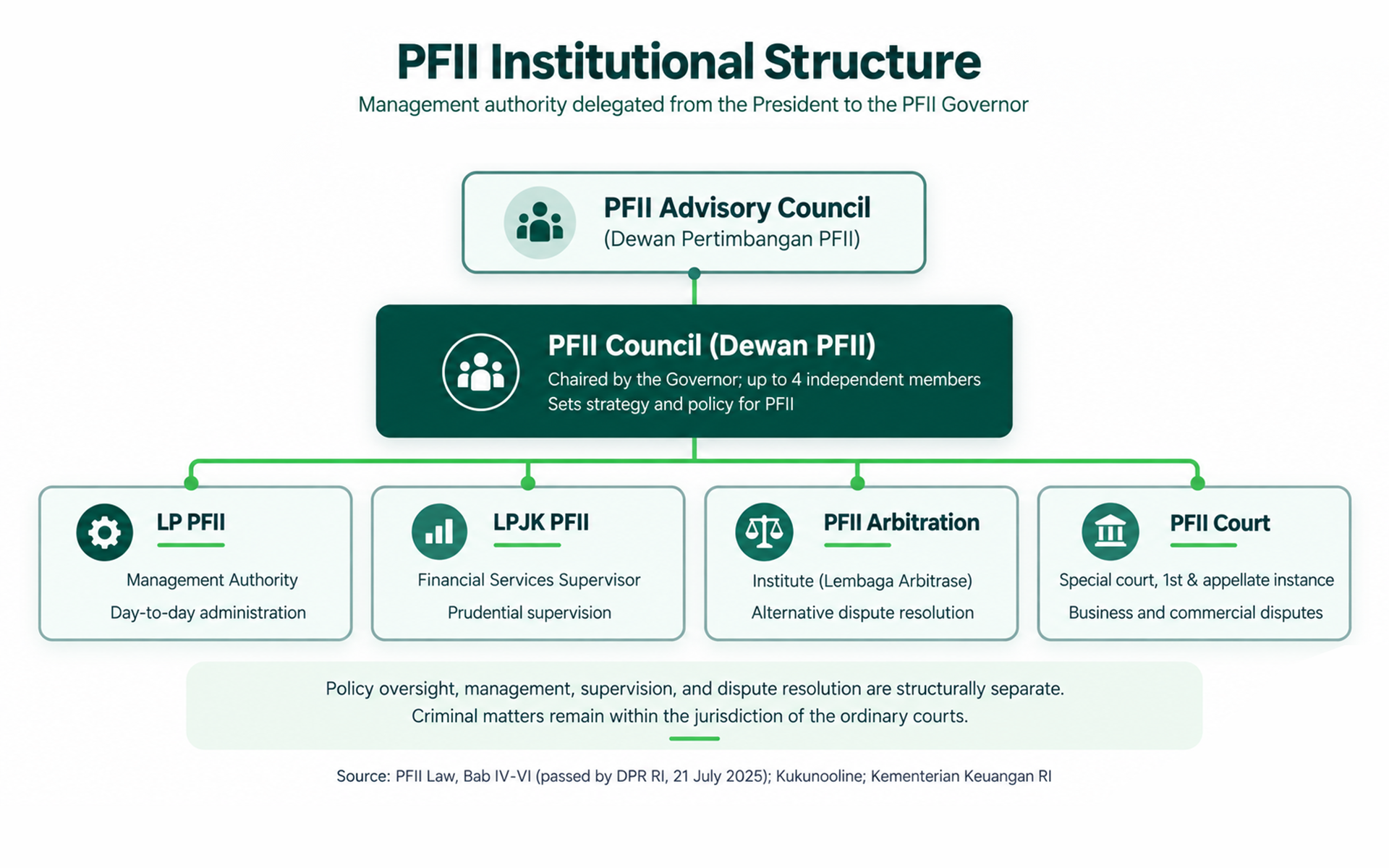
PFII’s institutional architecture includes dedicated bodies for policy, administration, supervision, arbitration, and dispute resolution. Management authority is delegated by the President to a PFII Governor. The Governor chairs the PFII Council (Dewan PFII) and oversees its strategic and policy functions supported by an independent PFII Advisory Council. The PFII Management Authority is responsible for day-to-day administration.
The dispute resolution framework features two distinct bodies: a dedicated PFII Arbitration Institute and a specialist PFII Court with first-instance and appellate levels. The PFII Court is reported to oversee PFII-related commercial disputes, disputes arising from PFII contracts and tax incentives and the recognition of arbitral awards connected to PFII matters. Foreign nationals may reportedly serves as ad hoc judges and decisions refusing recognition of international arbitral award on national-interest grounds may reportedly be appealed to Indonesia’s Supreme Court. As PFII is newly established, these provisions should be confirmed against the enacted legislation before being relied upon. Criminal matters remain within the jurisdiction of the ordinary courts.
Regulatory Perimeter
PFII should not be interpreted as replacing Indonesia’s existing financial regulatory framework. The relationship between PFII institutions and established authorities, including OJK, Bank Indonesia, Deposit Insurance Corporation (LPS), Ministry of Finance, anti-money-laundering authorities, and the courts will be central to matters such as licensing, supervision, enforcement and investor protection. The allocation of responsibilities and coordination mechanisms among these bodies will merit close attention as the implementing regulations are developed and issued.
Legal and Operating Features
A distinctive feature for legal teams is language regime. The reported statutory framework permits the use of English for PFII Court judgments. Public commentary indicates a broader intent to permit English for PFII regulations, contracts, and proceedings too. However, the exact scope should be verified against the final enacted legislation before being relied upon. By contrast, Indonesia’s general language law typically requires the use of Indonesian in official documents and contractual matters. Supreme Court Circular Letter No. 3 of 2023 has also recognized limited circumstances in which agreements drafted in foreign language may continue to be legally enforceable.
A related provision permits the incorporation and adaptation of common law, equity, and international commercial law principles within PFII activities. This creates a hybrid legal framework operating within Indonesia’s sovereignty legal system. It does not establish a separate common law jurisdiction nor does it replace Indonesia’s civil law system.
Within PFII, business activities may be conducted in foreign currency while Indonesian Rupiah remains available for operating activities in the normal course of business. The extent to which foreign-currency may be used will to be further defined in implementing regulations. Key areas requiring clarifications include the categories of permitted transactions and counterparties, applicable settlement mechanisms and reporting obligations, and the interaction between the PFII regime and Bank Indonesia’s Mandatory-Rupiah rules for transactions outside PFII.
Tax, Fiscal, and Mobility Incentives
To implement these objectives, the framework applies a ring-fenced regime under which qualifying activities conducted within the PFII zone may be eligible for corporate income tax relief, while participants are restricted from raising funds or transacting commercially with the domestic market outside the zone. The relief may take the form of a corporate income tax exemption of up to 100% for up to 50 years, subject to the terms and conditions to be set out in the forthcoming Government Regulations and Ministry of Finance Regulations.
Two factors qualify the scope of the incentive. First, Indonesia’s Directorate General of Taxes has indicated that the maximum 50-year term exemption will not be available to all activities or categories of professionals. The applicable duration and extent of the incentive will vary and are expected to be further prescribed in Government Regulations and Ministry of Finance Regulations. Second, the incentive remains subject to Indonesia’s global minimum tax (GMT) framework. Both the leadership of Commission XI and the Ministry of Finance have confirmed that multinational enterprise groups with consolidated annual revenue of at least EUR 750 million remain subject to a 15% minimum effective tax rate in accordance with Indonesia’s GMT regulations, which took effect on 1 January 2025.
Commercial Implication
The global minimum tax does not diminish the relevance of PFII for large multinational groups, but it may alter the basis on which its benefits are evaluated. For in-scope groups, the principal advantages of PFII may lie less in the headline CIT incentive and more in its legal-operating features, non-CIT incentives, business-structuring flexibility, financial-services functionality and immigration arrangements. The manner in which PFII-specific rules will interact with GMT mechanics remains subject to clarification through implementing regulation. Any assessment of potential benefits will therefore require careful modelling against the applicable eligibility criteria and implementing rules once these are issued. This discussion is provided for general information only and should not be regarded as tax advice.
| Confirmed in the PFII Framework | Pending Implementing Regulation |
|---|---|
| Corporate income tax relief up to 100%, up to 50 years, for qualifying activities | Precise activity and profession eligibility list for the full-term rate |
| VAT and Luxury Goods Sales Tax (PPnBM) relief | Duration tiers for excluded or partial categories |
| Customs facility incentives | Detailed PFII-specific interaction mechanics with GMT beyond the confirmed 15% floor |
| Preferential treatment for certain foreign-source income | — |
| Golden visa, immigration, and residency incentives (as publicly described) | Exact conditions and legal basis per incentive |
Source: PFII Law; Direktorat Jenderal Pajak; Ministry of Finance officials (Herman Saheruddin, Dirjen SPSK); Commission XI DPR RI (Misbakhun, Hekal); OECD Minimum Tax Implementation Handbook.
Eligible Activities, Businesses, and Structures
Special purpose vehicles (SPVs) and trustees are specifically enabled within PFII framework for securitization transaction and management of entrusted assets or funds. These structures are intended to facilitate cross-border financial activities and support the needs of international financial institutions. The framework is intended to cover the financial sector, the financial-support sector, and other designated activities, rather than to establish a parallel market for domestic retail financial services in Indonesia.
The table below highlights where PFII is likely to have practical relevance and where its purpose is either unclear or explicitly out of scope. It also distinguishes between permitted structures and licensed activity: a structure permitted under PFII framework does not by itself imply that the business activity may be conducted without the requisite regulatory authorization.
| Likely Relevance | Needs Confirmation, or not the Core Purpose |
|---|---|
| Treasury and financing functions | Domestic retail financial activity |
| Investment holding, cross-border structuring | Structures lacking qualifying PFII activity or substance |
| Fund, wealth-management, family-office activity | A universal substitute for all offshore SPVs |
| Securitization and trustee-based structures | Immediate migration before implementing regulations |
| Financial-services and support activities | Structures built mainly for incentives, no commercial substance |
Source: PFII Law; official government commentary on permitted PFII activities.
Key Issues to Monitor Before Structuring Decisions
Four matters remain genuinely unresolved.
- Location: Bali has emerged as the leading candidate and has drawn the most official commentary. However, the law does not designate a single statutory location. Instead, it authorizes the government to establish one or more PFII zones.
- Substance and eligibility design: The implementing regulations will play a critical role in determining which structures can genuinely benefit from the regime, particularly through their definitions of commercial substance, beneficial ownership, and anti-round-tripping safeguards. These requirements are likely to be decisive in distinguishing eligible arrangements from those that do not qualify.
- The compliance perimeter: The credibility and long-term effectiveness of of the PFII regime will also depend on the scope and rigor of its compliance framework. Key considerations includes AML/CFT controls, sanctions screening, beneficial ownership disclosure, tax information exchange, economic substance requirements, and mechanisms for cross-border regulatory cooperation. To date, public reporting has provided limited detail on how these elements will be implemented in practice.
- The operating proposition beyond fiscal incentives: While PFII’s legal and fiscal incentives are likely to attract significant attention, its ultimate appeal will depend on how effectively these features translate into a compelling operating environment for market participants. The implementing regulations, together with the development of the broader ecosystem, will determine the extent to which PFII offers a differentiated valued proposition across areas such as sector coverage, market access, liquidity, counterparty depth, licensing framework, financial infrastructure and overall operational readiness.
What Investors and Businesses Should Do Now
Three steps apply regardless of sector.
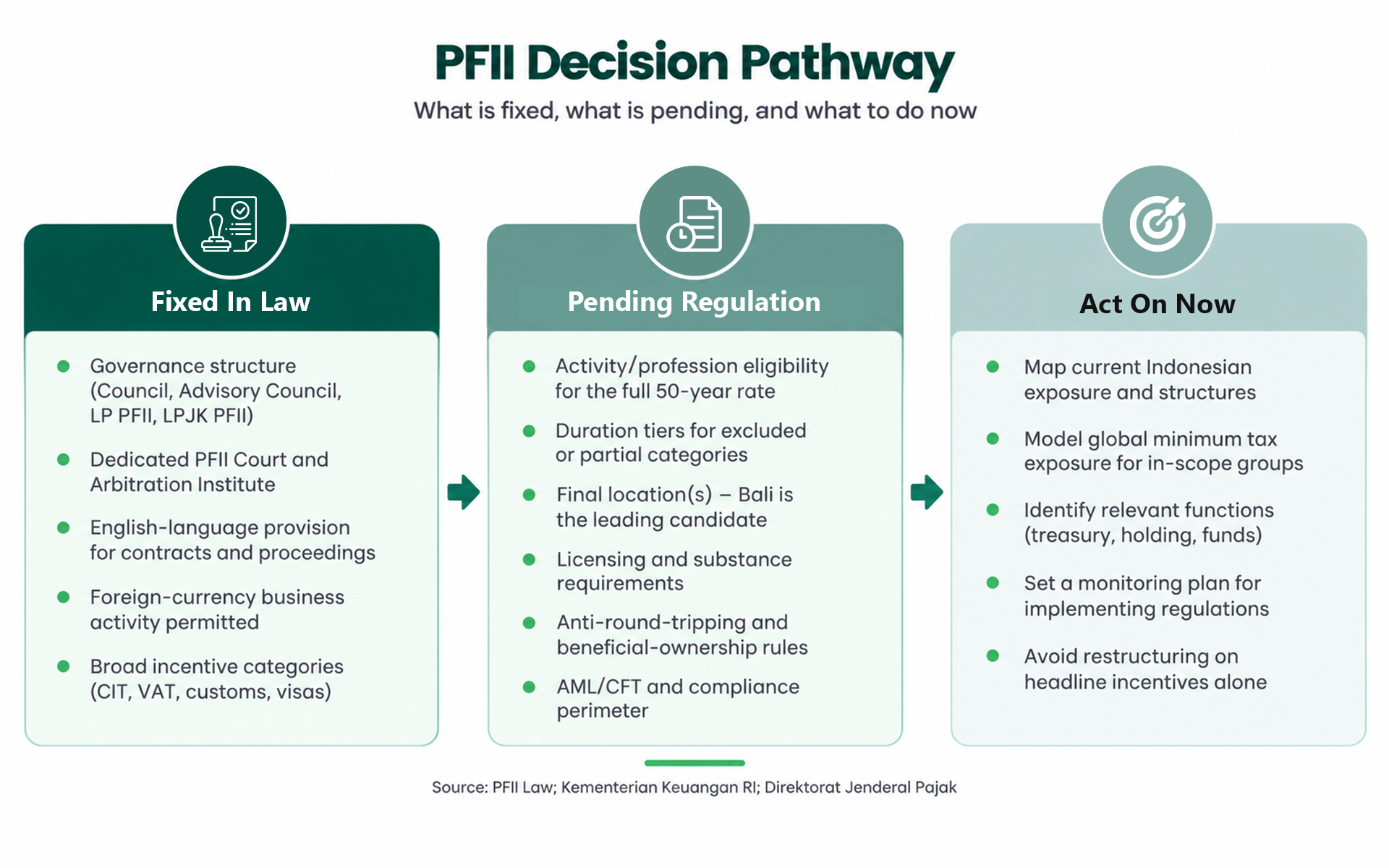
- Map current structures: Review Indonesian investments and activities currently held through Singapore, Labuan, BVI, Cayman, or other offshore jurisidictions. Assess whether functions such as treasury, financing, holding, fund management or asset management could plausibly be relevant to PFII framework.
- Assess potential applicability: Before considering any restructuring, evaluate the likely eligibility of relevant entities and activities, together with the associated tax implications,, including the global minimum tax regime, regulatory approvals and substance requirements. The commercial rationale should remain a central consideration throughout the analysis.
- Monitor implementing regulations closely: Any restructuring decisions should be deferred until there is greater clarity on keys aspects of the regime, including eligibility criteria, permitted activities, tax treatment, location of PFII zones, licensing requirements and operational conditions. Headline incentives alone should not drive restructuring decisions.
For Foreign Investors and Multinational Groups
Foreign investors and multinational groups should consider identifying existing SPV structures that may warrant a PFII suitability assessment once the implementing framework becomes clearer. Existing structures are typically established based on factors such as fund domicile, investor familiarity, treaty access, capital-markets rules and financing-documentation requirements. The introduction of PFII does not, in itself, alter the relevance of these factors. Any assessment of PFII should also take into account the implications of the 15% global minimum tax regime as this may materially affect the value of any available tax incentives. Incorporating these considerations into current planning can help organizations evaluate potential opportunities more effectively and reduce the need for significant reassessment once the implementing regulations are issued.
For Financial Institutions, Funds, and Financial-Service Providers
The key considerations are likely to be eligibility, licensing and operational requirements (e.g., minimum substance thresholds) applicable to particular sectors, rather than the headline tax rate alone. These factors will ultimately determine whether PFII is a practical and viable option for specific businesses. However, they are also among the most important aspects of the regime that remain to be clarified through the implementing regulations.
For Indonesian Businesses and Financial Institutions
Board and General Counsel’s Decision Lens
The following six questions can provide a useful framework for an initial assessment of PFII opportunities before undertaking a detailed legal, regulatory and tax analysis:
- Strategic fit: Does PFII facilitate a treasury, financing, fund management, asset-management or regional-hub function that the group has a genuine commercial need to establish or expand?
- Eligibility: Would the proposed activity, entity structure, investor profile and personnel arrangement be eligible under the PFII regime once the implementing regulations are finalized?
- Tax outcome: What is the net outcome after taking into account the combined effects of the global minimum tax, withholding tax, and indirect tax?
- Regulatory feasibility: What licensing, regulatory oversight, reporting, AML/CFT compliance and corporate governance would apply to the proposed structure and activity?
- Substance: Can the group demonstrate sufficient commercial substance, including appropriate personnel, physical presence, decision-making authority, risk management capabilities and genuine commercial purpose for the proposed structure?
- Execution: Is there a credible timeline for securing the location, infrastructure, service providers, talent, and counterparties?
This lens is a starting framework for internal discussion. It does not substitute for jurisdiction-specific legal and tax advice.
Illustrative Scenarios (Hypothetical, Not Client Examples)
The following examples are hypothetical and for general illustrations only. They do not reflect nor describe any actual NDP client, matter or engagement and should not intended to constitute nor should they be interpreted as a recommendation.
- Scenario A – Regional Treasury Function: A multinational group currently manages Indonesia-related financing through a Singapore treasury company. The group may consider whether PFII warrants consideration for that function if sufficient operational substance can be established and the relevant regulatory and tax implications are clarified. Any such assessment would depend on factors including eligibility requirements, GMT considerations and licensing details that are not yet available. However, jurisdictional decisions driven by other considerations such as fund domicile, treaty access or investor familiarity would not necessarily be affected.
- Scenario B – Fund or Family Office Platform: A fund manager or family office with cross-border investment activity may find PFII relevant as a potential jurisdiction for to trustee structures or wealth-management operations. Any evalution would need to be informed by the applicable licensing framework, investor eligibility requirements, substance and staffing obligations and the specific conditions attached to any available incentives. These factors would require careful confirmation before any structuring or location decision could be considered.
Conclusion
PFII has cleared its primary legislative hurdle, but its practical impact will ultimately depend on the content of the implementing regulations and how the regime develops in practice. Key issues remain unresolved including eligibility criteria, permitted activities, tax incentives, licensing requirements, operational substance, geographic scope and the interaction between PFII and Indonesia’s existing regulatory framework.
For investors and businesses, the immediate priority should be on evaluation rather than restructuring. Existing structures can be mapped and tested against the emerging PFII framework to identify potential opportunities and constraints including any implications arising from the global minimum tax regime, while businesses continue to monitor the implementing regulations that will shape the framework’s practical operation.
NDP will monitor for the relevant regulatory developments as they are issued and provide updates on their implications for investment structures, financing arrangements, financial services activity, tax considerations, regulatory compliance and potential restructuring initiatives.
Partner Perspective
“PFII is a rare event in Indonesia’s legal landscape: a bespoke institutional framework, complete with its own court, arbitration institute, and language regime, built specifically to compete for capital that has historically gone to Singapore, Dubai and other regional centers. The ambition is genuine and the fiscal package is aggressive by regional standards. But the framework as approved is still a shell. Every feature that would actually drive a client’s structuring decision, eligibility, sector scope, the interaction with the global minimum tax, the compliance perimeter and even the final location, is deferred to implementing regulations that have not yet been issued. My view is that clients should treat PFII as a live regulatory development to track closely, not as a jurisdiction to move into today. The investors and businesses best placed to benefit will be those who map their existing structures now, form a view on where PFII could plausibly be relevant to their business, and are ready to move once the substance and eligibility rules are published, rather than those who wait for the marketing narrative to catch up with the law.”
Jade Hwang, Foreign Consultant
Frequently Asked Questions
1. What is Indonesia’s International Financial Center framework?
PFII is a dedicated financial framework approved by Indonesia’s DPR on 21 July 2026. It provides for specialist institutions, dispute-resolution mechanisms, and fiscal incentives, and is intended to operate alongside Indonesia’s existing domestic financial system rather than replace it.
2. Why is Indonesia establishing PFII?
Indonesia’s government has framed PFII as a means of deepening domestic capital markets, expanding access to foreign capital, and strengthening the competitiveness of the financial-services ecosystem. The framework was mandated under Article 248A of the 2026 amendment to Indonesia’s Financial Sector Development and Strengthening Law, known as UU P2SK.
3. How may PFII benefit foreign investors?
Qualifying foreign investors may benefit from corporate income tax relief of up to 100% for up to 50 years, subject to eligibility criteria and implementing regulations. Other fiscal and non-fiscal incentives may also be available, including VAT, customs, immigration and residency-related incentives depending on the applicable rules.
4. Which businesses may be relevant to PFII?
PFII may be relevant to banks, capital-markets institutions, insurance companies, pension funds, investment managers, family offices, and wealth management businesses, subject to eligibility and licensing requirements. The framework also provides for structures such as special purpose vehicles and trustees, where permitted for qualifying activities.
5. What is the institutional structure supporting PFII?
PFII’s institutional architecture includes an Advisory Council, the PFII Council, the PFII Management Authority, the PFII Financial Services Supervisory Authority, a dedicated PFII Arbitration Institute, and a specialist PFII Court. The PFII Council is chaired by a Governor, to whom authority is delegated by the President. Most implementing detail, including sector-specific eligibility, will follow through Government Regulations and Ministry of Finance Regulations.
6. To what extent can PFII businesses rely on common law and international commercial-law principles?
PFII permits the adoption and adaptation of common law, equity, and international commercial law principles within its activities, subject to the framework established under Indonesian law. It therefore operates as a hybrid framework within Indonesian legal sovereignty, rather than as a separate common-law jurisdiction.
7. Can transactions in the PFII be conducted in foreign currency?
Business activities within PFII may generally be conducted in foreign currencies, reducing conversion friction for cross-border financing. Indonesian Rupiah remains available for ordinary operational transactions. The precise scope should be confirmed against the enacted law and Bank Indonesia’s requirements.
8. Where will PFII be located?
Bali is currently the leading candidate for the PFII location and has been publicly discussed by senior government officials, including Indonesia’s Minister of Finance. Under the PFII framework, the government may establish more than one PFII zone; there is no requirement that a jurisdiction have only a single center.
9. Is the 50-year tax holiday available to all PFII businesses?
No. Indonesia’s Directorate General of Taxes has confirmed that not all activities or professions will qualify for the full 50-year term. Certain categories will be subject to separate, shorter terms, and the 15% global minimum tax floor will still apply to in-scope multinational groups.
10. Should investors or businesses restructure now to use PFII?
No immediate restructuring is required. Investors and businesses should first wait for the implementing regulations clarifying eligibility requirements, permitted activities, tax and other incentives, licensing requirements, location, and operational requirements. Once these rules are available, relevant structures can be mapped and their potential legal, regulatory, tax, and commercial impact assessed before any restructuring decision is made.
About Nusantara DFDL Partnership
Nusantara DFDL Partnership (NDP) is an Indonesian law firm and a member of the DFDL network, which operates across Southeast Asia. NDP advises foreign corporations, institutional investors, and Indonesian businesses across a full suite of corporate legal services, including corporate advisory, mergers and acquisitions, foreign direct investment, joint ventures, employment law, real estate, dispute resolution, restructuring, and cross-border transactions. NDP works with clients across sectors including digital infrastructure, financial services, energy, manufacturing, and property.
Disclaimer:
This article reflects the PFII framework as approved by Indonesia’s DPR on 21 July 2026, based on public government statements, DPR proceedings, and media reporting available as at the publication date above. It is provided for general informational purposes and does not constitute legal, tax, or investment advice. Formal statute number, presidential assent, and State Gazette (Lembaran Negara) publication details, along with the precise text of all provisions and implementing regulations referenced as pending, should be verified against the official legal record before any structuring decision is made.