Key Takeaways
- Indonesia generally applies mandatory post-closing notification. A qualifying transaction must be notified to KPPU within 30 working days after its legally effective date.
- Thresholds are only one part of the analysis. Parties must also confirm the transaction type, change of control where relevant, Indonesian nexus, group aggregation, any applicable exemption, the effective date, and the correct notifying entity.
- Current thresholds. Notification may be required where combined assets in Indonesia exceed IDR 2.5 trillion or combined sales in Indonesia exceed IDR 5 trillion; a higher asset threshold applies to banking transactions.
- Foreign-to-foreign transactions require a specific Indonesian nexus analysis. The parties should apply KPPU Regulation No. 3 of 2023 to the facts rather than assume that offshore closing removes Indonesian filing risk.
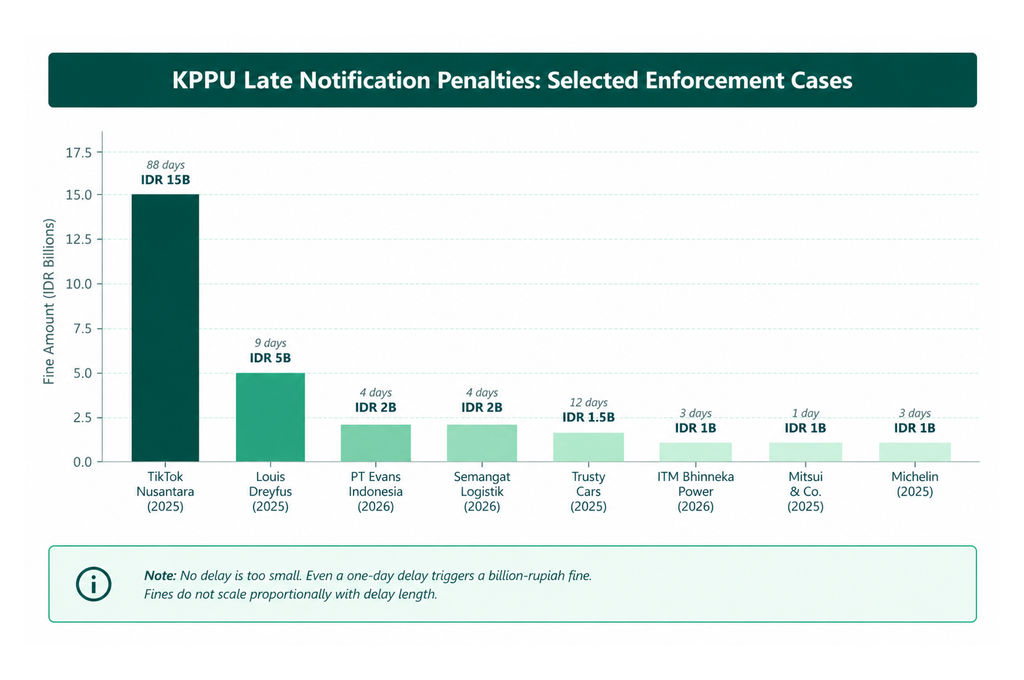
- Late notification is actively enforced. In the TikTok–Tokopedia matter, KPPU imposed an IDR 15 billion fine after finding an 88-working-day delay and an initial filing by the wrong entity.
- Penalty exposure requires case-specific analysis. GR 44/2021 governs administrative sanctions generally, while KPPU Regulation No. 5 of 2023 revokes the former 2012 late-notification fine guideline; it is not a replacement operational fine guideline.
- Pre-closing preparation remains essential. Identify the trigger date, responsible filer, supporting documents, translations, fee requirements, and filing logistics well before closing.
1. Why KPPU Merger Filing Compliance Matters Now
Indonesia’s Competition Commission (Komisi Pengawas Persaingan Usaha or KPPU) actively enforces the post-closing merger-notification regime. The principal compliance risk is not limited to large or domestic transactions: offshore acquisitions, special-purpose acquisition vehicles, and short delays can also attract scrutiny where the statutory tests are met.
A filing analysis should not begin and end with the financial thresholds. Deal teams should test the transaction type, any relevant change of control, Indonesian nexus, group aggregation, exemptions, the legally effective date, and the identity of the notifying party. These questions should be resolved before closing because the notification period is measured from the legally effective date.
2. KPPU Merger Filing in Indonesia: The Legal Framework
Indonesia’s merger-control framework is layered: the Competition Law creates the substantive prohibition and notification obligation; government regulations implement notification, sanctions, and fees; and KPPU regulations govern notification and case procedure.
The Foundation: Law No. 5 of 1999
Law No. 5 of 1999, also known as the Competition Law is the foundation law. Article 28 and Article 29 are the critical provisions within Law No. 5 discussing substantive prohibition and notification obligation respectively.
- Article 28 prohibits mergers, consolidations and acquisitions that may cause monopolistic practices or unfair business competition.
- Article 29 requires parties to notify KPPU of any merger, consolidation, or share acquisition that meets certain thresholds.
Law No. 5 of 1999 has been amended, including through Law No. 6 of 2023. The current sanctions framework should be read together with GR 44/2021. The application of general administrative-fine provisions to a particular late-notification case requires case-specific statutory and decisional analysis.
The Implementing Regulations
- Government Regulation No. 57 of 2010 (GR 57/2010) established the basic framework for merger notification. It defined the types of transactions that require notification and the parties responsible for filing the same.
- Government Regulation No. 44 of 2021 (GR 44/2021) governs KPPU’s administrative-sanctions framework, including criteria, types of sanctions, fine calculation, and procedures for objections and cassation. Its interaction with a late-notification violation should be analysed against the applicable statutory provision and KPPU decision.
The Current Operating Rules
- KPPU Regulation No. 3 of 2023 took effect on 31 March 2023. This regulation defines and governs merger notifications. It replaced the earlier KPPU Regulation 3/2019. This regulation revised the thresholds, narrowed the asset calculation to Indonesian territory only, reintroduced the dual-nexus test for foreign-to-foreign deals, and shortened the review timeline.
- KPPU Regulation No. 5 of 2023 revokes KPPU Regulation No. 4 of 2012, the former guideline on fines for delayed notification. It should not be described as a replacement operational guideline or as independently creating the GR 44/2021 fine formula.
- Government Regulation No. 20 of 2023 (GR 20/2023) introduced the filing fee. Since May 2023, companies pay a fee when they submit a merger notification.
Table 1: Legal Framework Chain for KPPU Merger Filing in Indonesia
| Level | Regulation | Key Function | Status |
|---|---|---|---|
| Primary law | Law No. 5/1999 (Arts. 28-29) | Creates notification obligation and prohibits anti-competitive mergers | Active (amended by Law 6/2023) |
| Implementing regulation | GR 57/2010 | Defines notifiable transactions and filing parties | Active |
| Implementing regulation | GR 44/2021 | Sets new fine calculation method (50% profit / 10% sales) | Active |
| KPPU regulation | KPPU Reg 3/2023 | Current procedural rules: thresholds, timelines, dual-nexus test | Effective 31 March 2023 |
| KPPU regulation | KPPU Regulation No. 5 of 2023 | Revokes KPPU Regulation No. 4 of 2012 on late-notification fine guidance | Effective 31 March 2023 |
| Government regulation | GR 20/2023 | Filing fee framework | Effective May 2023 |
For practical analysis, read the instruments by function: Law No. 5 of 1999 creates the substantive and notification obligations; GR 57/2010 implements notification; KPPU Regulation No. 3 of 2023 governs current notification and assessment procedure; GR 44/2021 addresses administrative sanctions and court challenges; GR 20/2023 governs KPPU non-tax state revenue; and KPPU Regulation No. 5 of 2023 revokes the former late-notification fine guideline.
3. KPPU Merger Notification Thresholds: Who Must File
Not every transaction is notifiable. The filing analysis requires a qualifying transaction and the applicable control, nexus, threshold, aggregation, exemption, effective-date, and filing-party tests.
The Two Threshold Tests
A merger, consolidation, or share acquisition requires notification if the combined parties meet either of the following:
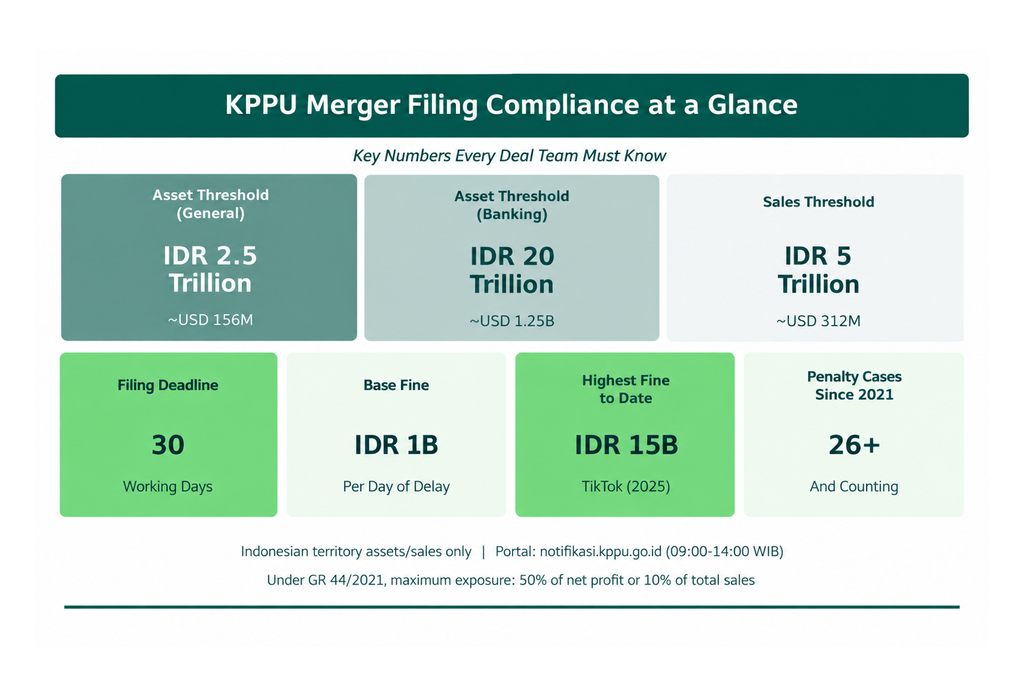
- Asset test: Combined assets in Indonesia exceed IDR 2.5 trillion (roughly USD 156 million). For banking sector transactions, this threshold rises to IDR 20 trillion (roughly USD 1.25 billion).
- Sales test: Combined annual sales in Indonesia exceed IDR 5 trillion (roughly USD 312 million).
Exceeding either financial threshold does not by itself resolve the filing question. Parties should also confirm how the relevant group’s Indonesian assets and sales are aggregated and whether the transaction falls within the scope of KPPU Regulation No. 3 of 2023.
A Critical Change: Indonesian Assets Only
Before KPPU Regulation 3/2023, threshold calculations included global assets. A multinational with minimal Indonesian operations could therefore fall within the notification threshold.
Since 31 March 2023, the threshold analysis focuses on assets and sales attributable to Indonesia under KPPU Regulation No. 3 of 2023. Multinational groups should document the calculation methodology and the entities included in the aggregation.
Who Bears the Filing Obligation
The notification obligation falls on specific parties depending on the transaction type.
A merger or consolidation must be notified by the party that will remain or come into existence in the merged entity, while an acquisition of shares must be notified by the acquirer. In the TikTok-Tokopedia case, for example, KPPU rejected the notification that had been submitted by TikTok’s parent, Bytedance. It is the acquirer as identified in the transaction documents that must notify.
Table 2: KPPU Merger Notification Thresholds
| Threshold Test | Amount (IDR) | Amount (USD approx.) | Applies To |
|---|---|---|---|
| Combined assets (general) | IDR 2.5 trillion | USD 156 million | All sectors except banking |
| Combined assets (banking) | IDR 20 trillion | USD 1.25 billion | Banking sector only |
| Combined sales | IDR 5 trillion | USD 312 million | All sectors |
Note: Only assets and sales in Indonesian territory count toward these thresholds under KPPU Regulation 3/2023.
4. When the Filing Timeline Starts: The Legally Effective Date
KPPU mandates reporting and filing of all mergers, consolidations and acquisitions exceeding the threshold (discussed above) within 30 working days. This 30 working day period seems to offer a sufficiently liberal reporting window. However, many transactions are filed late because teams fail to identify when the reporting timeline starts.
The reporting timeline does not start at signing. It does not start at commercial closing either. It starts at the legally effective date. That date depends on the type of transaction.
Legally Effective Date by Transaction Type
Domestic merger: The date MOLHR (Ministry of Law and Human Rights) approves the amendment to the articles of association of the surviving entity.
Domestic consolidation: The date MOLHR approves the deed of establishment of the new entity.
Domestic share acquisition: The date the acquirer notifies MOLHR of the share transfer. This is the notification date, not the approval date.
Asset acquisition: The date the assets are formally transferred.
Foreign-to-foreign transaction: The closing date in the transaction agreement, or the date of regulatory approval in the jurisdiction where the transaction takes place.
Public company transaction: Either the date the disclosure letter is submitted to OJK (the Financial Services Authority), or the final payment date for shares in a rights issuance, merger, or consolidation.
The Practical Problem
Many deal teams misjudge what happens on the commercial closing date. The KPPU filing date is usually scheduled from this date on for a domestic share acquisition. The legally effective date of the MOLHR notification, however, can be several days or even weeks after commercial closing. Conversely, the MOLHR notification may even occur before the deal team expects it, which means that the 30-day window starts to tick before the team members even start counting.
In the PT Evans Indonesia case, the company missed the deadline by just four working days. The transaction became legally effective on 23 November 2023. The filing deadline was 8 January 2024. The notification arrived on 10 January 2024. The result was an IDR 2 billion fine.
Understanding Indonesia’s two-tier board system matters here. Board approvals feed into the MOLHR filing timeline. A delay at the board level can shorten the KPPU filing window without anyone noticing.
Table 3: When the 30-Day KPPU Filing Clock Starts
| Transaction Type | Legally Effective Date | Common Pitfall |
|---|---|---|
| Domestic merger | MOLHR approval of amended articles | Confusing MOLHR submission date with approval date |
| Domestic consolidation | MOLHR approval of deed of establishment | Waiting for MOLHR approval while clock is already running |
| Domestic share acquisition | MOLHR notification date | Assuming the clock starts at commercial closing |
| Asset acquisition | Date of asset transfer | Overlooking partial transfer triggers |
| Foreign-to-foreign | Closing date or foreign regulatory approval | Assuming Indonesian filing tracks foreign closing timeline |
| Public company | OJK disclosure letter date or final payment date | Multiple possible trigger dates create ambiguity |
5. Foreign-to-Foreign Transactions and KPPU’s Dual-Nexus Test
In some instances, global deals can also trigger Indonesian filing obligations. For example, a Singapore company acquires a Dutch target. Even then, notification to KPPU is mandatory if both parties have sufficient Indonesian nexus.
The Dual-Nexus Requirement
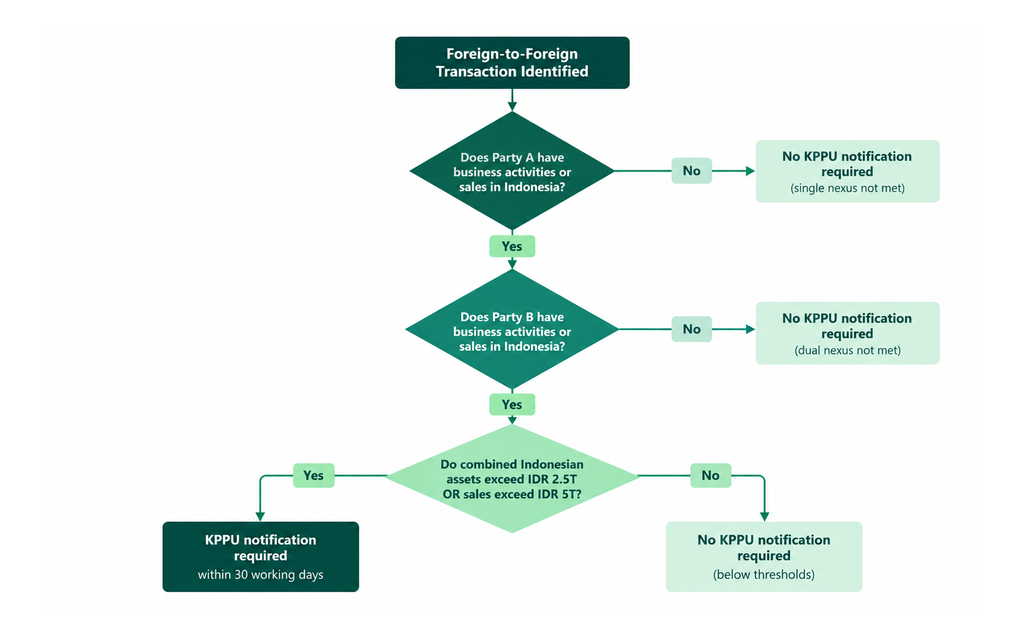
Under KPPU Regulation 3/2023, a foreign-to-foreign transaction requires notification only if both of the following conditions are met:
- At least two parties to the transaction have direct or indirect business activities in Indonesia, or sales to Indonesia.
- The combined assets or sales of those parties in Indonesia exceed the notification thresholds (IDR 2.5 trillion assets or IDR 5 trillion sales).
This is the dual-nexus test. Both sides of the deal must have an Indonesian connection.
What Counts as ‘Business Activities in Indonesia’
The Indonesian nexus inquiry is fact-specific. Parties should assess the business activities and sales of the relevant transaction parties and their groups by reference to KPPU Regulation No. 3 of 2023 and current KPPU guidance.
The 2023 Change: From Single to Dual Nexus
Before KPPU Regulation 3/2023, a single nexus was just enough. If only one side of a foreign-to-foreign deal had Indonesian operations, notification was still required. This also made reporting to KPPU mandatory for many global transactions, even though they had minimal Indonesian impact.
The 2023 framework narrows the circumstances in which an offshore transaction is reportable, but it does not eliminate filing risk. Foreign parties should document both the Indonesian nexus and the threshold calculation and should not rely solely on the place of incorporation or closing.
6. How to File: KPPU’s Portal, Fees, and Assessment Process
KPPU Regulation No. 3/2023 shifted filing of mergers, consolidations and acquisitions to a completely electronic submission process. The filing process has defined steps and timelines. To circumvent any avoidable lapses or issues, it is important to thoroughly understand the process and associated timelines
The Filing Portal
All mergers, consolidations, or acquisitions that exceed the thresholds discussed above are filed on KPPU’s online portal at notifikasi.kppu.go.id. The portal accepts submissions only during working hours from Monday to Friday between 09:00 to 14:00 WIB (Jakarta time), excluding national holidays and joint leave days.
It is important to make note of both the working days and the reporting time window. For instance, a company that finishes preparing its documents at 3:00 PM on a Friday cannot file until Monday morning. If the filing deadline falls on that Friday, the filing, even if done on Monday, is late.
Required Documents
The notification submission must include:
- Completed notification form (in Indonesian).
- Corporate documents for all parties (articles of association, company profiles).
- Three years of audited financial reports.
- Business structure schemes showing ownership and control.
- Transaction summary and business plans.
- Competition impact analysis.
- Proof of filing fee payment.
All documents must be in Indonesian language.
All documents that are submitted must necessarily be in Indonesian language. Where the documents are in a foreign-language, they must be translated into Indonesian language and duly certified. The acquiring party shall submit the notification form and all required documents. In case the acquiring party has a parent company, then also the filing has to be done by the acquiring party. The parent company submission will not be accepted if the parent is not the acquiring party.
Document Legalization for Foreign Filings
Foreign-origin corporate documents, Powers of Attorney, and board resolutions require legalization before KPPU will accept them.
Indonesia acceded to the Hague Apostille Convention in 2022. Documents originating from Hague Convention signatory countries can be apostilled by the issuing country’s competent authority. An apostille is sufficient. No further consular legalization is needed.
For documents originating from non-signatory countries, the traditional consular legalization process applies. This involves authentication by the issuing country’s foreign ministry, followed by legalization at the Indonesian embassy or consulate in that country.
Apostille and consular legalization of foreign-origin documents (such as corporate documents, Powers of Attorney and board resolutions) will take several days. It is therefore recommended that deal teams factor in this time for document preparation to avoid wasting days of the 30-day notification period after the transaction has become legally effective.
Filing Fee
Since May 2023, KPPU charges a filing fee under GR 20/2023.
Calculation: GR 20/2023 provides a formula-based tariff for KPPU’s assessment of a merger, consolidation, or acquisition notification. The applicable valuation base, rate, cap, and any zero-tariff treatment should be confirmed against the regulation and current KPPU payment instructions for the specific filing.
KPPU’s Assessment Process
After submission, KPPU checks the notification and may request additional information before proceeding with its assessment. The applicable timetable and procedural track should be confirmed under KPPU Regulation No. 3 of 2023. A substantive merger assessment is distinct from a later proceeding alleging delayed notification or another violation.
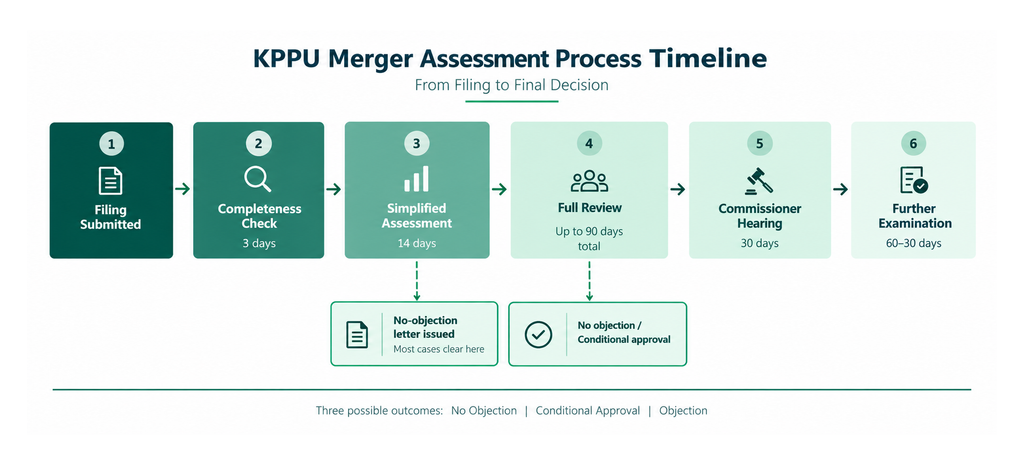
Once KPPU receives a complete filing, the review follows a structured timeline:
Stage 1: Completeness check (3 business days). KPPU verifies that all required documents are present and that the transaction is notifiable. If complete, KPPU issues a registration number.
Stage 2: Simplified assessment (14 business days). If KPPU finds no competition concerns, the review ends here with a no-objection letter. Most transactions clear at this stage.
Stage 3: Full review (up to 90 business days total). If the simplified assessment raises questions, KPPU moves to an initial review, followed by a comprehensive review if needed. KPPU applies the HHI (Herfindahl-Hirschman Index) to measure market concentration resulting from a merger, consolidation, or acquisition.
- Moderately concentrated market (HHI 1,500–2,500): The merger is a concern only if it increases the HHI by more than 250 points. A small deal in a moderately concentrated market is generally not a concern for KPPU. However, where the deal can significantly alter the market share, it does raise concerns for the KPPU.
- Highly concentrated market (HHI above 2,500): The HHI score bar is lower. A merger is a concern even if it increases the HHI by just 150 points. In a market that is already dominated by a few players, even a smaller deal can significantly alter the concentration in the industry.
Stage 4: Commissioner hearing (30 business days). If the full review identifies potential anti-competitive effects.
Stage 5: Further examination (60 business days, extendable by 30 days). For complex cases requiring additional evidence.
Three Possible Outcomes
- No objection. The transaction raises no competition concerns. This is the most common result.
- Conditional approval. KPPU approves the transaction subject to conditions (behavioural or structural remedies).
- Objection. KPPU finds the transaction may substantially lessen competition. The parties face potential administrative action.
7. The IDR 25 Billion Cap Is Gone: KPPU’s Uncapped Penalty Regime
The most important recent change in Indonesia’s merger notification regime is the removal of the cap on late filing fees. The IDR 25 billion cap on late filing fines no longer applies. However, many a times it has been observed that deal teams are still capping their risk exposure for delayed filing at IDR 25 billion. This is inaccurate.
The cap was removed through the following three regulations:
- The Job Creation Law (Law 6/2023) amended the Competition Law and removed the previous statutory ceiling on fines.
- GR 44/2021 introduced a new calculation method. Penalties can reach up to 50% of net profit or 10% of total sales from the relevant product market.
- KPPU Regulation 5/2023 repealed KPPU Regulation 4/2012, which was the old guideline that applied the IDR 25 billion cap.
Late Notificate Fine
To date, KPPU has not imposed more than IDR 15 billion in sanctions for late notification. However, the potential exposure can be much higher for companies with significant Indonesian revenue.
The Base Fine
KPPU mandates a penalty of IDR 1 billion per day for delayed filing of eligible merger, consolidation or acquisition. The penalty continues to accumulate for every business day from the date of notification deadline to the date KPPU accepts the filing to its satisfaction. If KPPU identifies gaps in documents already submitted, the fine continues to accumulate for every day the filer takes to cure those defects.
Penalty Calculation Factors
KPPU decisions show that the amount imposed is not determined solely by the number of days of delay. Relevant considerations may include the duration and circumstances of the violation, cooperation, prior conduct, impact, and ability to pay, depending on the applicable legal basis and the evidence in the proceeding.
In the TikTok–Tokopedia matter, KPPU imposed an IDR 15 billion fine. KPPU stated that the transaction became legally effective on 31 January 2024, the deadline was 19 March 2024, the initial notification was submitted by an entity that was not the official acquirer, and the delay was calculated at 88 working days. This illustrates the importance of filing through the correct transaction entity and validating the effective date and responsibility matrix before closing.
Beyond the Fine: Other Consequences
A late notification penalty is documented and becomes part of the public record. Potential counterparties, investors, and regulators in other jurisdictions can see it. For companies active in Indonesian M&A, a KPPU penalty can complicate future deals as it may raise questions about their compliance record.
Late notification is separate from the substantive assessment of whether a transaction may cause monopolistic practices or unfair business competition. Any available substantive remedies should be stated by reference to the amended Competition Law and GR 44/2021; the former statutory fine ranges should not be repeated as current law without verification.
8. Enforcement Illustration
The TikTok–Tokopedia decision provides a current, officially reported illustration of KPPU’s approach to timeliness and the identity of the notifying party.
TikTok Nusantara (SG) Pte. Ltd. acquired 75.01% of PT Tokopedia. KPPU’s official release states that the transaction was legally effective on 31 January 2024 and that the notification deadline was 19 March 2024. An initial submission was made by TikTok Pte. Ltd., which KPPU treated as not being the official acquiring entity. KPPU calculated an 88-working-day delay and imposed an IDR 15 billion fine on 29 September 2025.
Louis Dreyfus Company Melbourne Holdings Pty. Ltd. (2025)
The Australian subsidiary of Louis Dreyfus acquired shares in Emerald Grain Pty. Ltd. The notification was 9 business days late. KPPU imposed a fine of IDR 5 billion (roughly USD 300,000). (Case No. 19/KPPU-M/2024, decided 11 August 2025.)
PT Evans Indonesia (2026)
PT Evans Indonesia acquired 99.99% of two palm oil plantation companies in East Kalimantan. The transaction closed on 23 November 2023. The deadline was 8 January 2024. The notification arrived on 10 January 2024. That is 4 business days late. The fine was IDR 2 billion. KPPU noted the company cooperated and had no prior violations. (Case No. 14/KPPU-M/2025, decided 1 September 2026.)
PT Semangat Logistik Andalan (2026)
This company acquired 99.68% of PT Swift Logistic Solutions for IDR 4.9 billion. The transaction became effective on 19 June 2024. The notification deadline was 30 July 2024. Documents were declared complete on 5 August 2024. That is 4 business days late. Fine: IDR 2 billion. (Case No. 06/KPPU-M/2026, decided 10 August 2026.)
PT ITM Bhinneka Power (2026)
PT ITM Bhinneka Power, a subsidiary of Indo Tambangraya Megah (ITMG), acquired a 65% stake in PT Centra Multi Suryanesia Aset. The transaction became legally effective on 21 September 2023. The filing deadline was 2 November 2023. The notification was filed on 7 November 2023. That is 3 business days late. KPPU imposed a fine of IDR 1 billion. (Case No. 08/KPPU-M/2025, decided 2 June 2026.)
Additional Cases in 2025
| Company | Fine (IDR) | Days Late | Transaction |
|---|---|---|---|
| Trusty Cars Pte. Ltd. | 1.5 billion | 12 days | Share acquisition of PT Mitra Pinasthika |
| Mitsui & Co., Ltd. | 1 billion | 1 day | Acquisition of Position Partner |
| Compagnie Financiere Michelin | 1 billion | 3 days | Share acquisition of PT Royal Lestari |
Earlier Landmark Cases
| Company | Fine (IDR) | Days Late | Year |
|---|---|---|---|
| PT Plaza Indonesian Realty | 1 billion | 345 days | 2018 |
| PT Nirvana Property | 1 billion | 161 days | 2018 |
Pending Cases
MUFG Bank Ltd. is currently facing KPPU proceedings for a 6-business-day delay in notifying its acquisition of 70.61% of PT Mandala Multifinance Tbk. The preliminary hearing opened on 6 August 2026. (Case No. 07/KPPU-M/2026.)
What the Pattern Shows
- No delay is too small. KPPU is very clear in defining that a delay in filing even if for 1 day is a delay and penal provisions as applicable will follow. Delay for each day mandates a fine of IDR 1 billion. However, this is not a linear calculation. The penalty amount depends on other factors too. However, the intent is to communicate that KPPU does not exercise discretion to overlook minor delays.
- The fine does not scale proportionally with the delay. TikTok was fined IDR 15 billion for 88-day delay in filing. Trusty Cars Pte. Ltd. was fined IDR 1.5 billion for a delay of 12 days. Mitsui & Co. was fined IDR 1 billion for a 1 day delay. The calculation to arrive at the penalty or fine for delayed filing involves multiple factors, not just time.
- Foreign companies are not exempt. TikTok (Singapore), Louis Dreyfus (Australia), Mitsui (Japan), Michelin (France), and Trusty Cars (Singapore) all received penalties. KPPU treats both foreign and domestic filers the same way.
9. Pre-Merger Consultation with KPPU
KPPU allows parties to consult with it before a transaction closes. This consultation is voluntary. More importantly, this voluntary consultation does not replace the mandatory post-closing notification. However, a pre-closing consultation can significantly reduce the risk of delays and adverse findings during KPPU’s post-closing review.
Two Types of Consultation
- Verbal consultation. Verbal consultations are usually informal and, in many cases, held without the identity of the parties involved being disclosed. However, any views expressed by KPPU staff in such consultations will be non-binding and cannot be relied upon to support a notification’s assessment.
- Written consultation. Written consultation is a formal process. The parties submit the documents required for a full notification, and KPPU reviews them and issues a written opinion within the specified timeframe.
Why It Matters
First, it tells parties whether KPPU sees competition issues. If it does, the parties can restructure the deal before closing.
Second, it saves time at the filing stage. The consultation requires the same documents as a full notification. If the deal closes within one year and the terms have not materially changed, the post-closing filing can be completed quickly.
Important Limitation
It is critical to note that the pre-merger consultation is not an exemption from post-merger notification obligations. Even if no objections are raised by KPPU in consultation, the mandatory 30-day notification still has to be made after the transaction has become legally effective.
For companies managing broader beneficial ownership reporting obligations alongside the KPPU process, this early coordination of document preparation helps.
10. Practical Compliance Roadmap and Appeal Realities
Here is a practical roadmap, followed by what happens if things go wrong.
The Compliance Roadmap
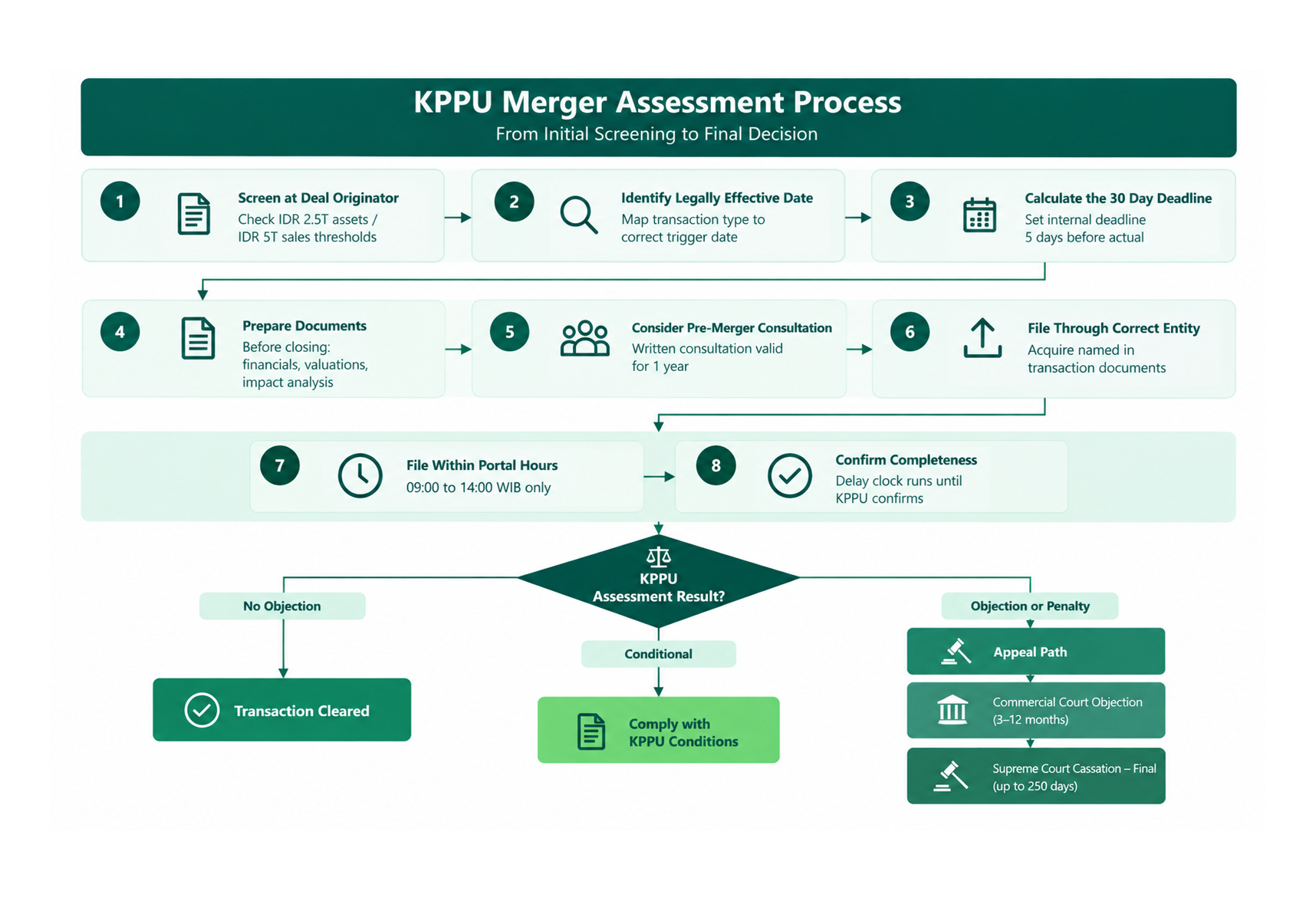
Step 1: Screen the transaction early. Confirm the transaction type, any change of control, Indonesian nexus, group aggregation, thresholds, and any applicable exemption before signing or, at the latest, well before closing.
Step 2: Fix the legally effective date. Identify the documentary or regulatory event that starts the 30-working-day period for the specific transaction structure and keep supporting evidence in the filing record.
Step 3: Set an internal deadline. Calculate the statutory deadline using the applicable Indonesian working-day calendar and target submission sufficiently early to address portal, payment, translation, or document issues.
Step 4: Prepare before closing. Allocate responsibility in the transaction documents, collect financial and corporate records, complete Indonesian translations and any required authentication, and confirm the filing-fee process.
Step 5: Consider pre-closing consultation. For complex or competition-sensitive transactions, assess whether consultation with KPPU would help clarify substantive issues. Consultation does not replace the mandatory post-closing notification.
Step 6: File through the correct entity. For an acquisition, confirm that the notifying entity is the acquirer identified in the transaction documents. The TikTok decision demonstrates the risk of submitting through a parent or affiliate that is not the official acquirer.
Step 7: Submit early and retain evidence. Confirm current portal operating instructions immediately before filing, submit before the last day, and preserve proof of submission, payment, and all communications with KPPU.
Step 8: Respond promptly to KPPU. Monitor the completeness review and answer requests for additional information without delay. The legal consequence of an incomplete submission should be assessed against the applicable regulation and KPPU practice rather than assumed.
Building an antitrust compliance program that includes KPPU merger filing as a standard checklist item protects the organization beyond any single deal.
Appeal Realities
A party seeking to challenge a KPPU decision should confirm the applicable objection and cassation procedure, deadlines, security requirements, and competent court under GR 44/2021, PERMA No. 3 of 2021, and current case law. These procedural requirements are technical and should not be reduced to generic time estimates.
KPPU Merger Filing Quick Reference
| Item | Detail |
|---|---|
| Governing law | Law No. 5/1999 (amended by Law 6/2023), GR 57/2010, GR 44/2021 |
| Current procedural regulation | KPPU Regulation No. 3 of 2023 (effective 31 March 2023) |
| KPPU Regulation No. 5 of 2023 | Revokes the former KPPU Regulation No. 4 of 2012 late-notification fine guideline |
| Asset threshold (general) | IDR 2.5 trillion (Indonesian territory only) |
| Asset threshold (banking) | IDR 20 trillion |
| Sales threshold | IDR 5 trillion (Indonesian territory only) |
| Filing deadline | 30 working days from legally effective date |
| Filing portal | notifikasi.kppu.go.id (09:00-14:00 WIB) |
| Filing fee | Formula-based tariff under GR 20/2023; confirm the current valuation base, rate, cap, and any zero-tariff treatment for the filing |
| Pre-merger consultation | Voluntary; written consultation documents valid for 1 year |
Partner Perspective
Afriyan Rachmad, Partner
Frequently Asked Questions
1. What is KPPU merger filing in Indonesia?
KPPU merger filing is the mandatory post-closing notification that companies must submit to Indonesia’s competition authority (KPPU) after completing a merger, consolidation, or share acquisition that meets certain asset or sales thresholds. It is a legal obligation under Article 29 of Law No. 5 of 1999.
2. When is a merger notification required in Indonesia?
A notification is required when the combined assets of the merging parties in Indonesia exceed IDR 2.5 trillion (IDR 20 trillion for banking) or their combined sales in Indonesia exceed IDR 5 trillion. The notification must be filed within 30 working days of the transaction’s legally effective date.
3. Who must notify KPPU of a merger or acquisition?
For a merger or consolidation, the surviving or newly formed entity files. For a share acquisition, the acquiring entity must file. KPPU rejected a filing by TikTok’s parent company because the acquiring subsidiary was the proper filer.
4. What are the KPPU merger notification thresholds?
The thresholds are IDR 2.5 trillion in combined assets in Indonesia (IDR 20 trillion for banking) or IDR 5 trillion in combined sales in Indonesia. Under KPPU Regulation 3/2023, only assets and sales within Indonesian territory count.
5. How long do companies have to notify KPPU after completing a merger?
Companies have 30 working days from the legally effective date. Working days exclude weekends, national holidays, and joint leave days. The portal operates only from 09:00 to 14:00 WIB.
6. What happens if a company fails to notify KPPU?
KPPU imposes a base fine of IDR 1 billion per day of delay. Under the current framework, the maximum potential fine is 50% of net profit or 10% of total sales. KPPU has penalized companies in at least 26 cases since 2021.
7. What are the penalties for late merger notification in Indonesia?
The base penalty is IDR 1 billion per day. The highest fine to date is IDR 15 billion, imposed on TikTok Nusantara (SG) in 2025. Even a one-day delay resulted in a IDR 1 billion fine for Mitsui & Co. The old IDR 25 billion cap no longer applies.
8. How does KPPU review mergers and acquisitions?
KPPU follows a staged process: completeness check (3 business days), simplified assessment (14 business days), full review (up to 90 business days), commissioner hearing (30 business days), and further examination (60+30 business days). Most transactions clear at the simplified assessment stage.
9. Do foreign companies need to notify KPPU of an acquisition?
Yes, if the transaction meets the threshold tests and has sufficient Indonesian nexus. For foreign-to-foreign transactions, both parties must have business activities or sales in Indonesia (the dual-nexus test). At least four foreign-to-foreign late notification penalties have been imposed since 2021.
10. Are cross-border mergers subject to KPPU notification?
Yes. Cross-border mergers are subject to notification if the combined Indonesian assets or sales exceed the thresholds. For foreign-to-foreign deals, the dual-nexus test under KPPU Regulation 3/2023 applies. Offshore transaction filings made up 43% of all KPPU merger notifications in 2023.
11. Can a company consult KPPU before completing a merger?
Yes. KPPU offers voluntary pre-merger consultation in two forms: verbal (informal, non-binding) and written (formal, using the same documents as a full notification). Written consultation documents remain valid for one year. However, pre-merger consultation does not replace the mandatory post-closing notification.
12. Is Indonesia moving toward a pre-merger notification system?
Legislative discussions between 2024 and 2026 have kept mandatory pre-merger notification on the policy agenda. KPPU’s 2025-2029 strategic plan includes this as a priority. However, Indonesia still operates a post-closing notification system. Companies should monitor developments, as the shift would fundamentally change deal timelines.
How NDP Can Help
Nusantara DFDL Partnership advises on the full scope of KPPU merger filing in Indonesia. Our M&A team works with foreign investors, regional counsel, and in-house legal teams to manage the notification process from deal structuring through filing and assessment.
We handle pre-merger consultations, threshold analysis, document preparation, portal filing, and KPPU assessment support. For companies managing financial distress situations alongside M&A activity, we coordinate the KPPU notification with restructuring timelines.
Our DFDL network spans 10 jurisdictions across Asia. For regional transactions that trigger notification requirements in multiple countries, we coordinate filings across borders. See our analysis of Vietnam’s competition enforcement framework for a cross-border comparison.
To discuss your KPPU merger filing requirements, contact our M&A team.
About Nusantara DFDL Partnership
Nusantara DFDL Partnership (NDP) is an Indonesian law firm and a member of the DFDL network, which operates across Southeast Asia. NDP advises foreign corporations, institutional investors, and Indonesian businesses across a full suite of corporate legal services, including corporate advisory, mergers and acquisitions, foreign direct investment, joint ventures, employment law, real estate, dispute resolution, restructuring, and cross-border transactions. NDP works with clients across sectors including digital infrastructure, financial services, energy, manufacturing, and property.