This article on commercial lease agreements in Indonesia identifies 10 legal risks that tenants (commercial ) should address before signing, renewing, or exiting a lease in Indonesia. It explains where those risks commonly arise, what tenants should verify during due diligence, and which protections should be reflected in the lease agreement.
Commercial property leases are governed by several intersecting areas of Indonesian law, including the Civil Code (Kitab Undang-Undang Hukum Perdata), the Basic Agrarian Law, tax regulations, licensing requirements, and building regulations. These requirements may appear manageable when the lease is signed but can give rise to material issues during the tenant’s occupation, at renewal, or when a dispute with the landlord occurs.
Indonesian law does not provide substantial statutory protection for commercial tenancies. There is no standalone tenancy act, dedicated rent tribunal, or specialist housing court. Commercial tenants therefore rely almost entirely on the terms of the lease agreement for their protection.
The 10 risks below are the issues commercial tenants should examine before committing to premises in Indonesia. For each risk, the article explains what can go wrong, what the tenant should check, and what protective language should be included in the lease.
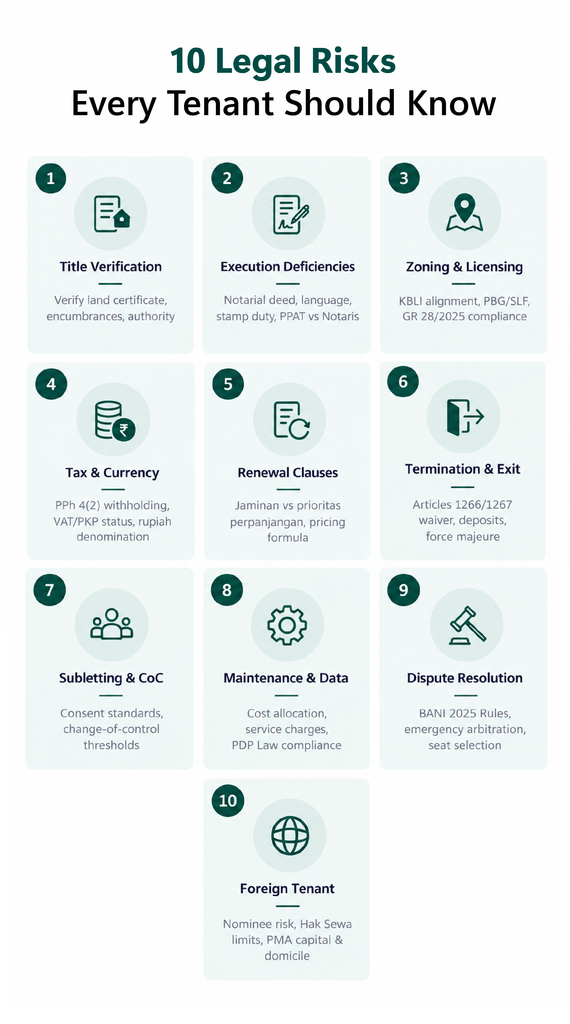
For tenants, the central point is simple: Indonesian commercial lease protection is mostly contractual. The lease must therefore do more than record rent and term. It should verify the landlord’s authority, align the premises with the tenant’s licensing needs, allocate tax and operating costs, preserve renewal and exit rights, and anticipate disputes before they arise.
Key Takeaways
- Indonesian law has no standalone commercial tenancy statute. The lease is the tenant’s primary legal protection.
- Verify the landlord’s land certificate, authority to lease, and encumbrance status at BPN before signing.
- Execute the lease as a notarial deed in Bahasa Indonesia. An English-only agreement risks nullity under Law No. 24 of 2009.
- Confirm zoning alignment, KBLI classification under the new KBLI 2025, and valid PBG/SLF before committing.
- Clarify all tax obligations upfront. Tenants must withhold PPh 4(2) at 10%. VAT treatment depends on the landlord’s PKP status.
- Negotiate a binding extension guarantee (jaminan perpanjangan). A mere priority right gives no certainty.
- Include an express waiver of Articles 1266 and 1267 of the Civil Code. Without it, termination for breach may need a court order.
- Foreign tenants face additional risks: nominee prohibitions, Hak Sewa limitations, and PT PMA domicile alignment.
Deal-Stage Risk Map
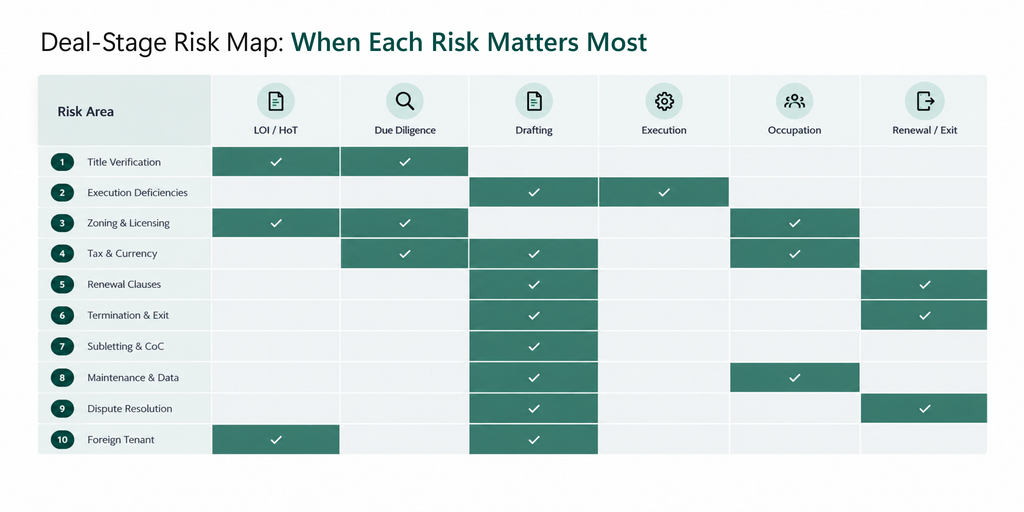
| Deal Stage | Applicable Risks |
|---|---|
| LOI / Heads of Terms | Risk 1 (Title), Risk 3 (Zoning), Risk 10 (Foreign Tenant) |
| Due Diligence | Risk 1 (Title), Risk 3 (Licensing), Risk 4 (Tax) |
| Drafting and Negotiation | Risks 2, 4, 5, 6, 7, 8, 9 |
| Execution | Risk 2 (Notarial deed, stamp duty, language) |
| Occupation | Risk 3 (PBG/SLF), Risk 4 (Tax compliance), Risk 8 (Maintenance) |
| Renewal or Exit | Risk 5 (Renewal), Risk 6 (Termination, deposit) |
The Legal Framework Behind Every Commercial Lease in Indonesia
Commercial lease law in Indonesia is not codified in a single statute. Several legal and regulatory frameworks may affect a commercial lease, depending on the type of property, the tenant’s business activities, and the structure of the transaction.
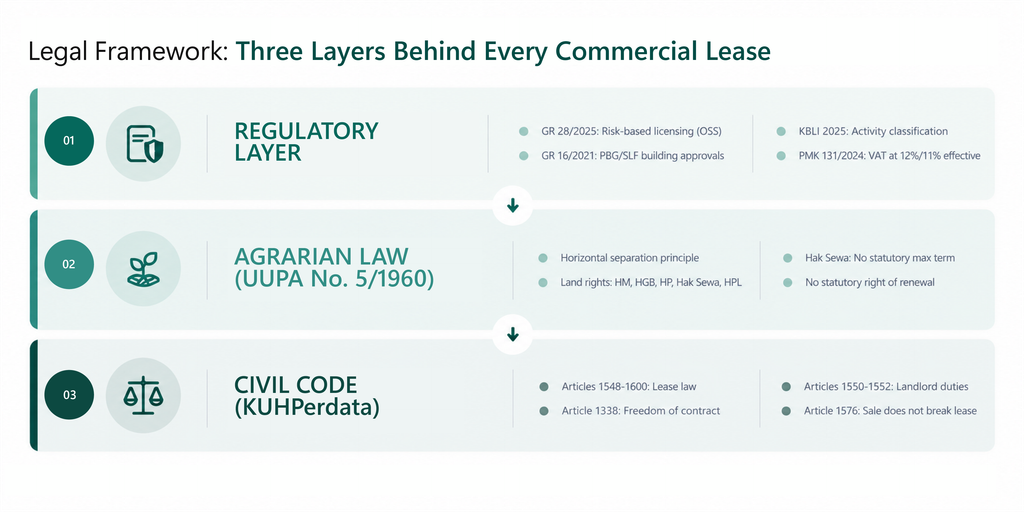
The Three Layers
The Civil Code:
The Indonesian Civil Code (Kitab Undang-Undang Hukum Perdata, or KUHPerdata), Articles 1548 to 1600, governs lease agreements (sewa menyewa). Article 1548 defines a lease as granting the use of a thing for a determinate period in return for an agreed payment. Article 1338 establishes the principle of freedom of contract (asas kebebasan berkontrak). Articles 1550 to 1552 set out the landlord’s core duties: to deliver the premises in good condition and to maintain quiet enjoyment. Article 1576 provides that a sale of the property does not terminate the lease.
Agrarian law:
The Basic Agrarian Law (UUPA, Law No. 5 of 1960) establishes the principle of horizontal separation (asas pemisahan horizontal), meaning that the land and the building on it may have different legal owners. Relevant land rights include Hak Milik (freehold), Hak Guna Bangunan (HGB, right to build), Hak Pakai (right to use), Hak Sewa (leasehold), and Hak Pengelolaan (HPL, management right). Hak Sewa is a contractual lease right that is not registered at the National Land Agency (Badan Pertanahan Nasional, BPN). It has no statutory maximum term and no statutory right of renewal. These features are significant when assessing the tenant’s protection under a commercial lease.
The regulatory layer:
Government Regulation No. 28 of 2025 (GR 28/2025), promulgated on 5 June 2025, replaced GR 5/2021 and governs risk-based business licensing through the Online Single Submission (OSS) system. Building approvals follow GR 16/2021, which transitioned Indonesia from the former Izin Mendirikan Bangunan (IMB) system to Persetujuan Bangunan Gedung (PBG, the building approval) and Sertifikat Laik Fungsi (SLF, the building worthiness certificate confirming that the structure is safe and fit for its intended use).
The lessor matters:
The landlord may be an individual, a limited liability company (Perseroan Terbatas, PT), an industrial estate operator, or an institutional owner. Each type raises different title verification and authorisation requirements.
| Individual | PT | Estate Operator | Institutional | |
|---|---|---|---|---|
| Typical title | SHM or SHGB | SHGB | HPL with derivatives | SHGB (group) |
| Authorization | ID; spousal consent | Board resolution | Estate terms | Corporate resolution |
| PKP status | Often non-PKP (below IDR 4.8B) | Typically PKP | PKP | PKP |
| Common pitfall | Undisclosed co-owners | Expired HGB | HPL limits | Change-of-control triggers |
These layers intersect differently in every deal. The 10 risks below trace those fault lines.
Risk 1: Inadequate Title Verification and Due Diligence
The risk in practice: The landlord’s right to lease the property depends on the underlying land title. If the title is not properly verified, the tenant may face uncertainty over its right to occupy and use the property.
A Sertifikat Hak Milik (SHM) represents the strongest form of title. A Sertifikat Hak Guna Bangunan (SHGB) has a fixed expiry date. If the HGB lapses during the lease term, the tenant’s occupancy is at risk. Verify that the remaining HGB term covers the full lease period, including any renewal options.
Next, verify encumbrances at BPN. BPN records mortgages (hak tanggungan), court-ordered seizures, and other claims. A mortgaged property could face enforcement proceedings. Whether the tenant’s occupancy survives enforcement depends on the form of the lease and the priority of registered interests.
Check for overlapping claims. Girik (customary land title) and adat (customary law) claims remain common in certain regions and can take years to resolve.
Confirm the landlord’s authority to lease. For a corporate landlord, verify board authorisation and check whether the articles of association impose any transaction thresholds. In the case joint ownership, obtain all co-owners’ consent. For a power of attorney (surat kuasa), verify its scope and expiry.
Cross-check zoning. The local spatial plan (Rencana Tata Ruang Wilayah/RTRW and Rencana Detail Tata Ruang/RDTR) must permit the tenant’s intended activity at the leased address.
What to put in the lease: Include a landlord’s representation and warranty that the title is free from encumbrances and third-party claims. Add a condition precedent requiring satisfactory title verification before the lease takes effect. Where a mortgage exists, obtain a mortgagee acknowledgment letter confirming the tenant’s right to occupy the premises.
Risk 2: Lease Execution Deficiencies
The risk in practice: The way a lease is executed can affect its evidentiary value and enforceability. Tenants should therefore consider the form, language and execution requirements before signing.
Indonesian law recognises both private agreements (akta di bawah tangan) and notarial deeds (akta notaris). Both may be valid provided the requirements of Article 1320 of the Civil Code are satisfied. A private agreement may offer weaker protection against third parties, while a notarial deed provides a formal public record with stronger evidentiary weight.
A common error is assuming that a commercial lease should be executed before a PPAT (Pejabat Pembuat Akta Tanah, the land deed official). A PPAT handles only registrable transactions such as land transfers and the establishment of hak tanggungan. A commercial lease (sewa menyewa) is not on that list. The correct official for executing a commercial lease as a notarial deed is a Notaris.
Registered Rights as an Alternative
There is a strategic angle to consider. For long-term occupancy, replacing a contractual lease (Hak Sewa) with a registered right (Hak Pakai or HGB over Hak Milik land) gives the tenant a real right (hak kebendaan) with third-party effect. That step requires a PPAT deed under Minister of ATR/BPN Regulation No. 18 of 2021. HGB over Hak Milik land runs on a shorter maximum term and is renewed by a fresh grant, not by automatic extension.
Under Law No. 10 of 2020, lease agreements need stamp duty of IDR 10,000. An unstamped document cannot be used as evidence in court until retroactive stamping is completed. Retroactive stamping (nazegeling) is possible, it adds slight cost and delay.
Language Risk
Language creates a significant risk. Law No. 24 of 2009 on Flag, Language, and National Emblem requires agreements involving Indonesian parties to be in Bahasa Indonesia. In Nine AM Ltd v. PT Bangun Karya Pratama Lestari (Supreme Court Decision No. 601 K/Pdt/2015), the Supreme Court nullified an agreement executed only in English. An agreement involving an Indonesian party that is executed solely in English is null and void (batal demi hukum) under Indonesian law.
What to put in the lease: Execute the lease before a Notaris. Affix proper stamp duty. Prepare bilingual versions (Bahasa Indonesia and English) with an express controlling-language clause. For long-term commitments, evaluate whether a registered right provides better protection than a contractual lease.
Risk 3: Zoning, Licensing, and Building Compliance
The risk in practice: A signed lease does not mean the tenant can lawfully operate from the premises. The property must also meet zoning, licensing, and building compliance requirements.
Indonesia’s spatial planning system assigns land use at provincial and municipal levels through RTRW and RDTR plans. The tenant’s proposed activities should be compatible with the permitted use of the property. The OSS system also links business activities and KBLI classifications with applicable requirements. A mismatch may prevent the tenant from obtaining or maintaining the required business licences.
BPS Regulation No. 7 of 2025 replaced KBLI 2020 with KBLI 2025. The 19 June 2026 implementation deadline has passed. A joint ministerial decree of 25 March 2026 governs the transition; existing licences remain valid during the changeover period. A tenant whose KBLI code was remapped under KBLI 2025 may find that its business activity no longer aligns with the zoning of its leased address. Re-verify zoning alignment after the KBLI migration, even for existing leases.
Licensing Under GR 28/2025
GR 28/2025 restructured the risk-based licensing framework. Three changes are particularly relevant to commercial tenants. First, it introduces a “deemed approval” (persetujuan diam-diam) mechanism where authorities fail to meet prescribed service-level deadlines. Second, it requires the “business actor” (pelaku usaha) to obtain a PBG and SLF (Articles 106 to 108). Third, certain tenants in jointly used buildings in the trade and services sectors may be exempt from obtaining their own PBG and SLF.
Building Approvals
Many buildings still carry legacy Izin Mendirikan Bangunan (IMB) permits. These remain valid. However, any renovation or change of function requires a PBG. The SLF certifies that the building is safe for its intended use. Operating without a valid SLF creates regulatory and insurance risk.
The Bingin Beach enforcement action in July 2025, in which Bali authorities demolished 48 structures built without the required permits, illustrates the potential impact of building compliance issues on occupants. Regulatory action against a landlord can also affect a tenant’s ability to continue operating from the premises.
What to put in the lease: Require confirmed zoning alignment and a valid Nomor Induk Berusaha (NIB) as conditions precedent. Obtain copies of the PBG and SLF from the landlord. Tie rent commencement to GR 28/2025 service-level deadlines. Specify which party bears fit-out permit costs.
Risk 4: Hidden Tax and Currency Obligations
The risk in practice: Commercial lease agreements in Indonesia create tax obligations for both the tenant and the landlord. These obligations must be identified and allocated clearly before the lease is signed. Non-compliance may result in penalties, additional costs, or disruption to the lease.
Withholding Tax
Rental income is subject to final income tax (Pajak Penghasilan Pasal 4(2), or PPh 4(2)) at 10% of gross rent under Government Regulation No. 34 of 2017. When the tenant is a business entity, it acts as the withholding agent. The tenant must deduct 10%, deposit the tax by the 10th of the following month, and issue a withholding tax slip (bukti potong) to the landlord.
Value-Added Tax
Since 1 January 2025, the statutory Value-Added Tax (Pajak Pertambahan Nilai, PPN) rate is 12% under Minister of Finance Regulation No. 131 of 2024 (PMK 131/2024). For non-luxury supplies, including commercial rent, the tax base is calculated at 11/12 of the consideration, producing an effective rate of 11%.
PPN applies only if the landlord is a registered taxable entrepreneur (Pengusaha Kena Pajak, PKP). The registration threshold is IDR 4.8 billion in annual revenue. Many individual landlords fall below this threshold. When they do, no PPN applies, but the tenant loses the ability to claim input tax credits.
Draft PPN clauses as “at the prevailing statutory rate on the applicable tax base” rather than specifying a fixed percentage, to accommodate future rate changes.
Land and Building Tax
Pajak Bumi dan Bangunan (PBB, land and building tax) is technically the titleholder’s responsibility. Many leases contractually shift PBB to the tenant. This allocation must be expressly agreed.
Currency Denomination
Bank Indonesia Regulation No. 17/3/PBI/2015 and Law No. 7 of 2011 on Currency require rupiah denomination for domestic transactions, subject to applicable exceptions. Tenants should carefully review any foreign currency provisions in the lease. Where appropriate, rent should be denominated in rupiah with a clearly agreed mechanism for periodic adjustment.
What to put in the lease: State whether rent is inclusive or exclusive of PPN. Specify withholding tax mechanics and the party responsible for each tax obligation. Allocate PBB. Denominate rent in rupiah with a defined escalation formula.
Risk 5: Weak Renewal and Extension Clauses
The risk in practice: Hak Sewa is never automatically renewed. Without an explicit mechanism, the tenant has no right to stay after the term expires.
Two contractual protections exist. The difference matters.
A jaminan perpanjangan (guarantee of extension) creates a binding obligation. The landlord must extend the lease on pre-agreed terms. This gives the tenant certainty of continued occupancy.
A prioritas perpanjangan (priority for extension) is weaker. The landlord offers first refusal but is under no obligation to agree on price or other terms.
Most commercial leases use the weaker form. Tenants who invest in fit-out or build a customer base at a specific location should push for the stronger guarantee.
Define renewal pricing upfront. A fixed amount, a market-rate appraisal by an independent valuer, or an index-linked formula are all workable mechanisms. “Rent to be mutually agreed” creates a gap the landlord can exploit.
Start renewal discussions early. For long-term leases, three to five years before expiry preserves leverage.
What to put in the lease: Negotiate a jaminan perpanjangan with a defined pricing formula. Specify the notice period and the consequences if the landlord does not honour the extension obligation. Cap rent escalation at a defined percentage or index.
Risk 6: Termination, Exit, and Deposit Recovery
The risk in practice: How a lease ends is often where the greatest commercial value is at stake.
Early Termination
Early termination of a commercial lease in Indonesia depends on the terms of the agreement. The lease should clearly set out the circumstances in which early termination is permitted and the applicable conditions. Without a break clause, the tenant owes rent for the full term.
A critical point: include an express waiver of Articles 1266 and 1267 of the Civil Code. Without this waiver, termination for breach requires a court order (putusan pengadilan). That converts a contractual right into years of litigation. Standard market practice includes this waiver. Its absence is a red flag.
For a material breach, the lease should define the relevant breaches, the cure period, notice requirements, and consequences of non-cure. The agreement should also address the landlord’s insolvency, foreclosure, and loss of title as tenant termination triggers.
Force Majeure
The Civil Code recognises force majeure under the concept of overmacht (Articles 1244 and 1245). The lease should enumerate force majeure triggers, specify the notice period, prescribe steps to mitigate the impact, and distinguish between suspension and termination of the lease.
Legislative changes to zoning classifications, KBLI codes, and ownership structures can unexpectedly render a tenant’s business unlicensed to trade at the premises, potentially constituting a valid force majeure event. This risk should be expressly addressed in the force majeure clause.
Security Deposits
There is no requirement to hold a commercial lease deposit in escrow under Indonesian law. A deposit paid to an insolvent landlord will rank as an unsecured claim (tagihan konkuren) in the landlord’s bankruptcy estate.
Link the return of the deposit to the Exit Handover Report (Berita Acara Serah Terima) and set a specific time frame for the return. Cap the amounts that may be deducted. A bank guarantee is preferable to a cash deposit.
Holdover and Reinstatement
A tenant who remains on the property after the lease expires without entering into a new agreement occupies an uncertain position under the Civil Code. A court may treat the arrangement as an implied tenancy or treat the tenant as a trespasser. The tenant’s reinstatement obligation can be costly if the lease does not clearly define its scope and time frame.
What to put in the lease: Waive Articles 1266 and 1267 of the Civil Code. Define termination triggers and cure periods. Enumerate force majeure events, including regulatory change. Set deposit return deadlines tied to the Berita Acara Serah Terima. Cap the scope of reinstatement obligations.
Risk 7: Subletting, Assignment, and Change of Control
The risk in practice: A tenant that cannot sublease, assign, or survive a change of control is locked into a rigid position.
There is no general prohibition on subletting under the Civil Code. Many commercial leases will, however, require the landlord’s prior written consent before the tenant may sublet. A tenant who sublets remains liable to the landlord under the head lease unless the lease expressly provides for novation.
Assignment typically requires consent and execution of a new agreement. In M&A transactions, change-of-control clauses are significant. Institutional landlords often require consent for changes in the tenant’s shareholding structure. A share acquisition can trigger termination rights that the buyer did not anticipate.
What to put in the lease: Clarify consent standards. Push for “not to be unreasonably withheld or delayed.” Define change-of-control thresholds. Carve out intra-group reorganisations and internal restructurings.
Risk 8: Maintenance, Insurance, and Data Protection
The risk in practice: Weak leases often fail to allocate operating costs, repair obligations, insurance responsibilities, and building-management data duties with enough precision. These gaps can become expensive once the tenant has taken possession.
Under Articles 1550 to 1552 of the Civil Code, the landlord is responsible for structural repairs and the tenant for day-to-day maintenance. Many commercial leases contractually shift structural costs to the tenant. The allocation must be explicit.
Service charges in a multi-tenant building cover the maintenance of common areas. Since there is no statutory cap on service charge increases, the landlord has wide discretion over escalation. This creates cost exposure for the tenant.
Insurance and Indemnity
The landlord typically insures the building structure, while the tenant insures its fit-out and contents. Broad indemnity clauses should be carefully negotiated and delimited before inclusion in the lease.
Prepare the handover report (Berita Acara Serah Terima), complete with photographs and a condition schedule, when the tenant first takes occupation of the premises. This report will serve as the baseline for the tenant’s exit inspection.
Data Protection
Under Law No. 27 of 2022 on Personal Data Protection (the PDP Law), building access controls, CCTV systems, and visitor logs raise data controller and data processor questions. Few commercial leases in Indonesia address these obligations. For compliance-sensitive tenants, this gap is worth closing.
What to put in the lease: Define the maintenance split between structural and non-structural obligations. Cap service charge escalation. Require mutual indemnity with clearly defined scope. Prepare a Berita Acara Serah Terima at commencement. Add a data-processing clause addressing building management data under the PDP Law.
Risk 9: Dispute Resolution Pitfalls
The risk in practice: The forum and procedure for resolving a dispute determine cost, speed, and the enforceability of any resulting decision.
Litigation
Indonesian district courts (Pengadilan Negeri) are the default forum. Filing costs are low. However, cases routinely proceed through multiple appeal levels to the Supreme Court (Mahkamah Agung). Finality can take years.
Arbitration
Badan Arbitrase Nasional Indonesia (BANI) is the principal alternative. BANI has confirmed that cases filed from 2 January 2025 are governed by the 2025 BANI Rules. Those rules introduced emergency arbitration with a 14-day timetable, extendable by seven days, although the binding nature of the emergency arbitrator’s decision remains untested in Indonesian courts. This mechanism is directly relevant for urgent lease disputes such as lockouts, utility cut-offs, and wrongful eviction. The rules also permit multiparty and multicontract filings. Where foreign counsel represents a party, concurrent Indonesian-licensed counsel is required.
Seat Selection After Decision 100
Constitutional Court Decision No. 100/PUU-XXII/2024 (dated 3 January 2025) adopted a pure territoriality test: whether an award is domestic or international depends on where it is rendered, not on the nationality of the parties. Indonesian-seated awards carry greater annulment risk under Law No. 30 of 1999. Supreme Court Regulation No. 3 of 2023 permits partial enforcement of arbitral awards.
Institutional tenants should carefully weigh this when deciding between a BANI-administered arbitration seated in Indonesia and an international institution with an offshore seat.
What to put in the lease: Specify BANI arbitration with a defined seat, or an international arbitral institution if warranted. State the place of rendering of the award. Include a governing law clause specifying Indonesian law.
Risk 10: Risks Specific to Foreign Tenants
The risk in practice: Foreign-invested companies (PT PMA) and foreign individuals face risks that domestic tenants do not.
Nominee Arrangements
Foreign individuals cannot hold Hak Milik (freehold). Some use nominee arrangements in which an Indonesian citizen holds title on their behalf. Article 26(2) of the UUPA renders such arrangements null and void (batal demi hukum). The nominee retains title. The foreign party has no legal claim.
Peraturan Daerah Bali No. 4 of 2026 (24 February 2026) criminalises nominee arrangements, targeting all parties including intermediaries. This is a Bali provincial regulation only; no equivalent exists elsewhere in Indonesia. Its criminal reach is constrained by the hierarchy of laws, and implementing guidance is still developing. The direction, however, is clear: avoid nominee structures entirely.
Hak Sewa Limitations
The most commonly used right for foreign tenants in Indonesia is Hak Sewa. Hak Sewa is purely contractual: it is not registered, cannot serve as collateral, and requires the landlord’s consent for the use of the property. Upon expiry of the lease, all buildings and improvements revert to the landowner unless the lease provides otherwise.
PT PMA Domicile Alignment
A foreign company must operate through a PT PMA. Two capital tests apply under BKPM Regulation No. 4 of 2021: investment value exceeding IDR 10 billion per five-digit KBLI code per project location (excluding land and buildings), and paid-up capital of at least IDR 10 billion. BKPM Regulation No. 5 of 2025 tightens “project location” to the same city or regency and province, so a PMA taking premises across regency lines faces the threshold at each location. The lease address must match the PMA’s registered domicile in its NIB and articles of association. A mismatch triggers issues with OSS and BKPM.
What to put in the lease: Negotiate compensation for improvements at expiry. Include landlord cooperation obligations for permit applications. Confirm domicile alignment between the lease address and the PT PMA’s registered domicile. Avoid nominee arrangements.
Clause Red-Flag Quick Reference
| Clause | Weak Wording | Protective Wording |
|---|---|---|
| Renewal | “Landlord will consider renewal” | “Guaranteed extension for [X] years; rent adjusted by CPI, capped at [X]%” |
| Termination | “Either party may terminate on 30 days’ notice” | “Termination for uncured material breach after 60 days’ written notice; Articles 1266 and 1267 waived” |
| Rent escalation | “Rent adjusted at landlord’s discretion” | “Rent adjusted annually by CPI; capped at [X]% per annum” |
| Security deposit | “Returned at landlord’s discretion” | “Returned within 30 days of Berita Acara Serah Terima; documented deductions only” |
| Force majeure | “Neither party liable for acts of God” | “If force majeure exceeds 90 days, either party may terminate; rent abates; events include [defined list]” |
| Currency | “Rent in USD or IDR equivalent” | “Rent in IDR; adjusted semi-annually by [agreed index]” |
Conclusion: Lease Protection Must be Drafted, not Assumed
Commercial lease agreements in Indonesia are executed within a framework of multiple intersecting legal layers. Most problems that arise in connection with a commercial lease are structural in nature and can be avoided by engaging experienced legal counsel at the outset.
As set out in this article, the protection available to commercial tenants in Indonesia is found predominantly in the lease contract itself. While certain statutory protections exist, they are limited. The lease must therefore address comprehensively the tenant’s commercial, regulatory, and legal requirements.
NDP (Nusantara DFDL Partnership), part of the DFDL network, advises local and foreign-invested companies on commercial lease agreements in Indonesia. Our team assists clients with lease structuring, commercial lease due diligence and the resolution of lease-related disputes.
Partner Perspective
“From a tenant’s perspective, the key commercial issue is not only whether the premises are suitable today, but whether the lease will continue to protect the business when circumstances change. In Indonesia, that means verifying the landlord’s title and authority, ensuring that the premises support the tenant’s licensing and operational needs, and negotiating clear protections for renewal, termination, deposit recovery, tax allocation, and regulatory disruption. Tenants that address these points before signing are better positioned to avoid disputes and preserve business continuity throughout the lease term.”
Afriyan Rachmad, Partner
Frequently Asked Questions
1. Can a foreign company sign a commercial lease in Indonesia?
Yes. A foreign company can enter into a commercial lease agreement in Indonesia, but it must operate through a PT PMA (Perseroan Terbatas Penanaman Modal Asing), which signs the lease. The leased premises must correspond to the PT PMA’s registered domicile address.
2. Does a commercial lease need to be notarised?
A commercial lease is not required to be notarised for validity. Both private agreements and notarial deeds are valid under Article 1320 of the Civil Code. However, notarial execution provides stronger evidentiary weight (kekuatan pembuktian sempurna). For leases of significant value, notarial execution is strongly recommended.
3. What happens to the lease if the building is sold?
Article 1576 of the Civil Code provides that a sale does not terminate the lease. The buyer takes the property subject to the existing tenancy. A notarised lease provides the tenant with stronger protection in this scenario.
4. Is VAT payable on commercial rent in Indonesia?
PPN (VAT) is payable on commercial rent only if the landlord is a registered PKP. The statutory rate is 12% (PMK 131/2024), with an effective rate of 11% for commercial rent through the 11/12 tax base formula.
5. Can a landlord lock out a tenant for unpaid rent?
There is no statutory right to lock out a tenant for unpaid rent. A lockout without a court order or an express lease-based right exposes the landlord to liability. Tenants should review the lease to confirm whether it contains a self-help remedy permitting the landlord to restrict access.
6. How is a dispute under a commercial lease resolved?
The default forum is the district court (Pengadilan Negeri). Parties may agree to BANI arbitration. The 2025 BANI Rules introduced emergency arbitration with a 14-day timetable (extendable by seven days), which is particularly useful for urgent lease disputes.
7. Can a landlord terminate a commercial lease early in Indonesia?
A landlord can terminate a commercial lease early only if the lease expressly permits it or the tenant commits a material breach. Under Articles 1266 and 1267 of the Civil Code, termination for breach requires a court order; the contract does not end automatically. To avoid this, most commercial leases include a waiver of Articles 1266 and 1267. With the waiver, the landlord can terminate directly by giving notice as set out in the lease, without court proceedings. The absence of this waiver is a red flag for both parties.
8. Can a landlord increase rent during the lease term?
A landlord can increase the rent during the lease term only if the agreement includes a rent escalation clause. A fixed-term lease at a stated rent does not permit mid-term increases. An uncapped escalation clause, however, exposes the tenant to uncontrolled rent increases.
9. Who withholds tax on rent paid to an individual landlord in Indonesia?
The tenant does. When the tenant is a business entity, it acts as withholding agent for PPh Pasal 4(2) at 10% of gross rent under GR 34/2017. The tax must be deposited by the 10th of the following month. A bukti potong (withholding tax slip) must be issued to the landlord. If the tax is not withheld as required, the liability becomes the tenant’s own.
About Nusantara DFDL Partnership
Nusantara DFDL Partnership (NDP) is an Indonesian law firm and a member of the DFDL network, which operates across Southeast Asia. NDP advises foreign corporations, institutional investors, and Indonesian businesses across a full suite of corporate legal services, including corporate advisory, mergers and acquisitions, foreign direct investment, joint ventures, employment law, real estate, dispute resolution, restructuring, and cross-border transactions. NDP works with clients across sectors including digital infrastructure, financial services, energy, manufacturing, and property.
Disclaimer
This article is for general informational purposes only and does not constitute legal advice. Regulatory requirements in this area are subject to change. Readers should seek legal advice before taking steps to restructure, merge, transfer, dissolve, or otherwise reorganise an Indonesian entity or group.
Position stated as at August 2026. GR 28/2025 implementing guidance continues to develop. The KBLI 2025 migration deadline has passed; transitional provisions under the joint decree of 25 March 2026 remain in effect. This article is for general information only and does not constitute legal advice.