Executive Summary
Permendag 19/2026 took effect on 8 June 2026, revoking Permendag No. 31/2023 (Article 75) and replacing it with a significantly broader set of rules for digital commerce businesses serving Indonesia. It’s the most extensive update to the country’s e-commerce framework in three years.
The changes extend beyond earlier iterations. The regulation expands the categories of businesses now subject to PMSE rules, adds mandatory protections for sellers, introduces algorithmic obligations for marketplace platforms, tightens conditions for cross-border sellers, and establishes Indonesia’s first trade-level framework for artificial intelligence in commerce. Platforms now carry direct enforcement responsibilities as well. Multinational companies, foreign investors, platform operators, and cross-border sellers all need to understand what this means for how they operate.
Indonesia’s E-Commerce Regulatory Evolution
Indonesia’s approach to governing digital trade has evolved rapidly since 2019, when Government Regulation No. 80/2019 (PP 80/2019), the parent regulation still in force, established the basic architecture of PMSE (Perdagangan Melalui Sistem Elektronik) licensing. Permendag No. 50/2020 followed, introducing the landmark separation of social commerce from marketplace functions and the USD 100 minimum price floor for cross-border imports. Permendag No. 31/2023 consolidated these measures and provided the basis for enforcement actions, most prominently the 2023 suspension of TikTok Shop in Indonesia.
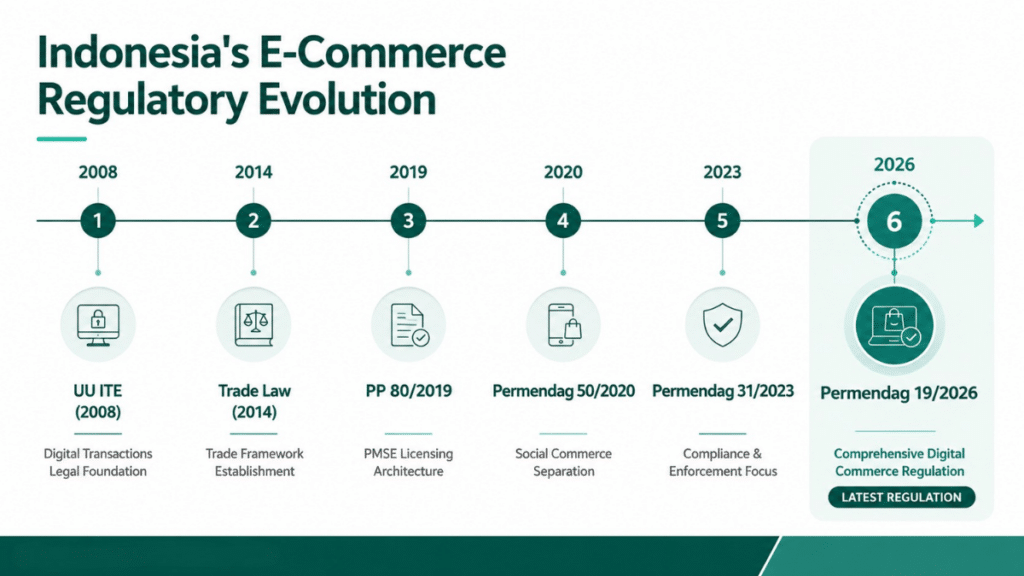
Permendag 19/2026 is the primary ministerial-level implementing regulation, sitting beneath PP 80/2019, which prevails where there’s any conflict. It operates alongside the Trade Law, the Personal Data Protection Law (UU PDP), the Consumer Protection Law, and the Competition Law. Meeting the requirements of Permendag 19/2026 doesn’t discharge obligations under any of these.
Changes Introduced by Permendag 19/2026
I. Wider Business Scope
Permendag 19/2026 expands the PMSE framework to cover eight business models. Ride-hailing platforms and Online Travel Agents (OTAs) are now included, alongside online retail, marketplaces, classified ads, price comparison platforms, daily deals, and social-commerce.
The regulation also introduces new terms, including domestic product and artificial intelligence.
II. Stricter Seller Licensing
Sellers must hold a valid NIB in the trade sector and show proof of compliance with applicable product standards before registering on a platform. BUMN and BUMD are now expressly covered.
Service sellers must also hold a competency certificate or be supported by certified technical personnel.
Existing sellers have 18 months to complete licensing, while new sellers have six months from registration. During this period, platforms must display a “Dalam Proses Legalisasi” label and suspend access once the deadline passes.
III. Stronger Seller Protection
Platforms must disclose all fees in a downloadable contract and obtain seller consent before making changes. Sellers may object to unilateral changes, and platforms must respond within 14 working days. If they do not respond, the objection is deemed accepted.
Certain platforms, including marketplaces, social-commerce operators, ride-hailing apps, and OTAs, must also provide formal seller complaint channels and document each complaint and resolution.
IV. More Platform Obligations
Platforms now have direct compliance duties. These include verifying seller licences, rejecting sellers without a valid NIB, monitoring price manipulation, preventing misuse of user data, prioritising domestic products, obtaining seller consent for promotions, and maintaining consumer complaint channels.
Platforms that fail to suspend non-compliant sellers after the grace period may face sanctions.
V. Tighter Cross-border Rules
The FOB USD 100 per unit import price floor remains in place.
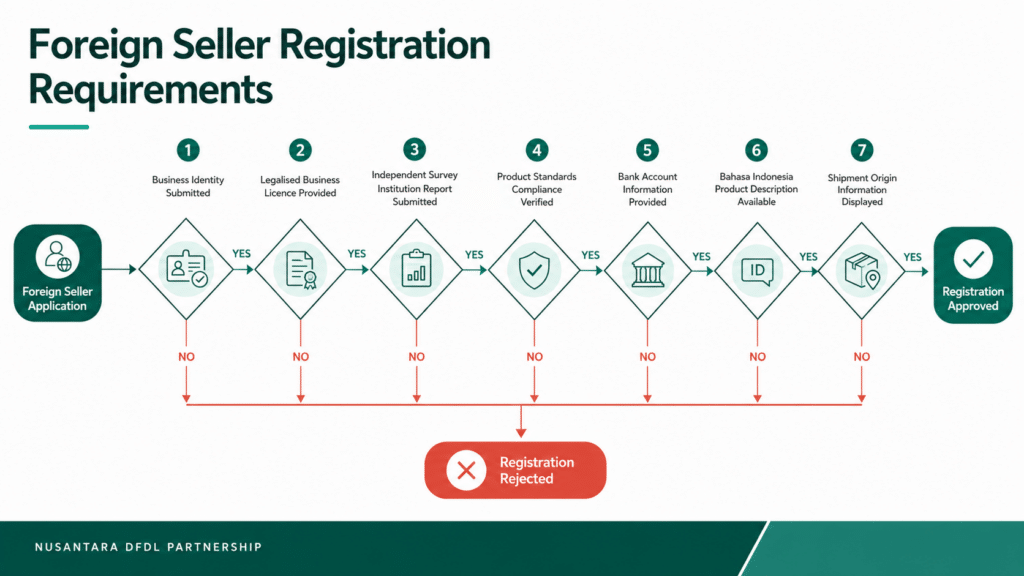
Foreign sellers must provide a legalised business licence, proof of product standard compliance, a bank account number, Bahasa Indonesia product descriptions, and the country of shipment. If these requirements are not met, the platform must reject the registration.
VI. Domestic Product Prioritisation
Platforms must prioritise domestic products in search results, including products from micro and small enterprises. They must also provide dedicated promotional pages for domestic products.
VII. AI Governance
Permendag 19/2026 introduces trade-level rules for AI use in PMSE. Businesses using AI must disclose AI-generated content, recommendations, or promotions. They must also ensure the information is accurate and verifiable, maintain internal AI governance, and provide a complaint or correction mechanism.
AI use must comply with competition law and must not harm consumers or other businesses.
VIII. Price Manipulation Risks
Platforms must monitor and prevent conduct such as below-cost selling, repeated subsidies that distort the market, open-ended discounts below production cost, and other anti-competitive behaviour.
Suspected violations must be reported to KPPU within three working days.
IX. Sanctions
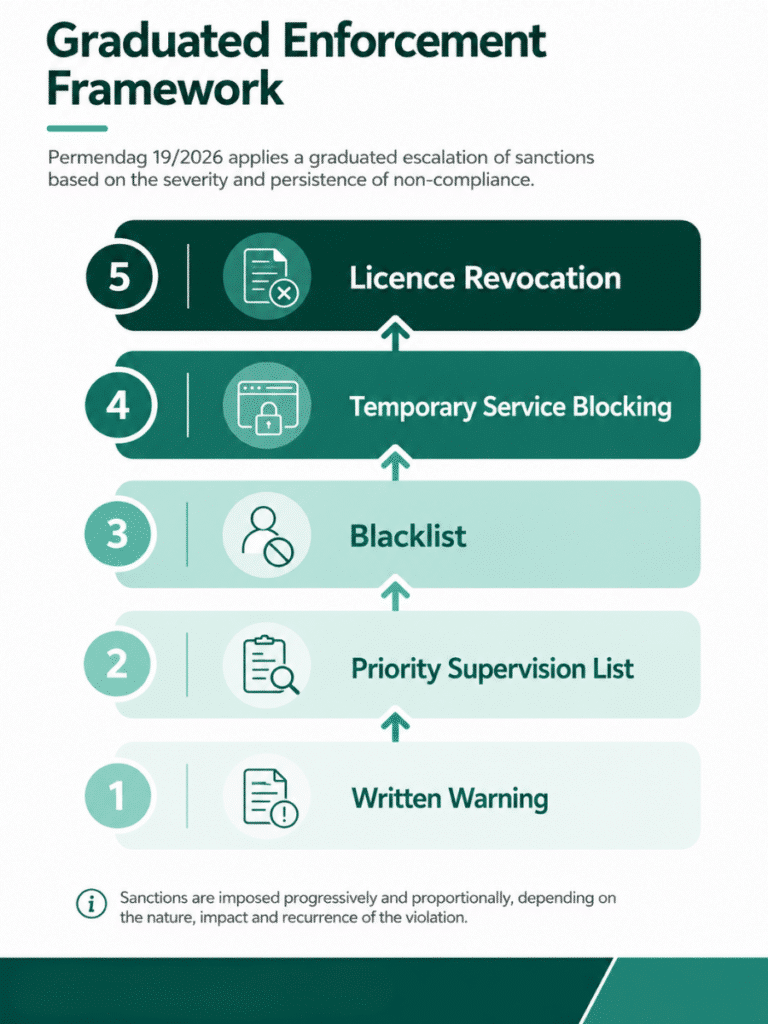
Sanctions include written warnings, inclusion in the priority supervision list, blacklisting, temporary platform blocking, and licence revocation. Warnings may be issued up to three times before escalation.
Platforms may also face separate sanctions if they fail to block sanctioned or non-compliant sellers.
Practical Impact on Businesses: Foreign Businesses and Cross-border Sellers
Cross-border selling into Indonesia is now considerably harder; the USD 100 floor stays, documentation requirements are more demanding, and platforms have no discretion to waive them.
I. Foreign Platform Operators
Under Article 22, only platforms that cross at least one of these thresholds need to appoint a KP3A representative office:
- At least 1,000 consumer transactions in one year
- At least 1,000 packages shipped to consumers in one year
- At least 1% of domestic internet users account for traffic in one year
II. Marketplace Operators
Marketplace platforms carry the heaviest load under the new rules. They now have to gate seller access based on license status, reconfigure search algorithms to prioritize domestic products, verify seller labels against documentation, overhaul fee contracts, and report suspected price manipulation to the KPPU within three working days. The system interconnection and data abuse prohibitions add a further layer of technical compliance.
III. Social Commerce Platforms
The prohibition on facilitating payment transactions within social commerce platforms is reaffirmed under Article 25(3), and Article 25(2) prohibits both marketplace and social commerce operators from acting as producers. Social commerce operators that have tested in-app checkout features face a clear regulatory boundary.
IV. Ride-hailing and OTA Operators
Gojek, Grab, Traveloka, and their peers now require a formal PMSE Business Licence for the first time under Article 7, and are subject to seller verification, fee transparency, domestic product promotion, and consumer complaint obligations.
V. MSMEs and Local Sellers
The regulation favours Indonesian MSMEs through mandatory search prominence, dedicated promotional areas, and fee incentives, but informal traders will ultimately need to register through OSS.
Compliance Sctions
I. For Platform Operators
- Audit the seller base for NIB compliance and verify all seller status labels are backed by supporting documentation (Articles 4(4), 16)
- Update seller fee agreements, contracts must be downloadable, fee changes need seller consent, and a 14-day objection response workflow must be in place (Article 14)
- Reconfigure search and ranking algorithms to show domestic products in the first row of search results, with the fallback rule in place (Article 40(3))
- Build price monitoring SOPs, set up the three-day KPPU reporting protocol, and confirm no PMSE systems are interconnected with non-PMSE systems (Articles 18(3), 18(4), 18(6))
- Audit all AI-deployed features, add Indonesian-market disclosure labels, and establish internal AI governance proportionate to risk (Article 47(3))
II. For Foreign Sellers
- Compile the full Article 6 disclosure package, including legalised business licences and independent survey institution verification
- Ensure all product listings are in Bahasa Indonesia with the country of origin and the shipping country displayed
- Review all SKU price points against the USD 100 FOB threshold
III. For Foreign Platform Operators Meeting Article 22(2) Thresholds
- Assess KP3A establishment requirements and appoint a representative office with the SIUP3A licence
- Ensure the KP3A appointment covers the three mandated functions: consumer protection, domestic product competitiveness, and dispute resolution
Key Takeaways
Permendag 19/2026 is a genuine overhaul of digital commerce regulation in Indonesia. It widens the categories of businesses subject to PMSE rules, tightens conditions for cross-border sellers, mandates algorithmic changes for domestic product promotion, introduces Indonesia’s first AI governance rules in a commercial context, and makes platforms directly responsible for the compliance of the sellers they host. A five-tier sanctions framework backs all of it.
Frequently Asked Questions
1. Does a foreign platform operator need to set up an office in Indonesia?
Not automatically. Only platforms crossing specific thresholds,1,000 transactions, 1,000 packages, or 1% of domestic internet users per year, must appoint a KP3A representative office under Article 22. Platforms below those thresholds still need a PMSE Business Licence through OSS, but no physical presence is required.
2. Can foreign sellers still sell products priced below USD 100 per unit?
Generally no. The FOB USD 100-per-unit floor remains in place under Article 23(1)-(2), and goods below it may be sold only if they appear on a government exemption list that was not published as of enactment. Treat the restriction as a hard limit until that list is released.
3. How should platforms handle the AI disclosure obligation?
Identify every feature where AI generates or influences what consumers see and add clear disclosures per Article 47(3)(a). Platforms must also maintain internal AI governance proportionate to risk and provide a complaint mechanism for AI-generated content; no specific disclosure format has been prescribed yet.
4. What happens if a platform doesn’t suspend an unlicensed seller after the grace period ends?
The platform itself enters a sanction pathway under Article 59, starting with up to three written warnings in 14-day intervals and escalating to temporary blocking of the platform’s own services. Inaction is not a neutral position under this regulation.
5. Does the 18-month transition period apply to all sellers?
No. The 18-month window under Article 74 applies only to sellers already registered when the regulation took effect on 8 June 2026. Sellers registering after that date have 6 months under Article 17(4), and platforms need to track both cohorts separately.
Read Also: Distressed M&A in Indonesia: Risks, Structures, and What Goes Wrong